Aerospace and defense company Ducommun (NYSE: DCO) reported Q3 2026 results beating Wall Street’s revenue expectations, with revenue up 6.8% year on year to $227 million. Its non-GAAP profit of $1.21 per share was 5.5% above analysts’ consensus estimates.
For more on Ducommun, read our free full research report.
Ducommun (DCO) Q3 2026 highlights:
- Revenue $227 million vs S&P analysts’ consensus estimates of $222.1 million (6.8% year-on-year growth, 2.2% beat)
- Adjusted EPS $1.21 vs S&P analysts’ consensus estimates of $1.15 (5.5% beat)
- Adjusted EBITDA $39.72 million vs analysts’ consensus estimates of $38.8 million (17.5% margin, 2.4% beat)
- Operating margin 11.4%, up from -37.7% in the same quarter last year
- Market capitalization $2.36 billion
“Another excellent quarter for Ducommun in 2026. With record revenue and gross margins in Q3, we continued to make great progress towards accomplishing our VISION 2027 goals and positioning ourselves for our new VISION 2032 Plan which was communicated in September. Net revenue grew, led by the significant ramp in commercial aerospace, partially offset by temporary weakness in defense revenues due to timing of certain programs. Defense bookings were very strong during the quarter with a book-to-bill of 2.2x and we expect to see momentum continue in our defense business in 2027,” said Stephen G. Oswald, chairman, president and chief executive officer. “Significant growth across our commercial aerospace business highlighted by the single-aisle aircraft platforms, Boeing 737 MAX and the Airbus A320 drove the 28% year-over-year increase, wonderful news and now nearing a $100 million quarterly run rate. In Ducommun's defense business we saw continued growth in our missile franchise specifically the Tomahawk, MIR, and TOW missile platforms, along with growth on fixed-wing aircraft platforms notably the F-15, offset by temporal weakness due to timing of orders and production on ground vehicles, Blackhawk and Apache rotary-wing aircraft platforms, and select radar programs. The future is very bright for our defense business with record RPO and bookings this year setting the stage for strong multi-year growth.
Revenue growth
A company’s long-term performance is an indicator of its overall quality. Any business can deliver a good quarter or two, but many enduring ones grow for years. Ducommun’s revenue grew at a mediocre 6.5% compounded annual growth rate over the last five years, falling short of our benchmark for the industrials sector.
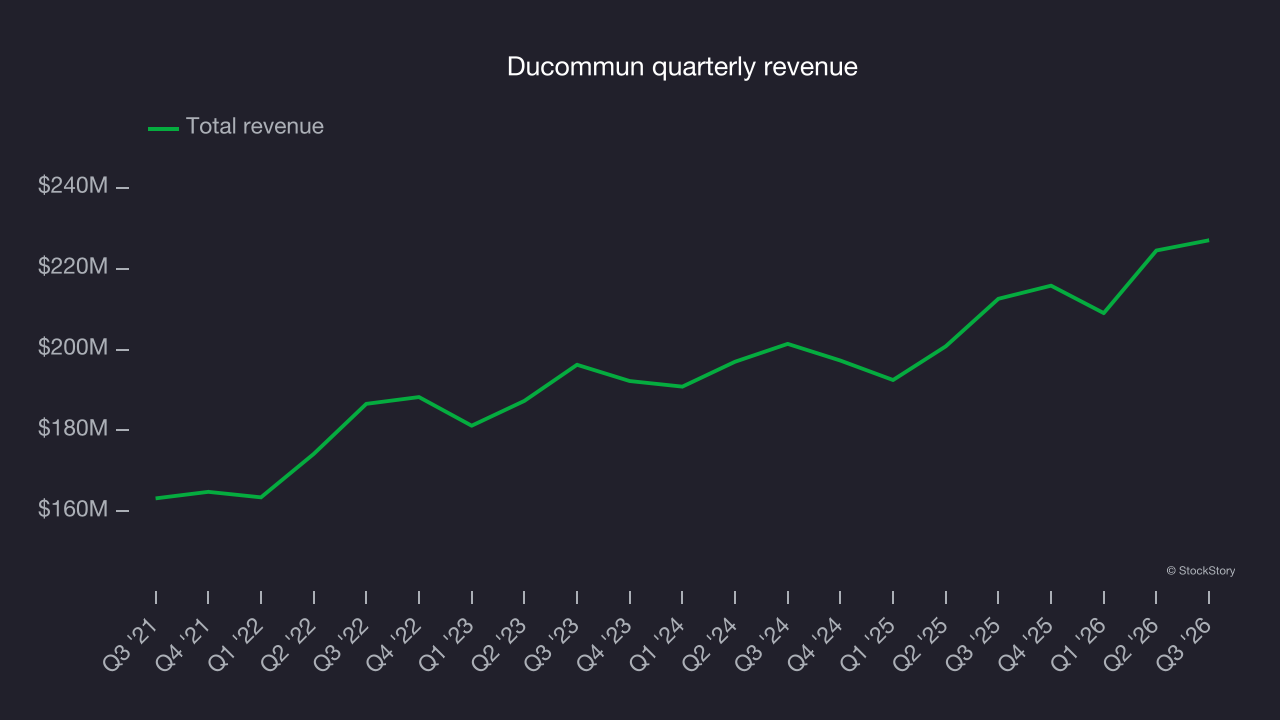
Long-term growth matters most, but within industrials, a half-decade historical view may miss cycles, industry trends or a company capitalizing on catalysts such as a new contract win or a successful product line. Ducommun’s annualized revenue growth of 5.9% over the last two years aligns with its five-year trend, suggesting its demand was consistently weak. 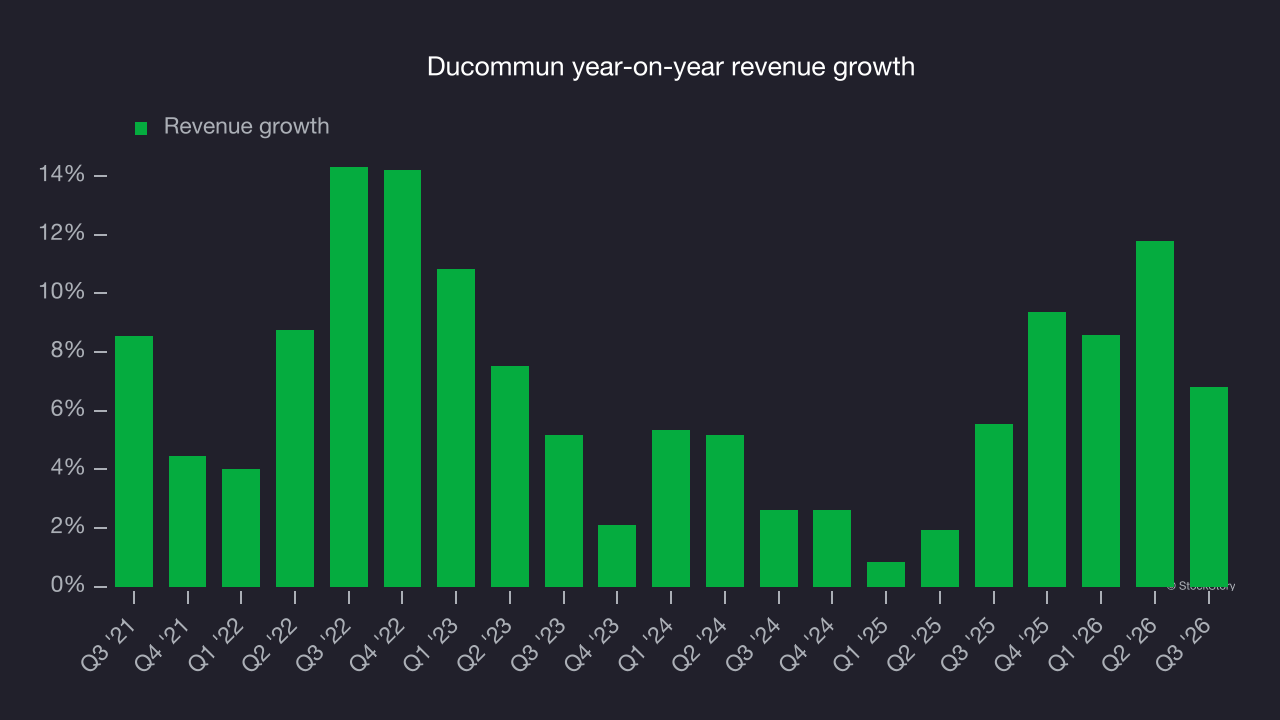
This quarter, Ducommun reported year-on-year revenue growth of 6.8%, and its $227 million of revenue exceeded Wall Street’s consensus estimates by 2.2%.
Looking ahead, sell-side analysts expect revenue to grow 7.8% over the next 12 months, according to S&P, an improvement versus the last two years. This projection is above average for the sector and indicates its newer products and services will fuel better top-line performance.
Operating margin
Ducommun was profitable over the last five years but held back by its large cost base. Its average operating margin of 4.1% was weak for an industrials business.
On the positive side, Ducommun’s operating margin rose by 3.5 percentage points over the last five years, as its revenue growth gave it operating leverage.
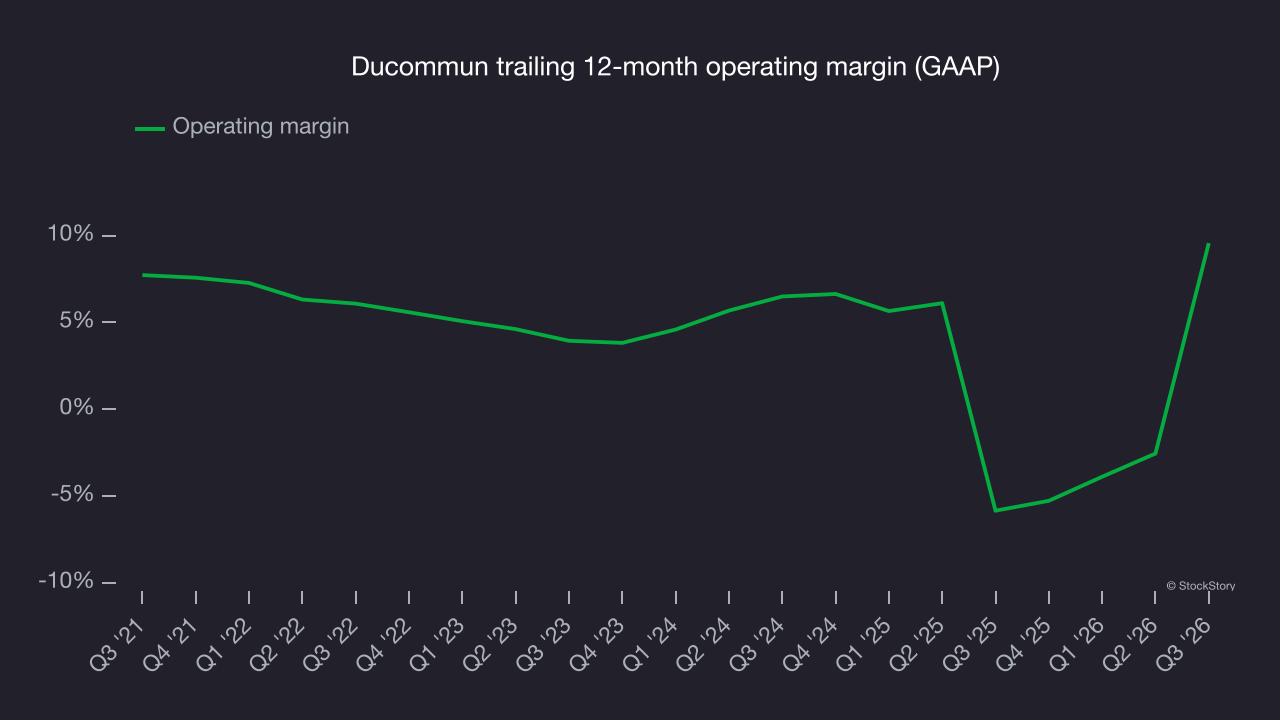
This quarter, Ducommun reported an operating margin of 11.4%, up 49 percentage points year on year. This increase was a positive development and shows it was more efficient.
Earnings per share
Revenue trends explain a company’s historical growth, but the long-term change in earnings per share (EPS) points to the profitability of that growth. For example, a company could inflate its revenue through excessive spending on advertising and promotions.
Ducommun’s unimpressive 6.6% annual EPS growth over the last five years aligns with its revenue performance. On the positive side, this indicates its incremental revenue was profitable.
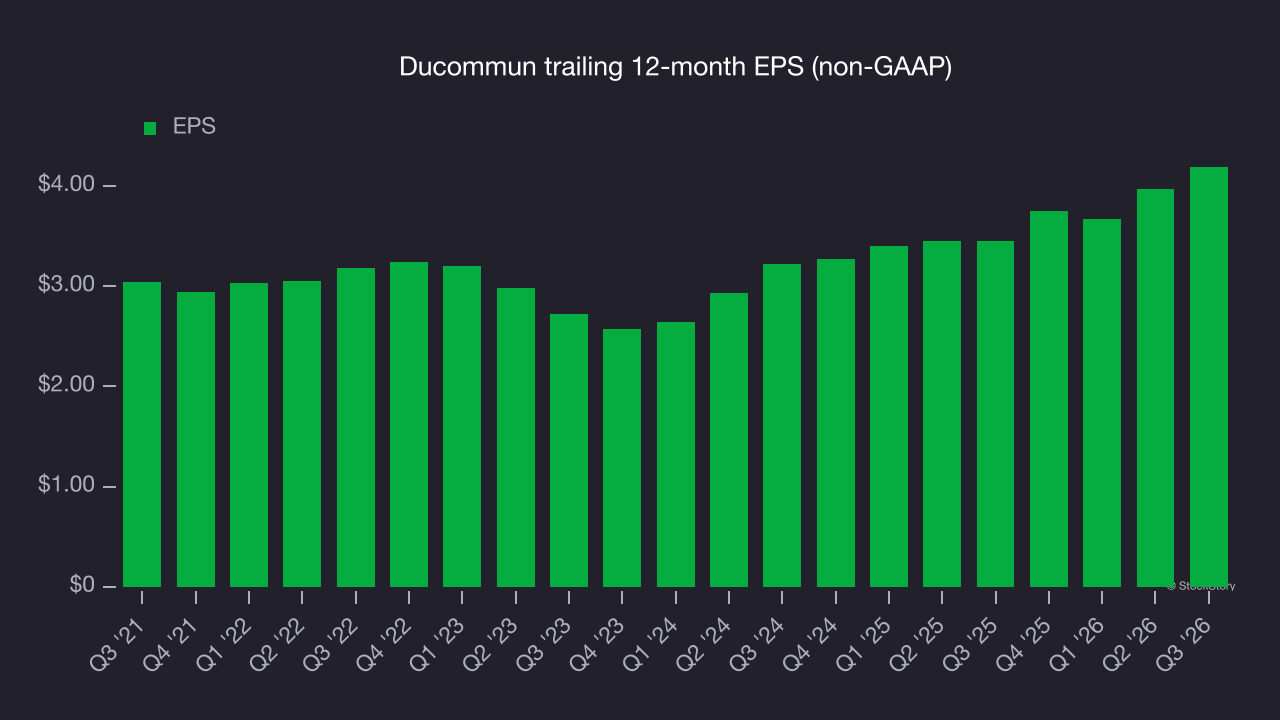
As with revenue, analyzing EPS over a shorter period can reveal changes in the business.
Ducommun’s two-year annual EPS growth of 14.1% was strong and topped its 5.9% two-year revenue growth.
Examining Ducommun’s quality of earnings helps explain its performance. Ducommun’s operating margin has expanded over the last two years. This was the most relevant factor (aside from the revenue impact) behind its higher earnings; interest expenses and taxes can also affect EPS but don’t tell us as much about a company’s fundamentals.
In Q3, Ducommun reported adjusted EPS of $1.21, up from $0.99 in the same quarter last year. This result beat analysts’ consensus estimates by 5.5%. Over the next 12 months, Wall Street expects Ducommun’s full-year EPS to grow 22.8% from $4.19 to $5.15, according to S&P.
Key takeaways from Ducommun’s Q3 results
Ducommun’s revenue and EBITDA both topped Wall Street’s consensus estimates in Q3, making it a decent quarter with some key metrics ahead of expectations. Shares remained flat at $157.16 immediately after the release.
Ducommun may have had a good quarter, but that alone doesn’t make the stock a buy. The latest quarter matters, but not nearly as much as longer-term fundamentals and valuation when deciding whether to invest. For more on Ducommun, read our full research report here (it’s free).