Nuclear fuel supplier Centrus Energy (NYSE: LEU) fell short of the market’s revenue expectations in Q3 2026, with revenue falling 25.9% year on year to $55.5 million. Its GAAP profit of $1.41 per share was significantly above analysts’ consensus estimates.
For more on Centrus Energy, read our free full research report.
Centrus Energy (LEU) Q3 2026 highlights:
- Revenue $55.5 million vs S&P analysts’ consensus estimates of $59.24 million (25.9% year-on-year decline, 6.3% miss)
- EPS (GAAP) $1.41 vs analysts’ consensus estimates of -$0.52 (significant beat)
- Operating margin -53.5%, down from -22.2% in the same quarter last year
- Market capitalization $1.96 billion
"Furthermore, our recent acquisition of Westerman helps to derisk our build out and our overall business model. It will drive growth for both organizations through commercial and operational synergies while diversifying our business model. We are now focused on scaling up our supply chain as we begin manufacturing and shipping more centrifuges from Oak Ridge to Piketon."
Revenue growth
A company’s long-term performance can give signals about its business quality. Even a bad business, especially in a cyclical industry, can perform well for a year or so, but a top-tier one should exhibit resilience through cycles. Centrus Energy’s revenue grew at a mediocre 8.5% compounded annual growth rate over the last five years, falling short of the standard for the energy upstream and integrated energy sector.
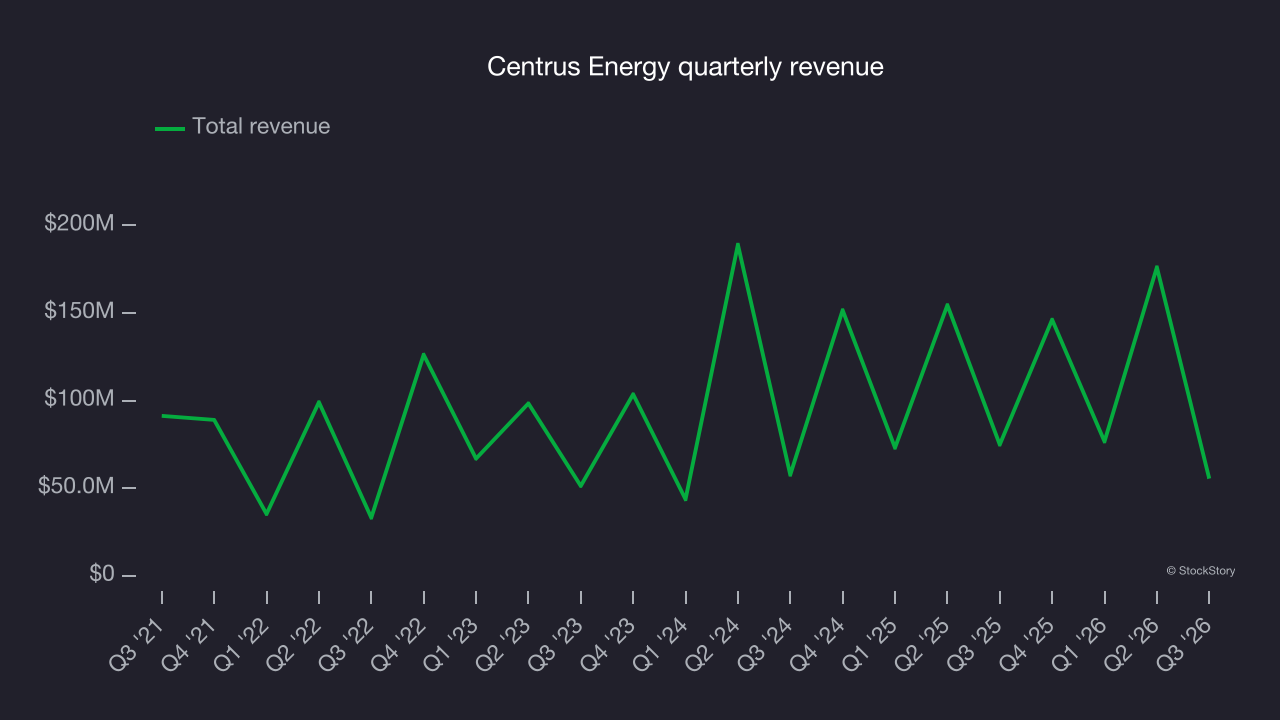
Even a long stretch in energy can be shaped by a single commodity cycle, so extending the view to ten years adds another perspective and reveals which companies are built to grow regardless of the pricing regime. Centrus Energy’s annualized revenue growth of 3.2% over the last ten years is below its five-year trend, but the results were still good.
This quarter, Centrus Energy missed Wall Street’s consensus estimates and reported an uninspiring 25.9% year-on-year revenue decline, generating $55.5 million of revenue.
Adjusted EBITDA margin
Adjusted EBITDA margin is an important measure of profitability for the sector and accounts for the gross margins and operating costs mentioned previously. Unlike operating margin, it is not distorted by accounting conventions around reserves, drilling costs and assumptions on commodity consumption from the well or basin. Adjusted EBITDA highlights the economic reality of how much cash the rock produces before the capital structure (debt service) and the drilling budget (capex) are considered.
Centrus Energy was profitable over the last five years but held back by its large cost base. Its average EBITDA margin of 21.4% was weak for an upstream and integrated energy business.
Looking at the trend in its profitability, Centrus Energy’s EBITDA margin decreased by 35.9 percentage points over the last year. This raises questions about the company’s expense base because its revenue growth should have given it leverage on its fixed costs, resulting in better economies of scale and profitability. Centrus Energy’s performance was poor, showing that costs were rising and it couldn’t pass them on to its customers.
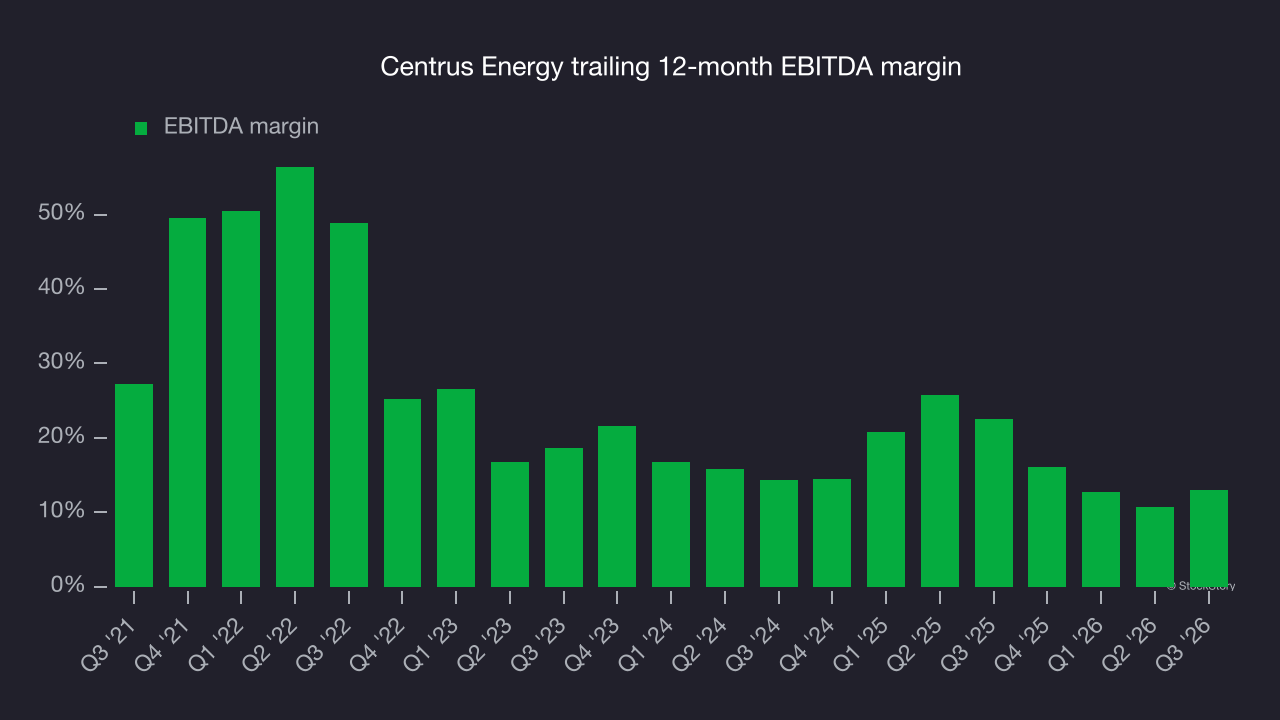
This quarter, Centrus Energy generated an EBITDA margin of negative 11%, up 8.4 percentage points year on year. This increase was a positive development, especially since its revenue fell, showing it was more efficient because it scaled down its expenses. Adjusted EBITDA beat Wall Street’s consensus estimates by 70.1%.
Free cash flow
Adjusted EBITDA shows how profitable a company’s existing wells are before financing and reinvestment decisions, but free cash flow shows how much value remains after paying the cost of replacing those wells. In upstream energy, production naturally declines over time, so companies must continuously reinvest just to stand still. A producer can report strong EBITDA margins yet generate little or no free cash flow if its wells decline quickly or if new drilling is expensive. Free cash flow therefore captures not only how efficiently a company produces hydrocarbons, but also how costly it is to sustain that production into the future.
Key takeaways from Centrus Energy’s Q3 results
Centrus Energy’s Q3 results had some key positives, including EPS that topped analysts’ consensus estimates. Revenue, however, fell short of expectations, making for a mixed quarter. Shares remained flat at $92.01 immediately after the results.
To assess Centrus Energy at its current price, consider its valuation, business quality and latest quarterly results. Read the full research report here (it’s free).