Timesnewswire / August 31, 2026 – If we turn the clock back a few years, when users were choosing a digital asset exchange, the first question they often asked was:
“Does this platform have the cryptocurrency I want to trade?”
Today, however, more and more traders who have experienced multiple market cycles are beginning to ask a different question:
“How secure is the system protecting my assets on this platform?”
This shift is not difficult to understand.
As the digital asset industry continues to evolve, competition among exchanges is no longer simply about the number of trading pairs, transaction fees, or promotional rewards.
For anyone who intends to use a trading platform over the long term, the factors that truly matter are becoming increasingly clear:
Asset security, trading stability, product diversity, user experience, and risk control.
During my recent experience with SaviCoin, one of my strongest impressions was that the platform is not simply trying to become another tool for “buying and selling crypto.”
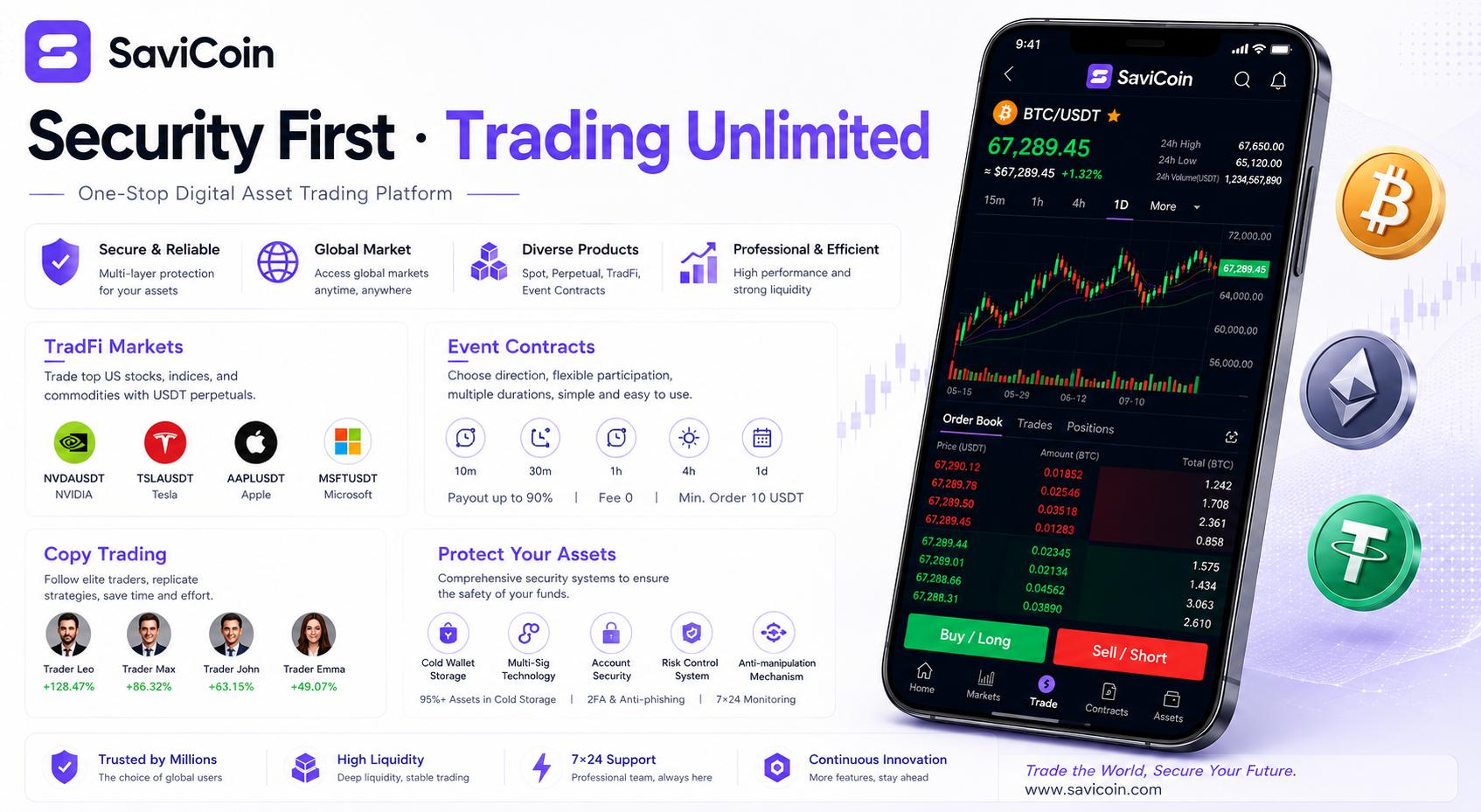
From digital asset trading to TradFi, Event Contracts, and Copy Trading, SaviCoin is attempting to bring different types of trading needs into a single account and trading ecosystem.
But if I had to choose one aspect among all these features that deserves the highest priority, I would not start with the variety of tradable products.
I would start with:
Wallet and asset security.
Because no matter how many features a trading platform offers, how attractive its UI is, or how diverse its trading products are, none of these experiences have a reliable foundation if asset security is not properly established.
I. Why Should Wallet Security Come First When Evaluating an Exchange?
Many users who are new to the digital asset market naturally assume:
Once USDT, BTC, or ETH has been deposited into an exchange and the balance appears correctly in the account, the assets are already “securely stored.”
In reality, things are not quite that simple.
Digital assets ultimately rely on blockchain addresses and private-key systems for control.
From a technical perspective, one of the core elements determining control over on-chain assets is the private key.
Therefore, exchange asset security is not simply a matter of having a login password.
It actually involves an entire system:
Wallet architecture, private-key management, hot and cold wallet segregation, deposit systems, withdrawal systems, account permissions, identity verification, abnormal behavior detection, and backend risk control.
This is also why experienced users increasingly pay attention to the underlying security architecture when evaluating a trading platform.
II. SaviCoin Wallet Security: What Really Matters Is More Than Just a “Wallet Address”
Many people think of an exchange wallet in very simple terms:
User deposits → Platform generates an address → Funds enter the address → End of process.
In reality, an exchange wallet system is far more complex than this.
A more comprehensive exchange asset-security system needs to address a very practical question:
How can a platform balance “allowing users to deposit and withdraw conveniently at any time” with “minimizing the exposure risk of assets”?
This is one of the key reasons why hot and cold wallet architectures exist.
Simply put:
Hot wallets are designed for efficiency, while cold wallets are designed for isolation.
Hot wallets operate in an online environment and are therefore better suited to handling higher-frequency deposits, withdrawals, and fund transfers.
However, because they are connected to the internet, their potential attack surface is also larger.
Cold wallets, by contrast, are typically offline or isolated from online environments, making them more suitable for purposes such as long-term asset storage.
From the perspective of industry security practices, hot and cold wallets are not substitutes for one another. Instead, they serve different roles.
One of the core ideas behind SaviCoin’s asset-security design is to reduce the long-term exposure of core assets to online environments through a hot-and-cold wallet separation mechanism.
In other words, what users see is simply a “Deposit” button and a “Withdraw” button.
But what really matters behind those buttons is how the wallet system manages assets and isolates risk.
III. Security Is Not Just About “Preventing Hackers” — It Is an Entire Line of Defense
One of the most common misconceptions when trading platforms talk about security is:
Focusing only on server security.
In reality, digital asset risks can come from many different directions.
For example:
User password leaks;
Compromised email accounts;
Leaked verification codes;
Abnormal device logins;
Phishing websites;
Malware;
Suspicious withdrawals;
Account takeovers;
Or even mistakes made by users themselves.
Therefore, a more reasonable security architecture cannot rely on just one layer of protection.
It needs to establish multiple layers of defense.
This is also one of the reasons why I believe SaviCoin’s wallet-security architecture is worth paying attention to.
First layer: Account identity verification
The account is the first gateway to a user’s assets.
For this reason, SaviCoin places account login, identity verification, and fund-related operations in an important position within its overall security framework.
For sensitive operations, increasing the number of verification layers through passwords, verification codes, and multi-factor authentication mechanisms can reduce the risk of an account being immediately compromised when a single credential is leaked.
For users holding larger amounts of funds in particular, enabling MFA solutions such as Google Authenticator is recommended.
The logic is simple:
A leaked password should not automatically mean losing control of your assets.
What a proper security system needs to achieve is preventing a single point of failure from compromising the entire account.
IV. Withdrawal Security Is Often More Important Than Deposit Security
Many trading platforms devote significant space to explaining “how convenient deposits are.”
But from an asset-security perspective, I am more interested in another question:
What does the platform do when funds are leaving?
Because deposits represent assets entering the platform, while withdrawals represent assets leaving the platform.
The risk levels associated with these two actions are not necessarily the same.
Therefore, a comprehensive wallet-security system should not treat withdrawals as simply:
User clicks Withdraw → System sends assets.
A properly designed process should include multiple stages such as account-status verification, withdrawal-request verification, risk identification, address checks, and abnormal-behavior monitoring.
For example, if an account has consistently logged in from the same device for a long period of time, then suddenly logs in from an unusual environment and initiates a large withdrawal shortly afterward, that behavior itself deserves additional attention from the risk-control system.
This is also why security and “absolute convenience” can sometimes conflict on a trading platform.
Users may wonder:
“Why do I need verification when withdrawing?”
“Why is additional confirmation sometimes required?”
But from a security perspective, appropriately increasing verification requirements for high-risk fund operations is itself part of protecting user assets.
What could actually be more dangerous is:
Allowing funds of any amount to be transferred out quickly from any device and any environment without meaningful verification.
When it comes to asset security, “speed” should never be the only metric.
V. What Truly Tests Wallet Security Is the Platform’s Risk-Control Capability
The wallet system is responsible for safeguarding assets.
The risk-control system, meanwhile, is responsible for determining:
Is the person currently operating this account actually behaving like the legitimate user?
These are two different layers of the problem.
A mature trading platform cannot simply protect its wallet servers. It also needs to protect user accounts themselves.
Therefore, a risk-control system needs to identify abnormal behavior across multiple dimensions, such as:
- Abnormal login environments
- Device changes
- High-frequency operations
- Unusual fund movements
- Abnormal withdrawal behavior
- Changes to account security settings
- Trading behavior that significantly deviates from normal patterns
When multiple risk signals appear simultaneously, the system needs to apply stricter verification measures.
From this perspective, exchange security is not a single feature.
It is an entire chain:
Login Security → Account Security → Trading Security → Wallet Security → Withdrawal Security → Risk Monitoring.
A significant weakness in any one of these areas could affect the entire system.
VI. A Truly Good Security Experience Should Make Complexity Almost Invisible to Ordinary Users
There is an interesting contradiction in security systems:
If they are too simple, they may not be secure enough.
If they are too complicated, they become difficult to use.
This is also one of the things I noticed while experiencing SaviCoin’s UI.
Even as the platform adds more trading functions, it has not turned its homepage into a professional trading terminal overloaded with buttons and data.
The overall visual structure remains relatively clear.
The main sections — Markets, Trading, Assets, and Contracts — are organized with clear hierarchy. For users who are new to the platform, there is no need to search through dozens of pages just to find basic functions.
On the asset page in particular, the information users care about most is actually quite limited:
How much do I have?
Where are my assets?
How do I deposit?
How do I withdraw?
How do I transfer funds?
Displaying this information clearly is far more important than simply adding large amounts of complicated data.
Once users enter the professional trading interface, features such as candlestick charts, order books, buy/sell panels, positions, and orders gradually become available.
This design logic makes sense:
Keep simple functions simple, while giving professional functions sufficient depth.
For a platform serving both ordinary users and active traders, this is extremely important.
VII. TradFi: SaviCoin No Longer Wants to Be Just a “Crypto Exchange”
If wallet security answers the question of “where assets are stored,” then TradFi addresses another question:
What else can users trade?
TradFi is short for Traditional Finance.
Broadly speaking, it includes stocks, indices, foreign exchange, bonds, commodities, and the traditional financial-institution ecosystem.
In recent years, one increasingly visible trend in the digital asset industry has been the gradual narrowing of the boundary between Crypto and traditional financial markets.
Users will not always focus only on BTC and ETH.
A mature trader may simultaneously pay attention to:
NVIDIA’s AI narrative;
Tesla’s delivery figures;
Apple’s product cycles;
Microsoft’s cloud business;
Amazon’s consumer data;
Gold’s safe-haven performance;
Technology-stock trends on the Nasdaq;
And even macroeconomic factors such as Federal Reserve interest-rate policy.
In the past, these assets often required users to switch between different platforms, different accounts, and even different funding systems.
What SaviCoin’s TradFi section is attempting to address is precisely this fragmented experience across different asset classes.
VIII. From NVDA to TSLA: TradFi Expands the Trading Horizon from Crypto to Global Markets
After entering SaviCoin’s TradFi section, users can follow trading instruments related to traditional financial markets.
Taking U.S. equity-related trading pairs as examples, the platform can provide corresponding markets around widely followed companies, such as:
NVDAUSDT —— NVIDIA / NVIDIA
One of the core companies in the global AI and GPU ecosystem, and one of the most closely watched technology companies in global capital markets in recent years.
Its market performance is typically influenced by AI infrastructure investment, data-center demand, semiconductor cycles, earnings reports, and forward guidance.
TSLAUSDT —— Tesla / Tesla
A major representative of the global electric-vehicle and technology industries.
Tesla’s price movements are influenced not only by vehicle sales, margins, and delivery figures, but also by autonomous driving, Robotaxi, its energy business, and broader market risk appetite.
AAPLUSDT —— Apple / Apple
One of the world’s largest consumer-electronics and technology companies.
iPhone sales, services revenue, AI strategy, supply-chain developments, and new-product cycles are all important variables closely watched by the market.
MSFTUSDT —— Microsoft / Microsoft
One of the world’s largest software and cloud-computing companies.
Azure, AI, enterprise software, and Microsoft’s integration with the broader AI ecosystem make it an important benchmark within the global technology sector.
AMZNUSDT —— Amazon / Amazon
Its businesses span e-commerce, cloud computing, advertising, and several other areas, with AWS remaining one of the major participants in the global cloud-computing market.
METAUSDT —— Meta Platforms / Meta
The technology company behind Facebook, Instagram, WhatsApp, and other products, while also investing heavily in AI, advertising technology, and next-generation computing platforms.
SNDKUSDT —— SanDisk / SanDisk
An important market instrument associated with the data-storage industry.
As investment in AI data centers continues to grow, NAND Flash, enterprise storage, and data-infrastructure cycles are attracting increasing market attention.
Beyond these examples, the value of TradFi is not simply that “a few more stock-related trading pairs have been added.”
What it truly changes is the user’s trading perspective.
Previously:
BTC rises → Watch BTC.
Now it may become:
NVIDIA earnings → Semiconductor-sector volatility → Nasdaq movement → Changes in market risk appetite → Impact on BTC and the broader Crypto market.
Traditional finance and digital assets have never been two completely isolated worlds.
For traders, placing these markets within the same analytical framework may be more meaningful than simply adding dozens of additional Tokens.
It should be noted that TradFi-related products offered on the platform do not necessarily represent direct ownership of ordinary shares in the corresponding companies. The specific nature of each product, trading hours, pricing mechanisms, leverage, and settlement rules should be determined by the actual SaviCoin product page and applicable rules.
IX. Event Contracts: Turning Complex Market Analysis into a “Directional Choice”
In addition to TradFi, another distinctive feature of SaviCoin, in my view, is:
Event Contracts.
Traditional perpetual contracts can have a certain learning curve for new users.
You need to understand:
Margin;
Leverage;
Liquidation price;
Unrealized P&L;
Funding rates;
Position value;
Maintenance margin ratio.
Event Contracts, however, use a different trading structure.
Users primarily make one judgment:
Will the price rise or fall over a specified period of time?
SaviCoin Event Contracts provide several different timeframes, such as:
10 minutes, 30 minutes, 1 hour, 4 hours, and 1 day.
After selecting a direction and investment amount, the position is settled according to the final outcome of the corresponding event.
The biggest characteristic of this product is not that it is “easier to make money.”
That needs to be made absolutely clear.
It simply makes the trading structure more intuitive.
Complex position management is reduced to:
Direction + Time + Amount + Result.
Therefore, for traders who prefer making short-term market-direction judgments, Event Contracts provide a different way to participate compared with spot trading and traditional perpetual contracts.
But a simpler structure does not mean lower risk.
Short-term price movements involve significant uncertainty, and repeated incorrect judgments can still result in substantial losses. Strict control over the amount committed to each trade therefore remains essential.
X. Copy Trading: Not “Copying Profits,” but Lowering the Barrier to Learning Trading Strategies
Another SaviCoin feature worth discussing separately is:
Copy Trading.
Many people entering the market encounter the same problem:
They know BTC and ETH, and they understand that they can go long or short.
But once they open a candlestick chart, they do not know:
When should I enter?
When should I stop out?
How much leverage should I use?
How large should my position be?
When should I take profit?
This is one of the reasons Copy Trading exists.
Users can review different traders’ historical performance, trading styles, and risk profiles, and then decide whether to follow them based on their own risk tolerance.
For ordinary users, this can lower the learning barrier associated with executing trading strategies.
However, one point must be emphasized:
Copy Trading ≠ Guaranteed Profits.
A trader who made money in the past is not guaranteed to remain profitable in the future.
Higher-return strategies may also involve significantly higher risk.
Therefore, a more reasonable approach to Copy Trading should be:
Look at returns, but also look at drawdowns; look at profits, but also look at risk.
Particular attention should be paid to:
Historical maximum drawdown, trading horizon, leverage habits, position management, consecutive losses, and strategy consistency.
If a trader generates extremely high returns over a short period but consistently relies on extreme leverage and oversized positions, the underlying risk may be far greater than that of a trader generating relatively stable returns.
Therefore, the core purpose of Copy Trading is not to find someone who “never loses money.”
It is to find:
A strategy whose risk profile matches your own.
XI. Only by Putting These Features Together Can You Understand What SaviCoin Is Trying to Build
If we look at SaviCoin’s core sections individually:
Wallet;
Spot;
Perpetuals;
TradFi;
Event Contracts;
Copy Trading.
They may appear to be nothing more than separate features.
But when they are brought together, a much clearer product strategy emerges.
SaviCoin is not simply trying to answer:
“How do we build another exchange that only trades BTC and ETH?”
Instead, it is asking:
How can a more complete multi-market trading gateway be built around a single account?
Users can hold digital assets.
They can trade Crypto.
They can monitor and participate in TradFi markets.
They can use Event Contracts for short-term directional trading.
They can also access different trading strategies through the Copy Trading system.
Meanwhile, asset management and wallet-security infrastructure remain at the foundation of the entire system.
That, in my view, is what makes the platform worth paying attention to.
XII. Why Do I Believe “Wallet Security” Should Come Before Every Other Feature?
When markets are performing well, people like to discuss:
Which cryptocurrency has risen the most?
Which trading pair offers the highest leverage?
Which promotion offers the biggest rewards?
Which trader has the highest returns?
But after experiencing multiple market cycles, you eventually realize:
All of these things depend on one fundamental condition —
Your assets are still there.
Trading opportunities will always exist.
If you miss NVIDIA today, there will be other stocks tomorrow.
If you fail to capture this BTC cycle, the market will eventually produce another one.
But for every trader, asset security remains a fundamental bottom line.
That is why, when evaluating a platform, I increasingly focus on several basic questions:
Does the account support multi-factor authentication?
Are fund-related operations subject to risk verification?
Does the wallet architecture use hot-and-cold wallet segregation?
Can abnormal logins be detected?
Are suspicious withdrawals subject to risk controls?
Is the long-term online exposure of core assets minimized as much as possible?
These systems may have almost no visible presence during normal use.
But they are exactly the infrastructure in which a trading platform should invest substantial resources.
XIII. UI Can Convince Users to Open an App for the First Time; Security Determines Whether They Stay for the Long Term
When opening a trading App for the first time, our most immediate impression naturally comes from the UI.
Is the interface clean?
Is the experience smooth?
Are market prices easy to understand?
Are the trading buttons easy to find?
These factors shape the first impression.
SaviCoin’s approach in this area is relatively clear:
Organize complex trading functionality into a clearer information hierarchy wherever possible.
But if the platform only had an attractive UI, it would still be nothing more than a “good-looking trading App.”
What truly determines whether users are willing to make it one of their primary long-term trading tools lies beneath the surface:
Trading stability, asset-management capability, wallet security, risk-control systems, and the ability to continuously improve the product.
For this reason, I would summarize SaviCoin’s product philosophy in one sentence:
Simplify the front end, expand the product offering, and build security into the foundation.
Keep the front end as simple as possible.
Continue expanding trading products.
And keep the security system running continuously in the background, largely invisible to users.
XIV. From Crypto to TradFi, Trading Platforms Are Entering the Next Stage
Over the past decade, the core problem digital asset trading platforms sought to solve was:
How do people buy Crypto?
In the future, the question trading platforms need to answer may increasingly become:
How can users manage and trade more types of global assets through a single account?
Crypto, stocks, indices, commodities, and different types of derivatives markets are increasingly intersecting.
TradFi itself refers to the traditional financial system, including banks, securities markets, asset management, and other traditional financial infrastructure. (CoinMarketCap)
For digital asset trading platforms, introducing TradFi-related markets into their product ecosystems essentially means expanding the boundaries of what users can trade.
Previously, users opening an exchange might only look at:
BTC, ETH, SOL.
Now they may simultaneously monitor:
BTC, ETH, NVDA, TSLA, AAPL, MSFT, SNDK, gold, and major indices.
This means that the next stage of competition among trading platforms may also gradually shift from:
“Who offers more cryptocurrencies?”
to:
“Who can provide a more complete, secure, and seamless multi-asset trading experience?”
XV. Final Thoughts: What Makes a Trading Platform Worth Watching Over the Long Term?
If we judge purely by the number of features, there has never been a shortage of trading platforms in the market.
Some offer spot trading.
Some offer perpetuals.
Some offer Copy Trading.
And more platforms are beginning to explore TradFi.
The truly difficult challenge is:
How do you bring all of these features into one complete ecosystem without sacrificing security or user experience?
This is one of the things that stood out to me after experiencing SaviCoin.
Its direction is not simply to keep adding more trading pairs, but to build a more complete product ecosystem around the concept of a “trading account”:
Using wallets and asset management as the foundation;
Building security defenses through account verification and risk control;
Reducing operational friction through a clean UI;
Meeting digital asset trading needs through Crypto spot and perpetual markets;
Expanding into stock-related and other traditional financial market scenarios through TradFi;
Providing short-term trading structures distinct from traditional contracts through Event Contracts;
And lowering the barrier for ordinary users to access trading strategies through the Copy Trading system.
Of course, no trading platform can promise absolute security, and no investment product is risk-free.
What truly matters is not simply hearing a platform say:
“Our platform is secure.”
What matters is whether the platform has actually built a multi-layered security architecture around:
Wallets, private keys, accounts, withdrawals, trading, and risk control.
Ordinary users may not study these technical details every day.
But there is actually a very simple way to think about it:
Trading features determine what you can do, the UI determines how comfortable the experience feels, while the wallet and security architecture determine whether everything else has a reliable foundation.
From this perspective, what makes SaviCoin most worth watching may not be a newly listed trading pair or any particular high-profile trading product.
Instead, it is the fact that the platform is attempting to establish a more complete trading philosophy:
Security as the foundation, experience as the gateway, and multi-asset trading as the future.
As digital asset trading platforms gradually evolve from pure Crypto Exchanges into more comprehensive trading platforms, what users ultimately need may no longer be simply “a place to buy crypto.”
Instead, they may need a trading gateway that allows them to view their assets more clearly, manage risk more effectively, discover opportunities, and participate across different markets.
This may also be the direction SaviCoin is pursuing.
Make asset security the foundation, make trading simpler, and bring different markets closer together.