Built for embedded machine vision and edge AI deployments that must run efficiently for extended periods without a continuous power source, this camera pairs the Onsemi HyperLux AR0822 sensor with eDR, Wake-on-Motion, and a super low power mode over MIPI CSI-2, giving machine vision integrators detailed 8MP HDR imaging without the power draw of a continuously streaming camera.
FORT WORTH, TX / ACCESS Newswire / September 1, 2026 / Vadzo Imaging, a provider of embedded vision solutions, today launched the Bolt-822CRS, an 8MP HDR MIPI Camera built around the Onsemi HyperLux AR0822 sensor for industrial inspection, edge AI, and battery powered machine vision deployments that need dependable HDR imaging without a continuous power budget.
Why Machine Vision Needs an 8MP HDR MIPI Camera Built for Power Constrained Deployment
Embedded machine vision deployments increasingly operate outside the controlled power environment of a factory floor with unlimited mains power available at every camera position. Remote inspection nodes, battery powered edge AI devices, and portable inspection tools all need genuine image quality without the power budget a continuously streaming camera assumes is always available. A camera that only performs well when power is not a constraint forces machine vision integrators to choose between the deployment locations that actually matter and the image quality those locations need, which is not a trade a modern edge vision program should have to make.
An 8MP Wake-on-Motion MIPI Camera approaches that problem directly, dropping into a low power monitoring state and activating full HDR capture only when motion or a triggering event actually occurs, rather than running the full imaging pipeline continuously regardless of whether anything in the scene has changed. A Low Power Wake MIPI Sensor configuration like this one give machine vision integrators meaningful power savings without asking them to accept a lesser camera during the moments that actually matter for inspection or detection.
A second, related challenge is dynamic range in scenes that combine bright reflective surfaces with shadowed recesses, which is common on a factory floor or in an outdoor inspection scenario. An eDR MIPI Camera configuration addresses that challenge directly at the sensor level, extending dynamic range within a single exposure rather than relying on multiple frames or a downstream processing stage to compensate.
Engineering Explanation: Dynamic Range and Power Efficiency Together
Onsemi designed the HyperLux AR0822 specifically and deliberately for machine vision and edge AI applications where power efficiency matters as much as image quality. As an Onsemi HyperLux AR0822 Camera, the sensor delivers 8 megapixel HDR resolution while drawing meaningfully less power than a comparable sensor not built around that specific efficiency goal, which matters directly for a camera deployed at a remote inspection point or powered from a limited battery budget.
Extended Dynamic Range is the feature that solves the dynamic range problem at the sensor level. As an AR0822 eDR Sensor, the Bolt-822CRS extends dynamic range from within a single exposure, holding detail in both a bright reflective surface and an adjacent shadowed recess without the ghosting a moving part or conveyor would introduce into a multi frame blended HDR image. An Extended Dynamic Range MIPI Camera configuration like this one gives machine vision integrators dependable image quality across the lighting variability a real industrial or outdoor scene actually presents.
Wake-on-Motion and super low power mode work together rather than solving separate problems. As a Wake-on-Motion MIPI Sensor, the Bolt-822CRS maintains a low power monitoring state between events and transitions quickly to full HDR capture once motion is detected, while an 8MP Super Low-Power MIPI Camera configuration further reduces baseline power draw during that monitoring state itself. Together, these two features address both the power cost of continuous full operation and the power cost of even a low power idle state, which compounds meaningfully across a deployment of many remote or battery powered nodes.
MIPI CSI-2 connectivity completes the design for embedded machine vision integration. As an AR0822 MIPI camera, the Bolt-822CRS connects directly to the MIPI CSI-2 interface already built into most embedded processors and edge AI compute modules used in machine vision deployments, avoiding the additional power draw and complexity a USB or networked interface would introduce into an already power constrained system.
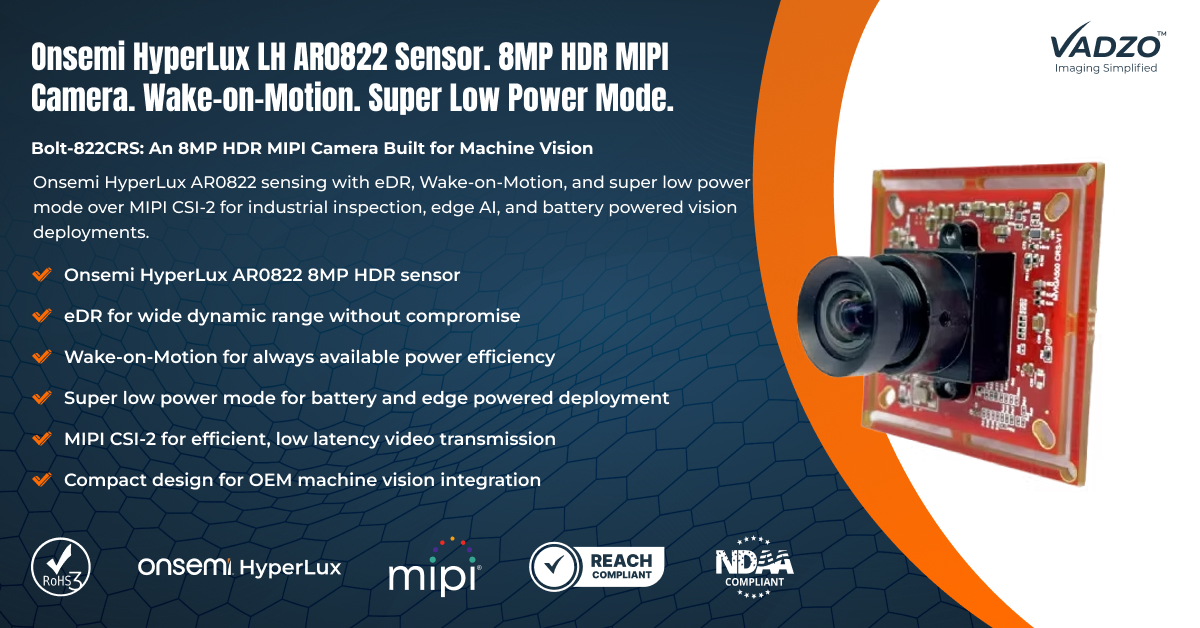
Product Overview
The Bolt-822CRS pairs the AR0822 LI-HDR MIPI Camera sensor with eDR, Wake-on-Motion, and super low power mode in a compact design suited to embedded machine vision, edge AI, and battery powered inspection integration. As an 8MP HDR MIPI Camera, it outputs full 8 megapixel resolution with HDR and power efficient processing active by default, giving machine vision integrators a single camera platform that covers industrial inspection, edge AI, and general purpose embedded vision from one module.
At the core of the module sits the Onsemi AR0822 HDR Camera sensor, chosen specifically for the combination of dynamic range and power efficiency that embedded machine vision deployments require. As a HyperLux AR0822 Camera platform, it pairs 8MP HDR MIPI Camera Module imaging with 8MP HDR MIPI Sensor power management, so the Bolt-822CRS reaches usable image quality across difficult lighting while also drawing meaningfully less average power than a continuously streaming camera of similar resolution.
Product Specifications
Key specs: 8MP (3840 × 2160) Max Resolution | Onsemi AR0822 HyperLux, 1/2.7 inch Sensor Format | 2.1 µm Pixel | Color, Rolling Shutter with eDR Chroma and Shutter | MIPI CSI-2 Interface | Fixed Focus, M12 Mount Optics
Key Capabilities
Onsemi HyperLux AR0822 Sensor for Detailed 8MP HDR Capture: The Bolt-822CRS is built around the Onsemi HyperLux AR0822 sensor, a device engineered specifically for machine vision and edge AI conditions rather than adapted from a general purpose imaging application. This gives the module genuine 8MP Low Power MIPI Sensor performance suited to the wide range of lighting and power constraints a real embedded machine vision deployment actually encounters. As a 4K MIPI Camera Module, it also fits directly into Vadzo Imaging's broader 4K camera portfolio, giving integrators a consistent point of comparison across resolution tiers.
eDR for Wide Dynamic Range Without Compromise: Industrial and outdoor machine vision scenes routinely combine bright reflective surfaces with shadowed recesses in ways that a single fixed exposure setting cannot resolve equally well. As an 8MP eDR Camera Module, the Bolt-822CRS holds detail across that full range in a single exposure, avoiding the ghosting that a moving part or conveyor would introduce into a blended HDR image. As a 4K HDR Camera Module, it also fits directly into Vadzo Imaging's broader HDR camera portfolio for integrators comparing dynamic range performance across product lines. Functioning as an eDR Machine Vision Sensor, it specifically targets machine vision deployments where both capabilities matter equally.
Wake-on-Motion for Always Available Power Efficiency: Running a large number of machine vision camera units at full power continuously is a real and growing operating cost for any deployment spanning more than a handful of units, particularly at remote or battery powered inspection points. As standard on the Bolt-822CRS, Wake-on-Motion maintains a low power monitoring state and transitions to full HDR capture only when motion actually enters the frame, meaningfully reducing the average power draw of a large scale machine vision rollout.
Super Low Power Mode for Battery and Edge Powered Deployment: Battery powered and remote machine vision nodes need power efficiency that goes beyond motion triggered activation alone, since even a low power monitoring state draws some baseline current that compounds over a long deployment. As a MIPI Camera Low Power Kit, the Bolt-822CRS's super low power mode further reduces that baseline draw, extending operational life for nodes that cannot rely on a continuous mains power connection.
MIPI CSI-2 for Efficient, Low Latency Video Transmission: Most embedded processors and edge AI compute modules used in machine vision deployments already include a native MIPI CSI-2 interface, which makes a MIPI connected camera a more direct and power efficient fit than a USB or networked camera requiring additional controller hardware. As a MIPI CSI-2 Low Power Camera, the Bolt-822CRS connects directly to that existing interface, reducing both the bill of materials and the power budget of a machine vision system's camera integration. That reduced component count also simplifies long term maintenance, since fewer discrete parts in the camera interface means fewer potential points of failure for a system that may operate unattended for extended periods between service visits.
Compact OEM Ready Design for Machine Vision Integration: Machine vision system manufacturers producing units at scale need a camera platform that stays consistent across a long production run. Vadzo Imaging supports full customization on this platform as an eDR Camera Manufacturer, including connector changes, optics selection, and firmware adjustments for manufacturers headed into volume production across multiple machine vision product lines. That customization extends to power profile tuning as well, since a manufacturer building a battery powered handheld device may need a different Wake-on-Motion sensitivity than one building a mains powered fixed inspection station, even though both rely on the same underlying sensor platform.
"Machine vision integrators keep telling us the same thing: a camera that only performs well with unlimited power available is not actually deployable at the edge, where a lot of the most valuable inspection and detection work now happens. The AR0822's eDR combined with Wake-on-Motion and super low power mode gives the Bolt-822CRS genuine HDR image quality without the power budget a continuously streaming camera assumes is always there. We built this camera for deployments measured by battery life and remote uptime, not just image quality on a bench." - Alwin Vincent - Product Manager at Vadzo Imaging
Application-Specific Sections
Industrial Inspection and Quality Control: Industrial inspection stations need HDR image quality to resolve both reflective metal surfaces and shadowed recesses on the same part, often at multiple stations across a production line where continuous power to every camera adds real infrastructure cost. As an Industrial Machine Vision MIPI Camera, the Bolt-822CRS delivers that HDR performance, and functioning as a Machine Vision Edge Camera, it extends the same capability to edge based inspection nodes distributed across a facility.
Edge AI and Embedded Vision Nodes: Edge AI deployments running inference locally rather than streaming continuously to a central server need a camera that matches that lower power, lower bandwidth design philosophy. As an Embedded Machine Vision MIPI camera, the Bolt-822CRS pairs naturally with edge AI compute hardware, and a MIPI Machine Vision Sensor configuration of the same module supports on device processing for applications where continuous data transmission is neither necessary nor power affordable.
Battery Powered and Remote Machine Vision: Remote inspection points and battery powered vision nodes cannot rely on the continuous power budget a factory floor camera typically assumes is available. As a Low Power Machine Vision Camera, the Bolt-822CRS's combined Wake-on-Motion and super low power mode extend operational life significantly, and a Wake-on-Motion Machine Vision Camera configuration gives remote deployments dependable image capture without a wired power connection. That independence from a continuous wired power source opens up mounting locations, such as remote poles, isolated equipment, or mobile platforms, that would otherwise require a dedicated power run before a camera could be installed at all.
Robotics and Automation Vision: Robotic work cells and automation platforms need HDR image quality for reliable part detection and quality verification without adding significant power draw to an already power constrained robotic platform. An HDR Machine Vision MIPI Camera built on this sensor holds detail across the mixed lighting typical of a robotic cell, giving automation integrators dependable vision without a corresponding increase in the platform's overall power budget.
OEM Integration for Machine Vision System Manufacturers: Machine vision system manufacturers building their own inspection, robotics, or edge AI hardware need a camera vendor who understands the power and connectivity requirements those platforms demand. The Bolt-822CRS ships from a Machine Vision MIPI Module with those requirements built in, and Vadzo Imaging supports OEM customization for cable length, connector type, and firmware for manufacturers standardizing on one camera across multiple machine vision product lines.
Frequently Asked Questions
Q: Why does an embedded machine vision camera need both Wake-on-Motion and a super low power mode rather than just one power saving feature?
A: Wake-on-Motion reduces power draw by keeping a camera in a low power monitoring state between events, but that monitoring state still draws some baseline current that accumulates over a long deployment, especially for a battery powered or remote node that may run for months between service visits. A super low power mode addresses that remaining baseline draw directly, reducing power consumption even during the monitoring state itself rather than only during full capture. Vadzo Imaging combines both features on its machine vision camera products because a deployment measured in months of unattended operation needs power savings at every stage of the camera's operating cycle, not just during the moments it happens to be actively capturing a full frame.
Q: What is eDR, and how does it compare to combining multiple exposures in software?
A: eDR, or Extended Dynamic Range, extends a sensor's dynamic range from within a single exposure captured on the sensor itself, rather than capturing multiple separate exposures and blending them together after the fact in software. That distinction matters directly in machine vision applications involving a moving part, a conveyor, or a robotic end effector, since combining multiple frames after capture can introduce ghosting or motion artifacts when something in the scene changes between those exposures. Vadzo Imaging selects sensors with genuine eDR for machine vision camera products specifically because industrial and robotics scenes are rarely still long enough for multi frame blending to work cleanly. A part moving along a conveyor or a robotic arm completing a motion is a normal, continuous condition in these environments rather than an edge case, which makes single exposure dynamic range handling a practical requirement rather than a nice to have feature.
Q: Why would a machine vision system choose a MIPI camera over a USB or GigE camera for an embedded edge deployment?
A: Most embedded processors and edge AI compute modules used in machine vision systems already include a native MIPI CSI-2 camera interface, which lets a MIPI connected camera draw power directly from that existing interface without the additional controller hardware a USB or GigE connection would require. That difference matters most in a power constrained edge deployment, where every additional component adds not just cost but also power draw that a battery powered or remote node cannot always afford. Vadzo Imaging offers its machine vision camera products in a MIPI connected format specifically because it matches the interface and power profile edge AI compute platforms are already built around.
Q: Can Vadzo Imaging customize a low power MIPI camera module for a specific machine vision or edge AI platform?
A: Yes. Vadzo Imaging supports full OEM customization across its machine vision camera portfolio, including optics selection suited to a specific working distance, connector and cable configuration matched to a particular embedded processor board, and firmware adjustments tuned for a specific Wake-on-Motion or power profile. Evaluation units ship with no minimum order requirement, and the same engineering team that built the standard product works directly with machine vision system manufacturers to adapt the module for a specific inspection, robotics, or edge AI platform headed into volume production.
Q: What should machine vision system integrators look for when selecting a camera for a battery powered or remote edge deployment?
A: A camera that performs well when connected to unlimited mains power does not necessarily perform the same way once deployed on battery power at a remote site, since power draw during idle or monitoring states matters as much as power draw during active capture for a deployment measured in months of unattended operation. Integrators should look for genuine low power design validated across a full operating cycle rather than only during active capture, a connectivity approach that does not add unnecessary power hungry components, and a supplier able to support customization for a specific power budget. Vadzo Imaging builds its machine vision camera products around exactly these priorities, since a camera that only saves power in a demo but drains a battery faster than expected in the field is not actually a viable choice for remote deployment. Requesting power consumption data across a full operating cycle, including idle and monitoring states rather than only active capture, is generally the more reliable way to confirm a camera's real world battery life before committing to a remote deployment at scale.
Availability
The Bolt-822CRS 8MP HDR MIPI Camera is available now and ready for evaluation and OEM integration. Evaluation kits include the camera module, mounting hardware, and integration documentation covering eDR configuration, Wake-on-Motion sensitivity tuning, and super low power mode setup, with no minimum order requirement. Contact Vadzo Imaging at support@vadzoimaging.com to request an evaluation unit or discuss volume production and OEM customization. Evaluation feedback is also welcome directly through the same contact channel, since real deployment conditions across a pilot installation often surface details a bench test alone would not reveal, and that feedback helps confirm a configuration before a manufacturer commits to a full production order.
About Vadzo Imaging
Vadzo Imaging develops embedded and machine vision camera products for OEMs, system integrators, and machine vision system manufacturers building production ready vision systems across industrial automation, robotics, edge AI, and security. The company's portfolio spans MIPI CSI-2, USB, GigE, Wi-Fi, FPD-Link III, and SerDes interface camera products, supporting deployment architectures from compact onboard modules to distributed networked installations. Vadzo provides end to end imaging support including sensor integration, ISP tuning, firmware development, and SDK frameworks to accelerate system deployment, and the company's engineering team works directly with customers throughout evaluation, pilot deployment, and volume production rather than handing off support after the initial sale. That ongoing engineering relationship matters most for embedded machine vision programs, where a camera platform may remain deployed across a fleet of remote or battery powered nodes for years after initial installation. Visit Vadzo Imaging to explore the full embedded vision camera portfolio.
Media Contact
Alwin Vincent
Vadzo Imaging
Email: alwin@vadzoimaging.com
LinkedIn: Vadzo Imaging
YouTube: Vadzo Imaging
X: Vadzo Imaging
SOURCE: Vadzo Imaging
View the original press release on ACCESS Newswire