Luxury electric car manufacturer Lucid (NASDAQ: LCID) fell short of the market’s revenue expectations in Q3 2026 as revenue rose 4.1% year on year to $350.3 million. Its non-GAAP loss of $2.30 per share was 4.2% below analysts’ consensus estimates.
For more on Lucid, read our free full research report.
Lucid (LCID) Q3 2026 highlights:
- Revenue $350.3 million vs S&P analyst consensus of $396.3 million (4.1% year-on-year growth, 11.6% miss)
- Adjusted EPS -$2.30 vs S&P analyst consensus of -$2.21 (4.2% miss)
- Adjusted EBITDA -$726.3 million (-207% margin, 1.2% year-on-year decline)
- Adjusted EBITDA margin -207%, up from -213% in the same quarter last year
- Free cash flow -$1.04 billion compared to -$955.5 million in the same quarter last year
- Market capitalization $1.30 billion
"Our transformation is beginning to show progress. We are acting with urgency, strengthening the fundamentals and driving greater discipline, while continuing to invest in the priorities to deliver profitable long-term growth," said Silvio Napoli, Chief Executive Officer. "We are grateful for the continued financial support from our anchor shareholder, which further energizes us to remain focused on execution and on our commitments as we build a stronger, sustainable Lucid."
Revenue growth
A company’s long-term revenue performance can indicate its overall quality. Any business can deliver a good quarter or two, but the best consistently grow over the long haul. Lucid’s revenue grew at a strong 224% compounded annual growth rate over the last five years. Its growth beat the average industrials company and shows its offerings resonate with customers.
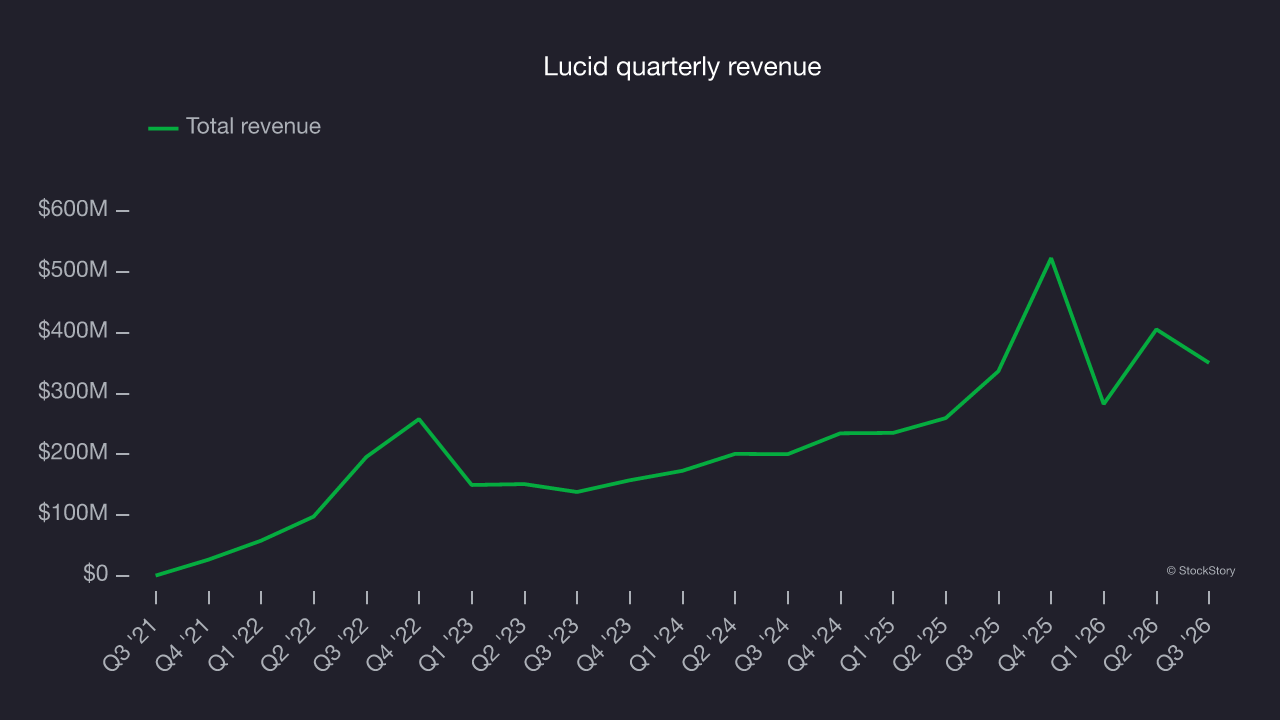
Long-term growth matters the most, but within industrials, a half-decade historical view may miss cycles, industry trends or a company capitalizing on catalysts such as a new contract win or a successful product line. Lucid’s annualized revenue growth of 46.2% over the last two years is below its five-year trend, but the results still suggest healthy demand. 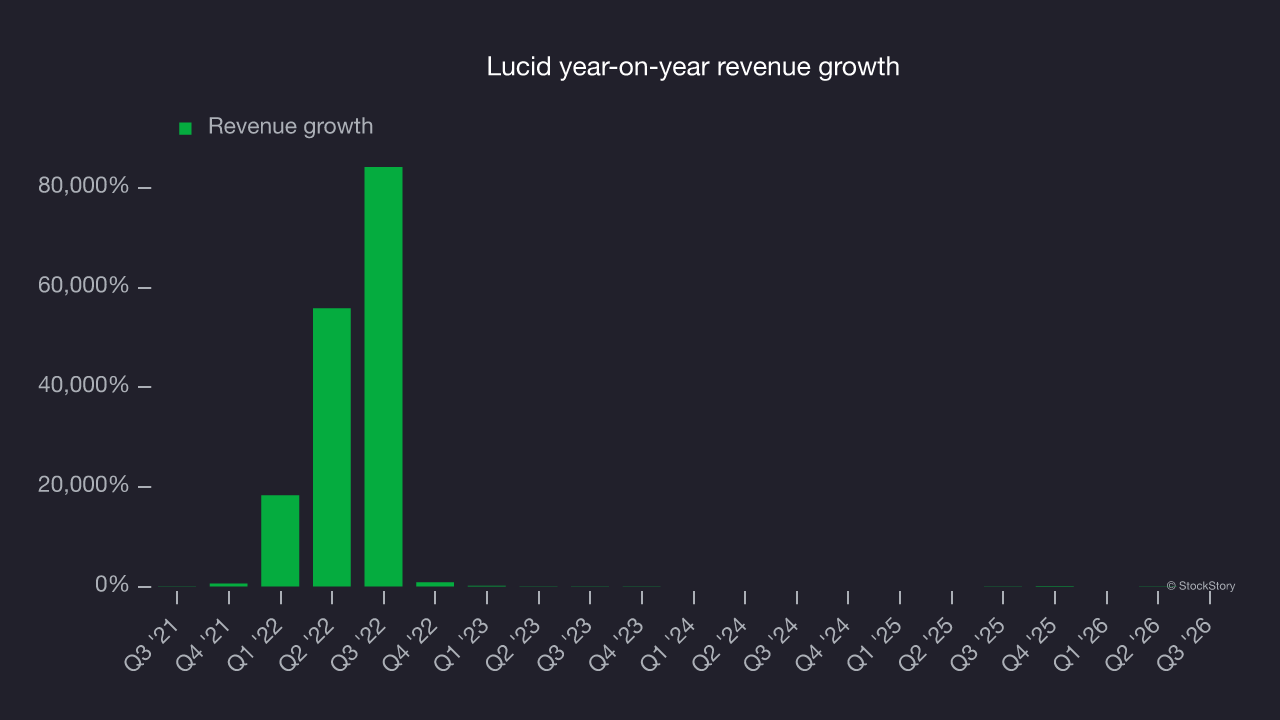
This quarter, Lucid’s revenue grew by 4.1% year on year to $350.3 million, falling short of Wall Street’s consensus estimates.
Looking ahead, sell-side analysts expect revenue to grow 68.5% over the next 12 months, according to S&P, an improvement versus the last two years. This strong projection implies its newer products and services will fuel better revenue performance.
Operating margin
Operating margin is an important measure of profitability as it shows the portion of revenue left after accounting for all core expenses, from the cost of goods sold to advertising and wages. It’s also useful for comparing profitability across companies with different levels of debt and tax rates because it excludes interest and taxes.
Over the last five years, Lucid’s operating margin rose by 362.4 percentage points. This improvement shows its costs declined relative to revenue. Its trailing 12-month operating margin was negative 256%.
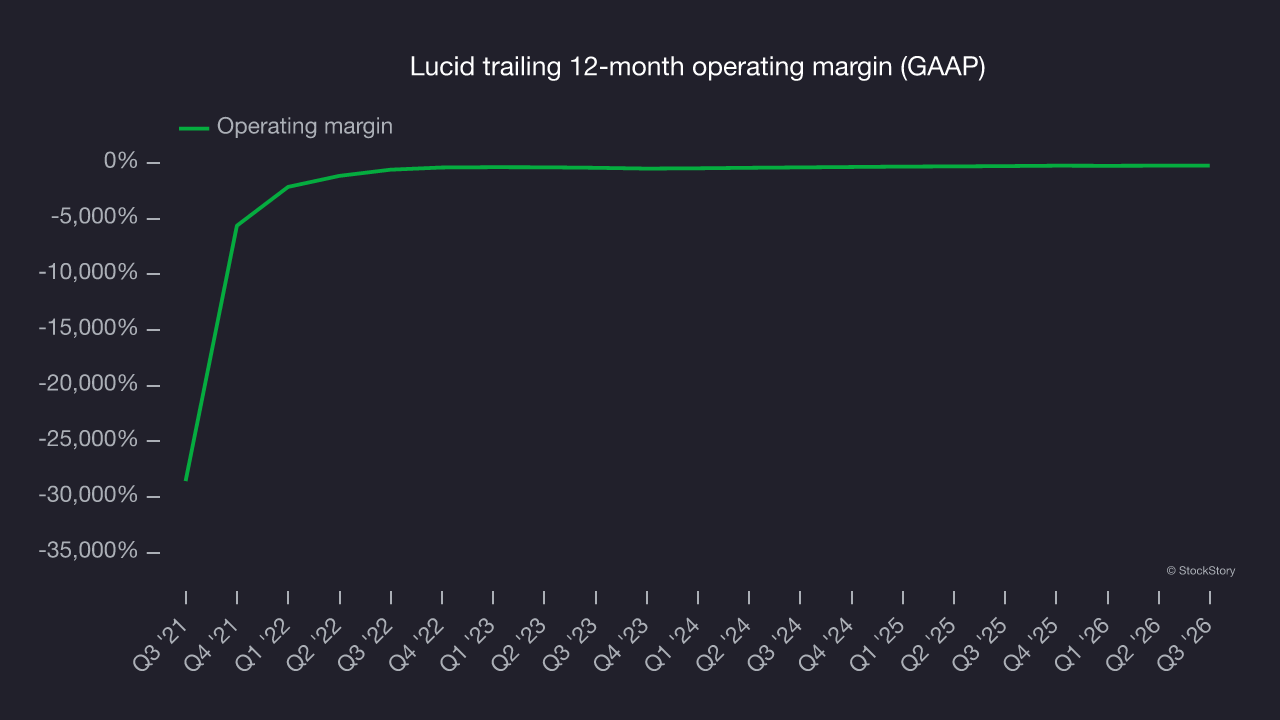
This quarter, Lucid generated a negative 245% operating margin.
Earnings per share
Long-term changes in earnings per share, or EPS, matter for the same reason as long-term revenue growth. Compared to revenue, however, EPS highlights whether a company’s growth is profitable.
Although Lucid’s full-year earnings are still negative, it reduced its losses and improved its EPS by 5.8% annually over the last four years. The next few quarters will be critical for assessing its long-term profitability.
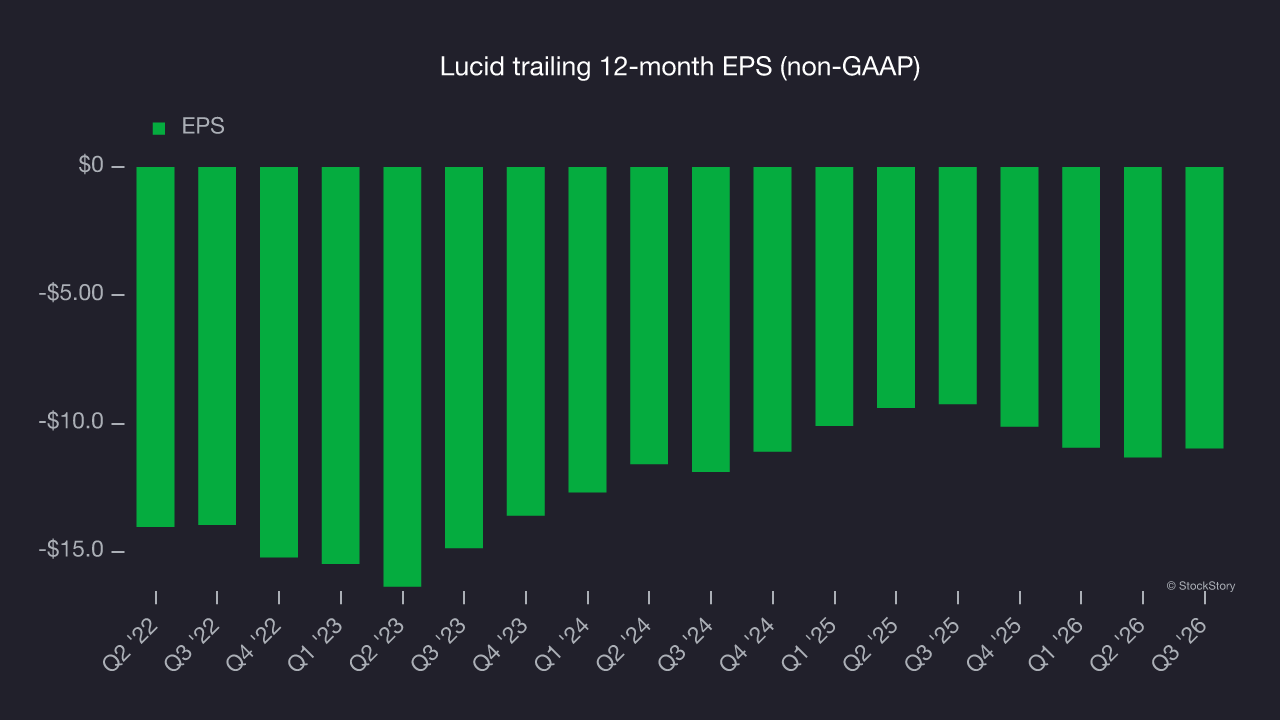
As with revenue, analyzing EPS over a more recent period can provide insight into an emerging theme or development for the business.
For Lucid, its two-year annual EPS growth of 3.9% was lower than its four-year trend.
In Q3, Lucid reported adjusted EPS of negative $2.30, up from negative $2.65 in the same quarter last year. Despite the year-over-year improvement, adjusted EPS missed analysts’ consensus estimates. Over the next 12 months, Wall Street expects Lucid to narrow its losses. Analysts forecast its full-year EPS will improve from negative $10.98 to negative $6.67, according to S&P.
Key takeaways from Lucid’s Q3 results
Lucid’s Q3 offered few positives: Revenue missed Wall Street’s consensus estimates, and EBITDA also fell short. It was a disappointing quarter, and shares fell 3.4% to $3.45 immediately after the report.
Lucid had an underwhelming quarter. The latest results matter when deciding whether to invest, but longer-term business quality and valuation matter more. Read the full research report here (it’s free).