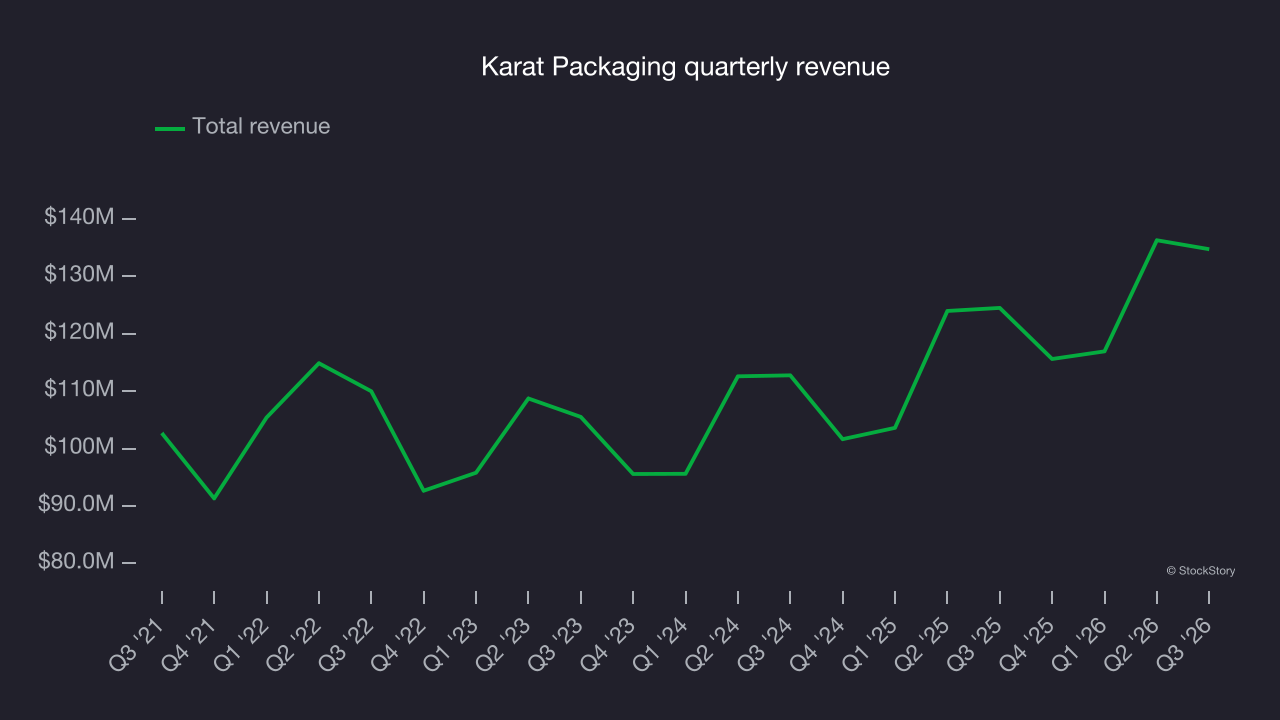
Foodservice packaging supplier Karat Packaging (NASDAQ: KRT) missed Wall Street’s revenue expectations in Q3 2026, but revenue rose 8.2% year on year to $134.7 million. Next quarter’s revenue guidance of $127.2 million underwhelmed, coming in 3.2% below analysts’ consensus estimates. Its non-GAAP profit of $0.24 per share was 47.8% below analysts’ consensus estimates.
For more on Karat Packaging, read our free full research report.
Karat Packaging (KRT) Q3 2026 highlights:
- Revenue $134.7 million vs S&P analysts’ consensus estimates of $140.3 million (8.2% year-on-year growth, 4% miss)
- Adjusted EPS $0.24 vs S&P analysts’ consensus estimates of $0.46 (47.8% miss)
- Adjusted EBITDA $8.94 million vs analysts’ consensus estimates of $13.86 million (6.6% margin, 35.5% miss)
- Revenue guidance $127.2 million at the midpoint for Q4 2026, below analysts’ consensus estimates of $131.4 million
- Operating margin 3.6%, down from 6.6% in the same quarter last year
- Free cash flow $9.62 million, up from -$1.52 million in the same quarter last year
- Market capitalization $1.02 billion
“We delivered solid top-line growth in the third quarter, with sales increasing 8.2 percent, and we saw continued strong momentum in our e-commerce business, where online sales grew nearly 38 percent over the prior-year quarter,” said Alan Yu, Chief Executive Officer. “While increased import as well as domestic shipping costs and elevated resin prices pressured margin and contributed to results below our expectations, we remain encouraged by the strength of our sales performance, especially the continued momentum in our e-commerce business expansion.”
Revenue growth
A company’s long-term performance is an indicator of its overall quality. Any business can experience short-term success, but top-performing ones sustain growth for years. Karat Packaging’s 8% annualized revenue growth over the last five years was decent. Its growth was slightly above the average industrials company and shows its offerings resonate with customers.
Long-term growth matters most, but within industrials, a half-decade historical view may miss cycles, industry trends or a company capitalizing on catalysts such as a new contract win or a successful product line. Karat Packaging’s annualized revenue growth of 10% over the last two years is above its five-year trend, suggesting its demand recently accelerated. 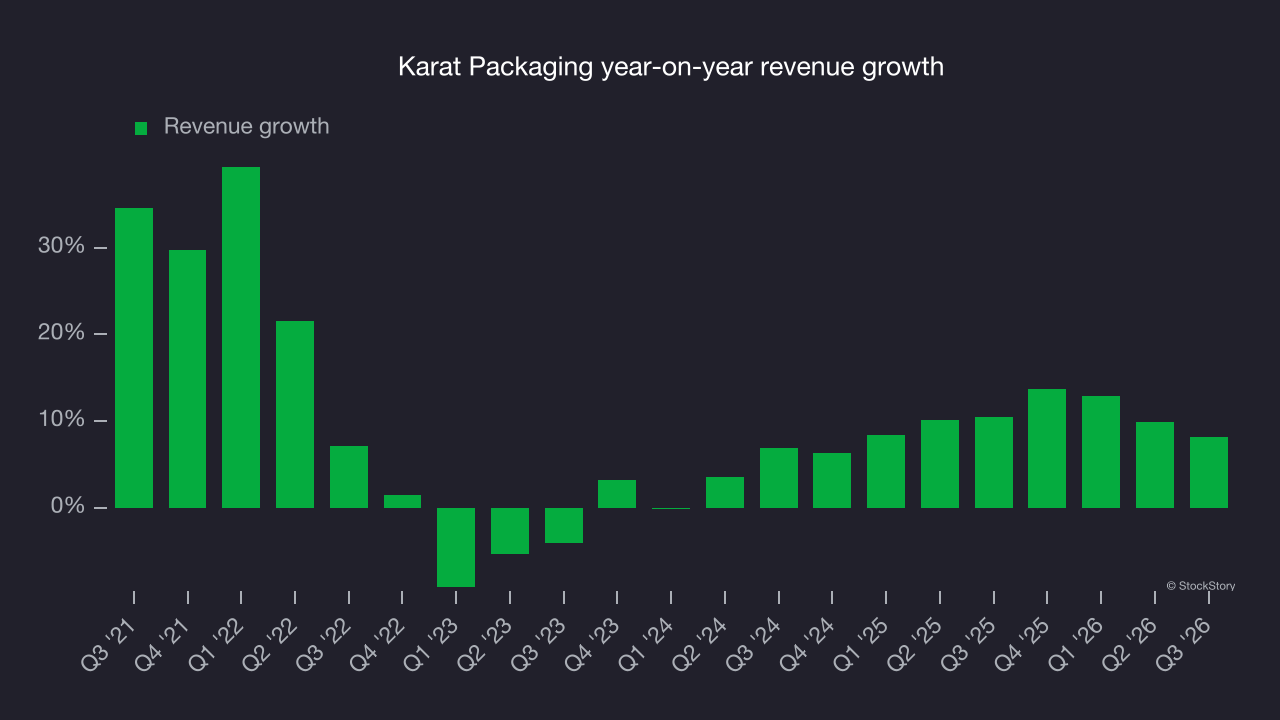
This quarter, Karat Packaging’s revenue grew by 8.2% year on year to $134.7 million, missing Wall Street’s consensus estimates. Company management is currently guiding for a 10% year-on-year increase in revenue next quarter.
Looking further ahead, sell-side analysts expect revenue to grow 10.2% over the next 12 months, according to S&P, similar to its two-year rate. This projection is noteworthy and indicates the market is forecasting success for its products and services.
Operating margin
Operating margin is one of the best measures of profitability because it shows how much money a company retains after procuring and manufacturing its products, marketing and selling those products and, most importantly, keeping them relevant through research and development.
Karat Packaging’s operating margin has more or less stayed the same over the last 12 months, averaging 8.6% over the last five years. This profitability was higher than the broader industrials sector, showing it did a decent job managing its expenses.
Karat Packaging’s operating margin might have fluctuated slightly but has generally stayed the same over the last five years. Margin expansion would be preferable, but Karat Packaging’s performance still shows it’s one of the better specialty equipment distributors, as most peers saw their margins decline.
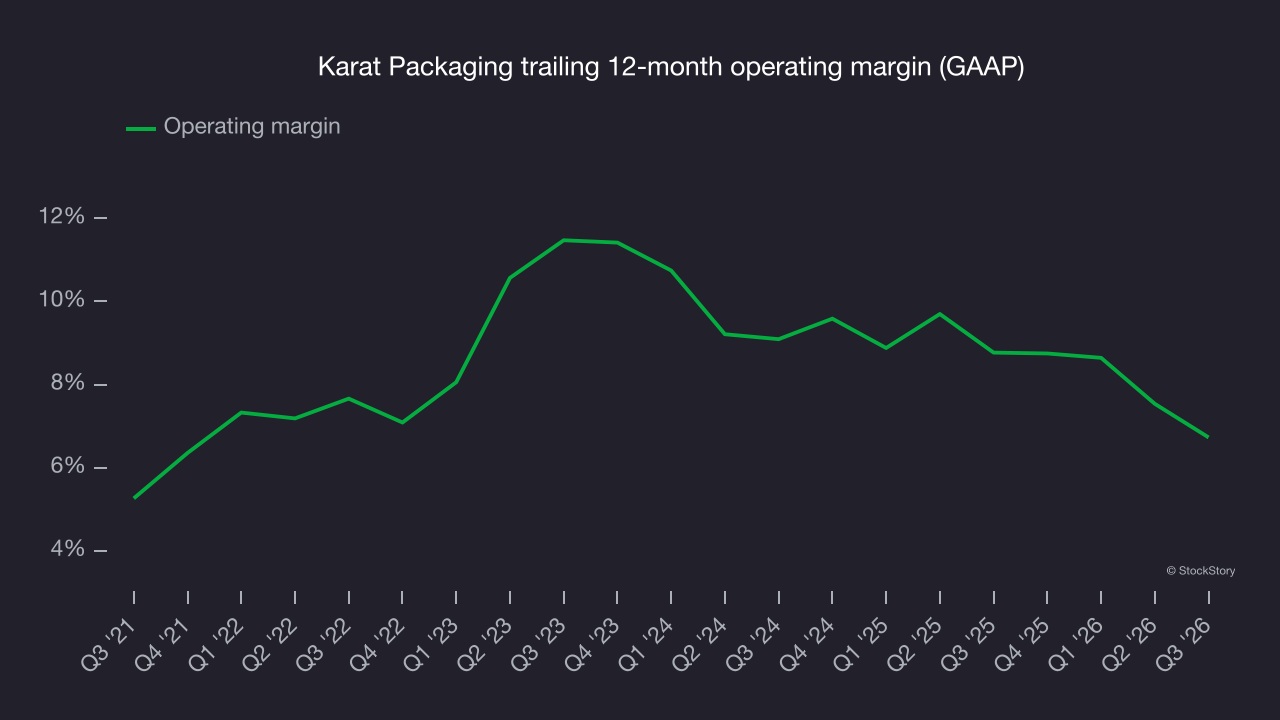
This quarter, Karat Packaging generated an operating margin of 3.6%, down 2.9 percentage points year on year. Its operating margin declined more than its gross margin, suggesting it was less efficient as expenses such as marketing, research and development and administrative overhead increased.
Earnings per share
Revenue trends explain a company’s historical growth, but the long-term change in earnings per share, or EPS, points to the profitability of that growth. For example, a company could inflate its revenue through excessive spending on advertising and promotions.
Karat Packaging’s EPS grew at a 26.8% compounded annual growth rate over the last five years, higher than its 8% annualized revenue growth. However, that outperformance warrants caution because its operating margin didn’t improve and it didn’t repurchase its shares, meaning the difference came from reduced interest expenses or taxes.
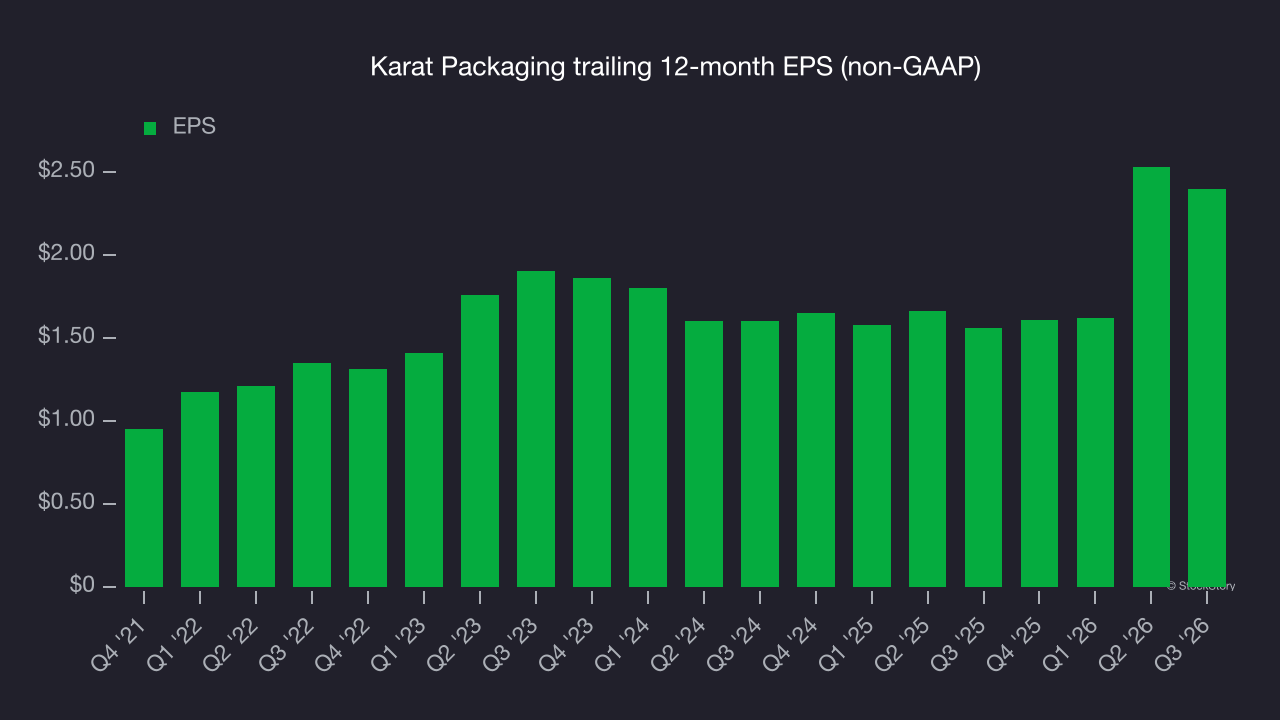
As with revenue, examining EPS over a shorter period can help identify changes in the business.
Karat Packaging’s two-year annual EPS growth of 22.5% was lower than its five-year trend. Even so, growth remained solid, and an acceleration would be welcome.
In Q3, Karat Packaging reported adjusted EPS of $0.24, down from $0.37 in the same quarter last year. This result missed analysts’ consensus estimates, but long-term adjusted EPS growth matters more than short-term movements. Over the next 12 months, Wall Street expects Karat Packaging’s full-year EPS to shrink by 13.7% from $2.40 to $2.07, according to S&P.
Key takeaways from Karat Packaging’s Q3 results
Karat Packaging’s Q3 results offered few positives, with both revenue and EBITDA falling short of Wall Street’s consensus estimates. It was a quarter that could have been better. Shares plunged 10% to $46.28 immediately after the release.
Karat Packaging’s earnings report left more to be desired. Whether that creates a buying opportunity requires a longer-term view. The latest quarter is only one piece of the business quality picture. Quality, combined with valuation, can help determine whether the stock is a buy. For more on Karat Packaging’s business quality and valuation, read the full research report here (it’s free).