Healthcare data analytics company Health Catalyst (NASDAQ: HCAT) beat Wall Street’s revenue expectations in Q3 2026, but revenue fell by 26.3% year on year to $56.28 million. The company expects the full year’s revenue to be around $247.5 million, close to analysts’ consensus estimates. Its non-GAAP loss of $0.03 per share was $0.02 above analysts’ consensus estimates.
For more on Health Catalyst, read our free full research report.
Health Catalyst (HCAT) Q3 2026 highlights:
- Revenue $56.28 million vs S&P analysts’ consensus estimates of $55.44 million (26.3% year-on-year decline, 1.5% beat)
- Adjusted EPS -$0.03 vs S&P analysts’ consensus estimates of -$0.05 ($0.02 beat)
- Adjusted EBITDA $779,000 vs analysts’ consensus estimates of $25,800 (1.4% margin, relatively in line)
- Revenue guidance The company reconfirmed its revenue guidance for the full year of $247.5 million at the midpoint
- EBITDA guidance $18.25 million at the midpoint for the full year, below analysts’ consensus estimates of $18.36 million
- Free cash flow -$6.21 million compared to -$4.88 million in the previous quarter
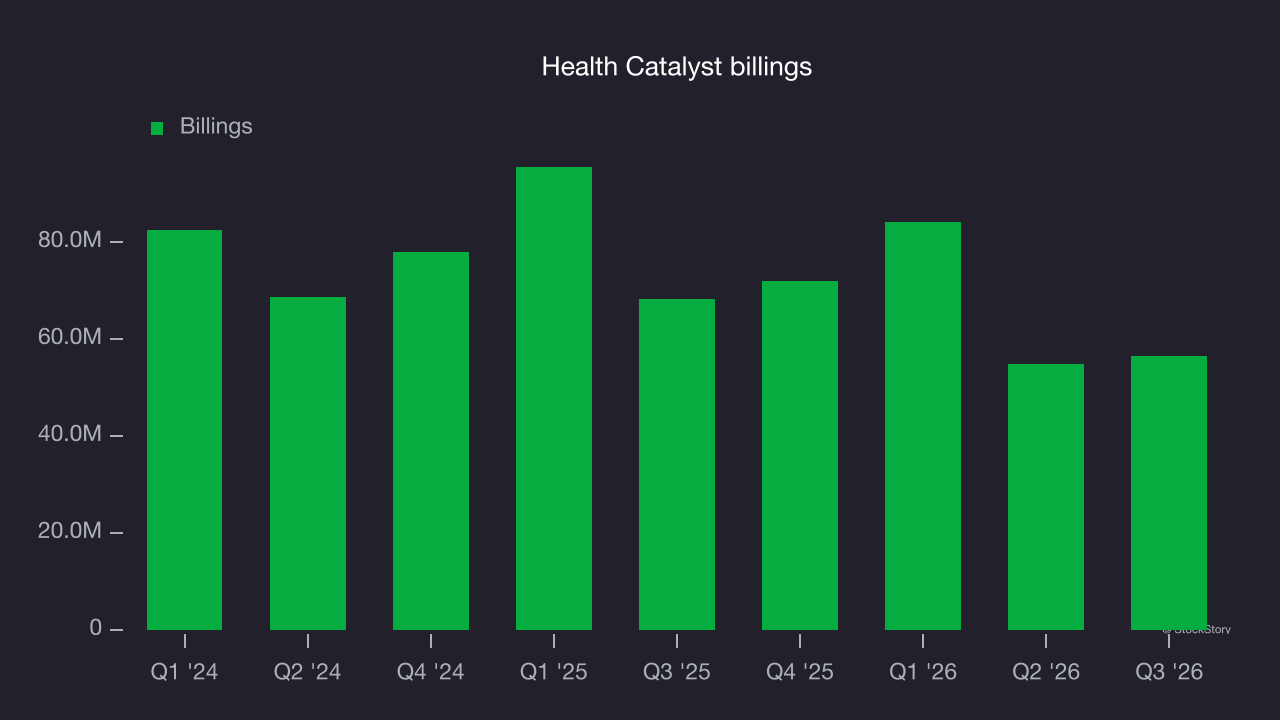
- Billings $56.59 million at quarter end, down 17% year on year
- Market capitalization $119.7 million
“We delivered a third quarter above the high end of our revenue and Adjusted EBITDA guidance, and we are reaffirming our full-year outlook,” said Simeon Kohl, President and Chief Executive Officer of Health Catalyst. “Our immediate priority is to strengthen the foundation of the business, with a focus on retaining the clients we serve and developing a path to generating durable, profitable revenue.”
Revenue growth
A company’s long-term revenue performance can indicate its overall quality. Any business can deliver a good quarter or two, but many enduring ones grow for years. Over the last five years, Health Catalyst grew its revenue at a weak 3.4% compounded annual growth rate, falling short of the software sector benchmark.
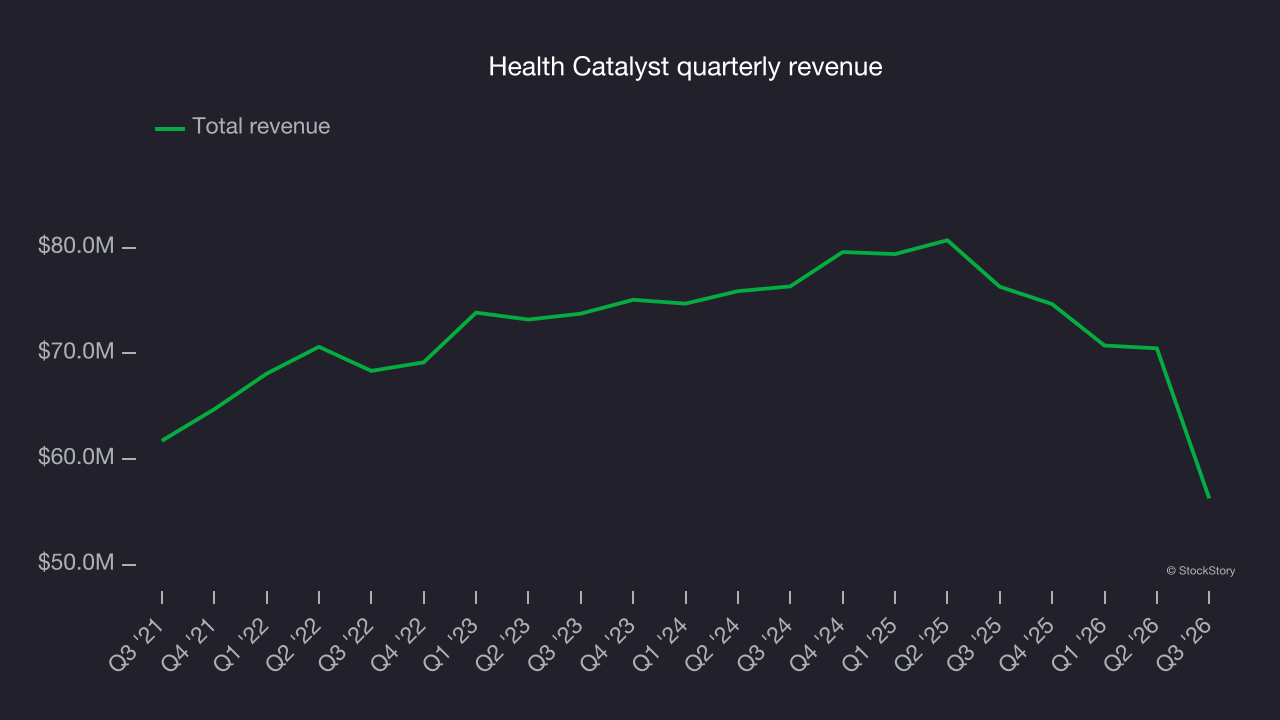
Long-term growth is the most important, but within software, a half-decade historical view may miss new innovations or demand cycles. Health Catalyst’s performance shows it grew in the past but relinquished its gains over the last two years, as its revenue fell by 5.1% annually.
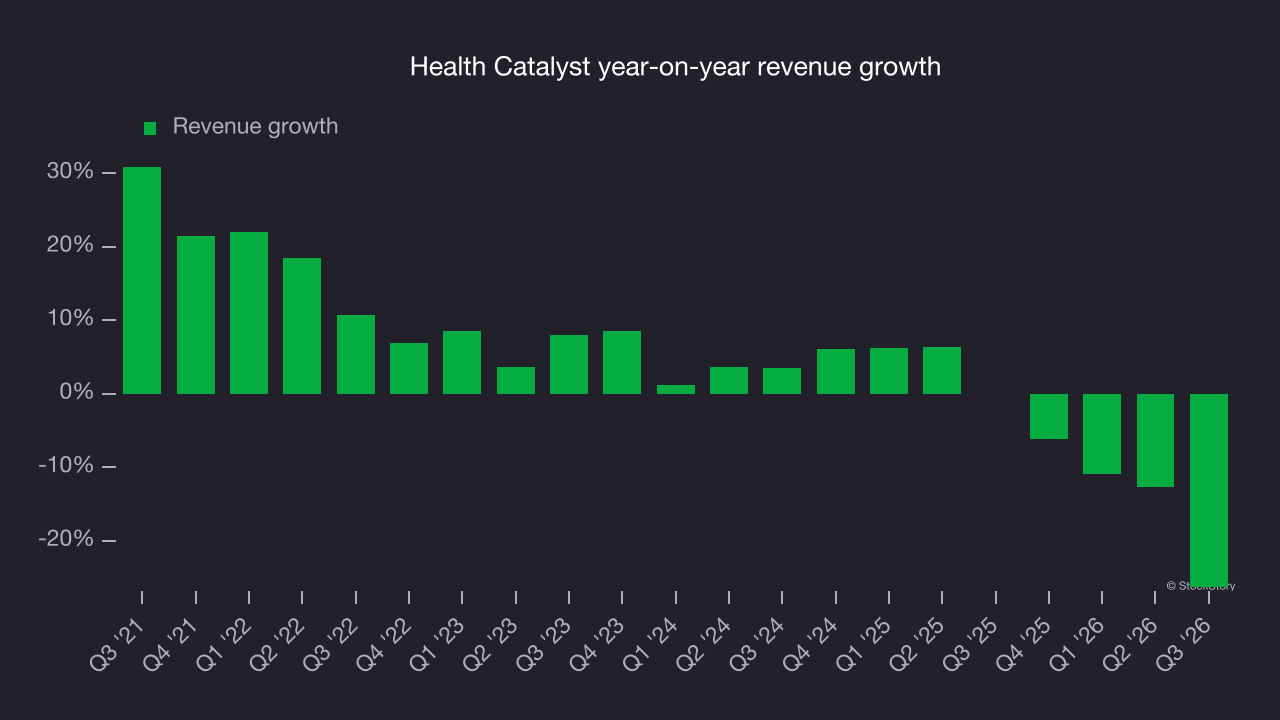
This quarter, Health Catalyst’s revenue fell by 26.3% year on year to $56.28 million but beat Wall Street’s consensus estimates by 1.5%.
Looking ahead, sell-side analysts expect revenue to decline by 24.7% over the next 12 months, according to S&P, a deceleration versus the last two years. This underwhelming projection implies its products and services will face some demand challenges.
Billings
Billings is a non-GAAP metric that is often called “cash revenue” because it shows how much money the company has collected from customers in a certain period. This is different from revenue, which must be recognized in pieces over the length of a contract.
Health Catalyst’s billings came in at $56.59 million in Q3, and it averaged 12.1% year-on-year declines over the last four quarters. This performance mirrored its total revenue and shows the company faced challenges in acquiring and retaining customers. It also suggests there may be increasing competition or market saturation.
Customer acquisition efficiency
The customer acquisition cost, or CAC, payback period represents the months required to recover the cost of acquiring a new customer. Essentially, it’s the break-even point for sales and marketing investments. A shorter CAC payback period is ideal, as it implies better returns on investment and business scalability.
Health Catalyst’s recent customer acquisition efforts haven’t yielded returns as its CAC payback period was negative this quarter, meaning its incremental sales and marketing investments outpaced its revenue. The company’s inefficiency indicates it operates in a highly competitive environment where there is little differentiation between Health Catalyst’s products and its peers.
Key takeaways from Health Catalyst’s Q3 results
Health Catalyst’s revenue beat analysts’ consensus estimates, but its outlook left the quarter looking softer overall. Full-year EBITDA guidance fell slightly short of estimates, and full-year revenue guidance was in line with Wall Street’s consensus. Shares remained flat at $1.50 immediately after the release.
How does Health Catalyst look at its current price? The latest quarter is only one piece of the longer-term business quality puzzle. Quality, when combined with valuation, can help determine whether the stock is a buy. For more, read the full research report here (it’s free).