Global online betting company Flutter Entertainment (NASDAQ: FLUT) fell short of the market’s revenue expectations in Q3 2026 as revenue rose 2.1% year on year to $3.87 billion. Its non-GAAP loss of $0.18 per share was significantly below analysts’ consensus estimates.
For more on Flutter Entertainment, read the full research report for free.
Flutter Entertainment (FLUT) Q3 2026 highlights:
- Revenue $3.87 billion vs S&P analysts’ consensus estimates of $3.99 billion (2.1% year-on-year growth, 2.9% miss)
- Adjusted EPS -$0.18 vs S&P analysts’ consensus estimates of $0.22 (significant miss)
- Adjusted EBITDA $360 million vs analysts’ consensus estimates of $414.2 million (9.3% margin, 13.1% miss)
- Operating margin -30.7%, down from -22% in the same quarter last year
- Free cash flow margin 0.9%, down from 2.3% in the same quarter last year
- Market capitalization $14.53 billion
Revenue growth
A company’s long-term revenue performance is one signal of its overall quality. Even a bad business can perform well for one or two quarters, but a high-quality one grows for years. Over the last five years, Flutter Entertainment grew its revenue at a 17.6% compounded annual growth rate. Though this growth is acceptable on an absolute basis, more than top-line growth is needed to assess the consumer discretionary sector, which can display significant earnings volatility. This means the bar for the sector is particularly high, reflecting the non-essential and hit-driven nature of the products and services offered. Additionally, the five-year growth period starts around Covid, when revenue was depressed before rebounding.
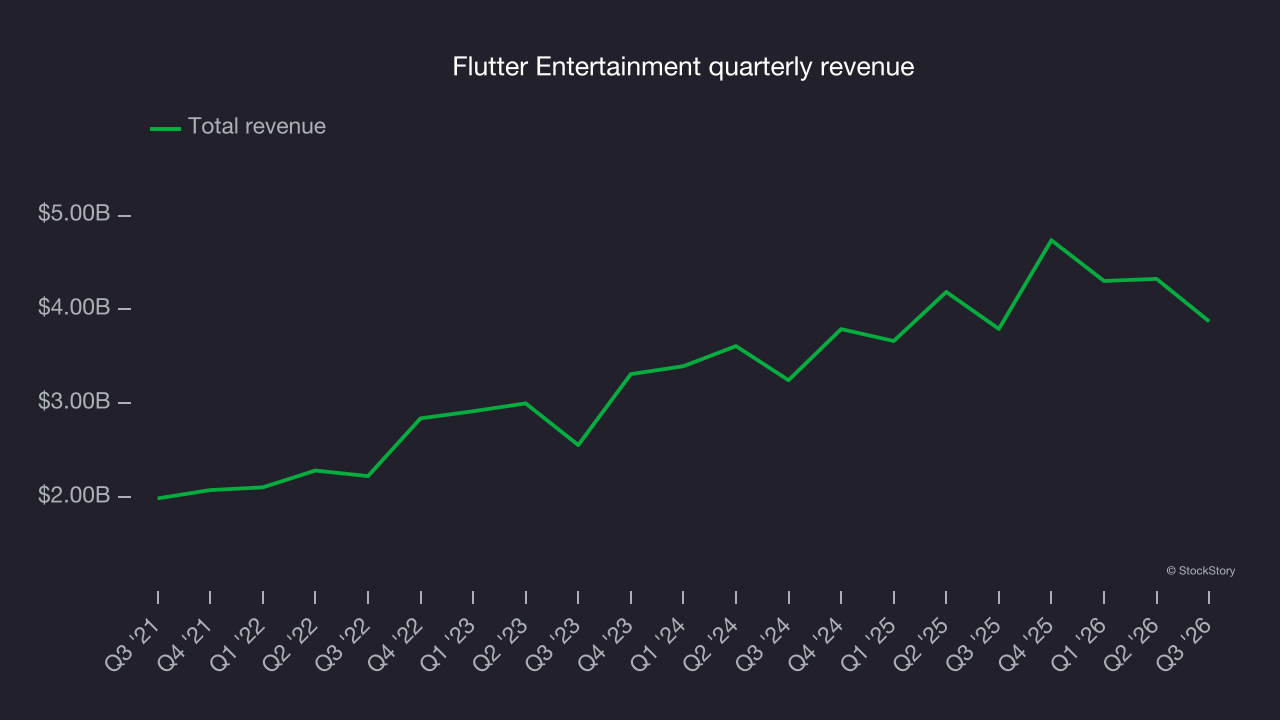
Long-term growth matters most, but within consumer discretionary, a longer historical view may miss a company riding a successful new product or trend. Flutter Entertainment’s recent performance shows its demand has slowed as its annualized revenue growth of 12.7% over the last two years was below its five-year trend. Decelerating revenue growth in the sector warrants caution, as it could signal changing consumer tastes aided by low switching costs. Note that Covid hurt Flutter Entertainment’s business in 2020 and part of 2021, and it rebounded substantially thereafter. 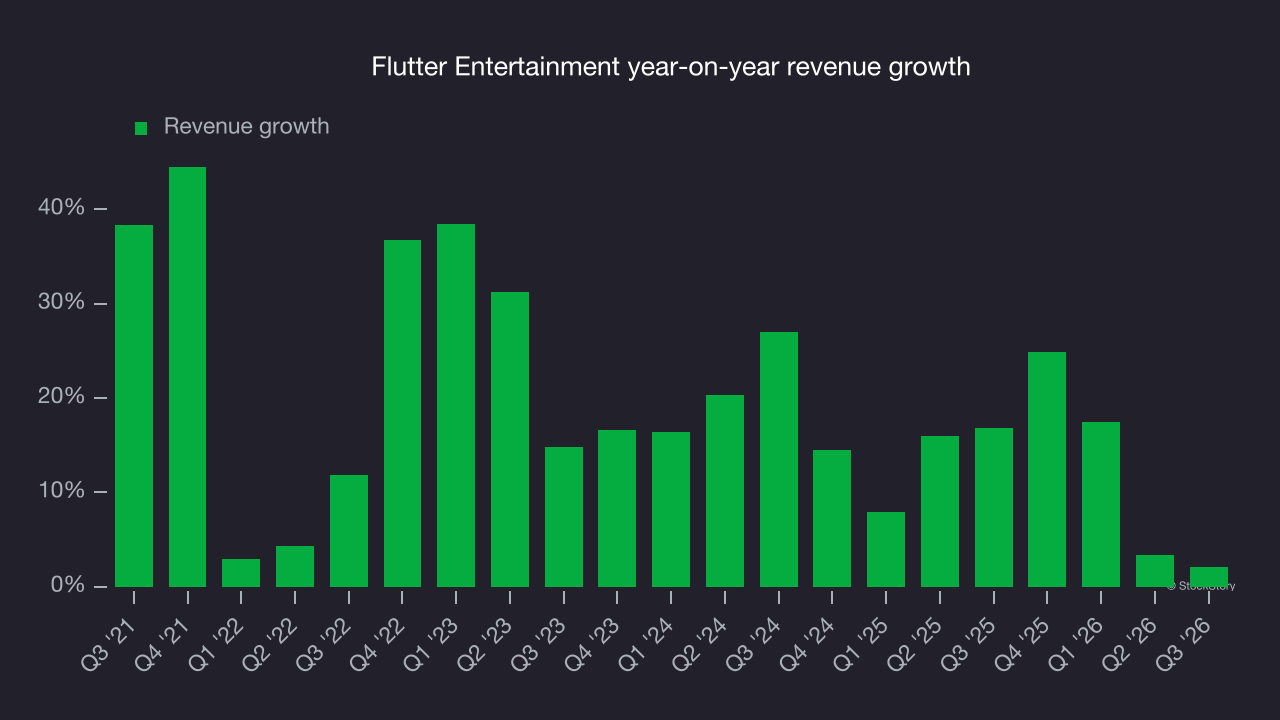
This quarter, Flutter Entertainment’s revenue grew by 2.1% year on year to $3.87 billion, falling short of Wall Street’s consensus estimates.
Looking ahead, sell-side analysts expect revenue to grow 8.4% over the next 12 months, according to S&P, a deceleration versus the last two years. This underwhelming projection indicates its products and services will see some demand headwinds.
Operating margin
Flutter Entertainment’s operating margin has shrunk over the last 12 months and averaged negative 2.9% over the last two years. Unprofitable consumer discretionary companies with falling margins deserve extra scrutiny because they’re spending heavily to stay relevant, an unsustainable practice.
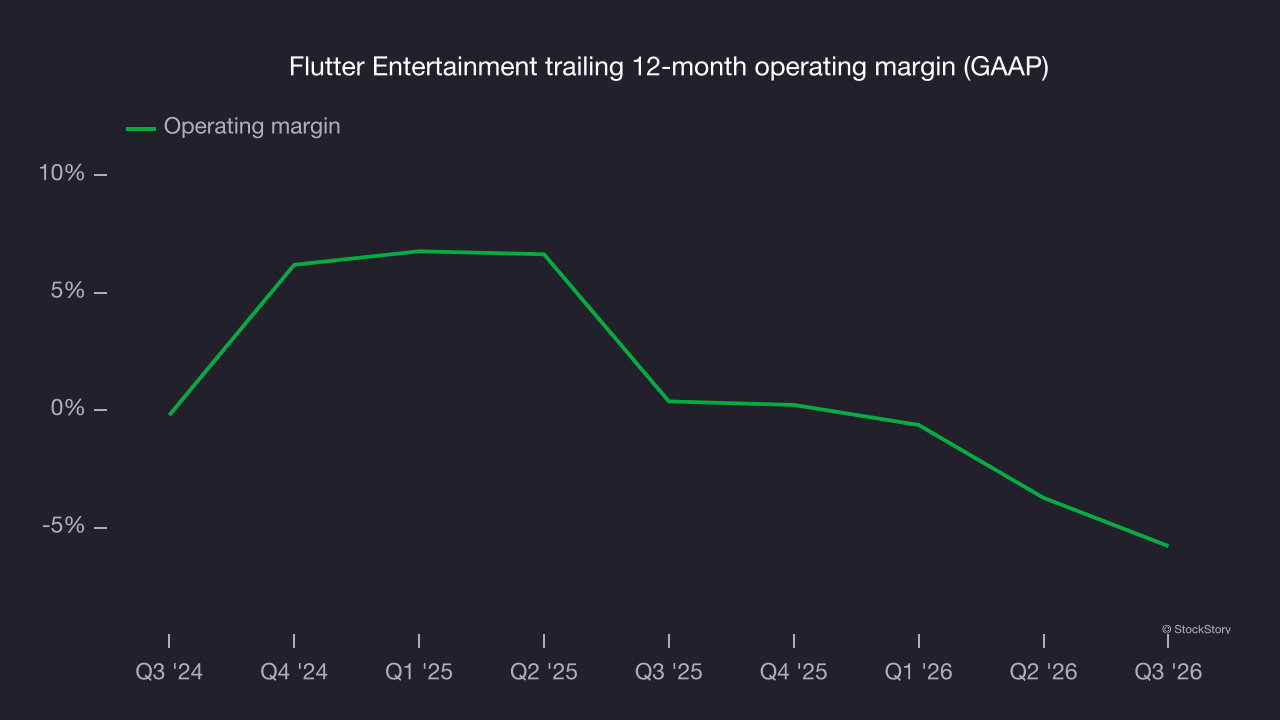
This quarter, Flutter Entertainment generated a negative 30.7% operating margin. The company’s consistent lack of profits raises concerns.
Cash flow
Earnings are valuable for assessing company performance, but cash flow matters because accounting profits cannot pay the bills.
Flutter Entertainment has shown poor cash profitability relative to peers over the last two years, giving the company fewer opportunities to return capital to shareholders. Its free cash flow margin averaged 4.5%, below what we’d expect for a consumer discretionary business.
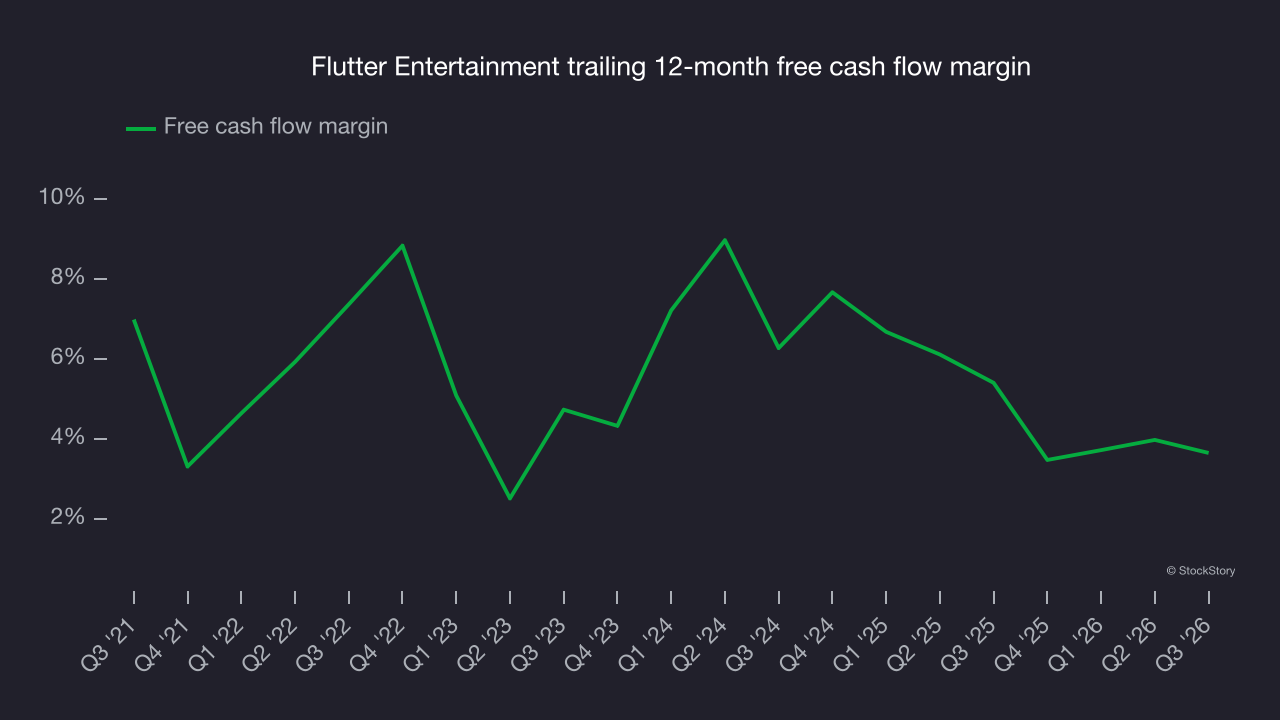
Flutter Entertainment broke even on free cash flow in Q3. The company’s cash profitability declined by 1.4 percentage points from the same quarter last year, warranting closer attention. Short-term fluctuations typically are not a major concern because investment needs can be seasonal, but whether the trend continues in future quarters bears watching.
Over the next year, analysts’ consensus estimates, according to S&P, project Flutter Entertainment’s free cash flow margin will remain unchanged from its level of 3.6% over the last 12 months.
Key takeaways from Flutter Entertainment’s Q3 results
Flutter Entertainment’s Q3 results offered few positives: EPS missed expectations and revenue fell short of Wall Street’s consensus estimates, making this a weaker quarter overall. Shares edged lower 1.8% to $82.27 immediately after the report.
Flutter Entertainment’s latest earnings report disappointed. One quarter doesn’t define a company’s quality or determine whether the stock is a buy at the current price. The latest quarter matters, but not nearly as much as longer-term fundamentals and valuation in making that decision. For more on Flutter Entertainment, read our full research report here (it’s free).