Language-learning app Duolingo (NASDAQ: DUOL) reported Q3 2026 results beating Wall Street’s revenue expectations, with revenue up 13.7% year on year to $309 million. Revenue guidance for next quarter was $322 million at the midpoint, 2.3% above analysts’ consensus estimates. Its GAAP profit of $0.54 per share was 4.4% below analysts’ consensus estimates.
For more on Duolingo, read our free full research report.
Duolingo (DUOL) Q3 2026 highlights:
- Revenue $309 million vs S&P analysts’ consensus estimates of $303.4 million (13.7% year-on-year growth, 1.8% beat)
- EPS (GAAP) $0.54 vs analysts’ consensus estimates of $0.56 (4.4% miss)
- Adjusted EBITDA $78.7 million vs analysts’ consensus estimates of $76.16 million (25.5% margin, 3.3% beat)
- Revenue guidance $322 million for Q4 2026, above analysts’ consensus estimates of $314.8 million
- EBITDA guidance $323 million for the full year, above analysts’ consensus estimates of $319.9 million
- Operating margin 7.8%, down from 12.9% in the same quarter last year
- Free cash flow margin 24.4%, down from 26.3% in the previous quarter
- Market capitalization $6.33 billion
Revenue growth
Reviewing a company’s long-term revenue performance reveals insights into its quality. Even a weak business can perform well for one or two quarters, but a high-quality one grows for years. Duolingo’s 34.7% annualized revenue growth over the last three years was strong. Its growth surpassed the average consumer internet company and shows its offerings resonate with customers.
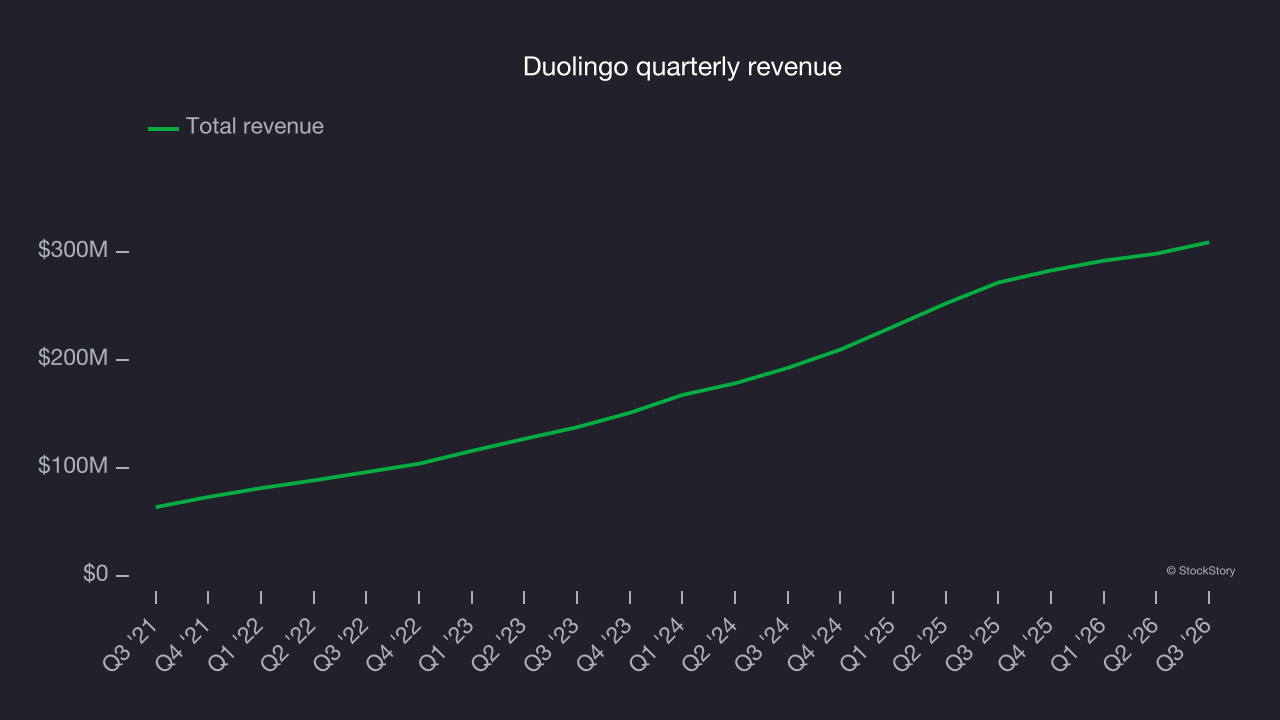
This quarter, Duolingo reported year-on-year revenue growth of 13.7%, and its $309 million of revenue exceeded Wall Street’s consensus estimates by 1.8%. Management is guiding for a 13.8% year-on-year increase in revenue next quarter.
Looking further ahead, sell-side analysts expect revenue to grow 12.1% over the next 12 months, according to S&P, a deceleration versus the last three years. Despite the slowdown, this projection is above the sector average and suggests the market is factoring in some success for its newer products and services.
Free cash flow
Free cash flow deserves emphasis because cash pays the bills, not accounting profits.
Duolingo has shown strong cash profitability, driven by its profitable business model and cost-effective customer acquisition strategy that enable it to stay ahead of the competition through investments in new products rather than sales and marketing. The company’s free cash flow margin was among the best in the consumer internet sector, averaging 34.6% over the last two years.
Duolingo’s margin expanded by 11.6 percentage points over the last few years. That is a positive because it gives the company more financial flexibility.
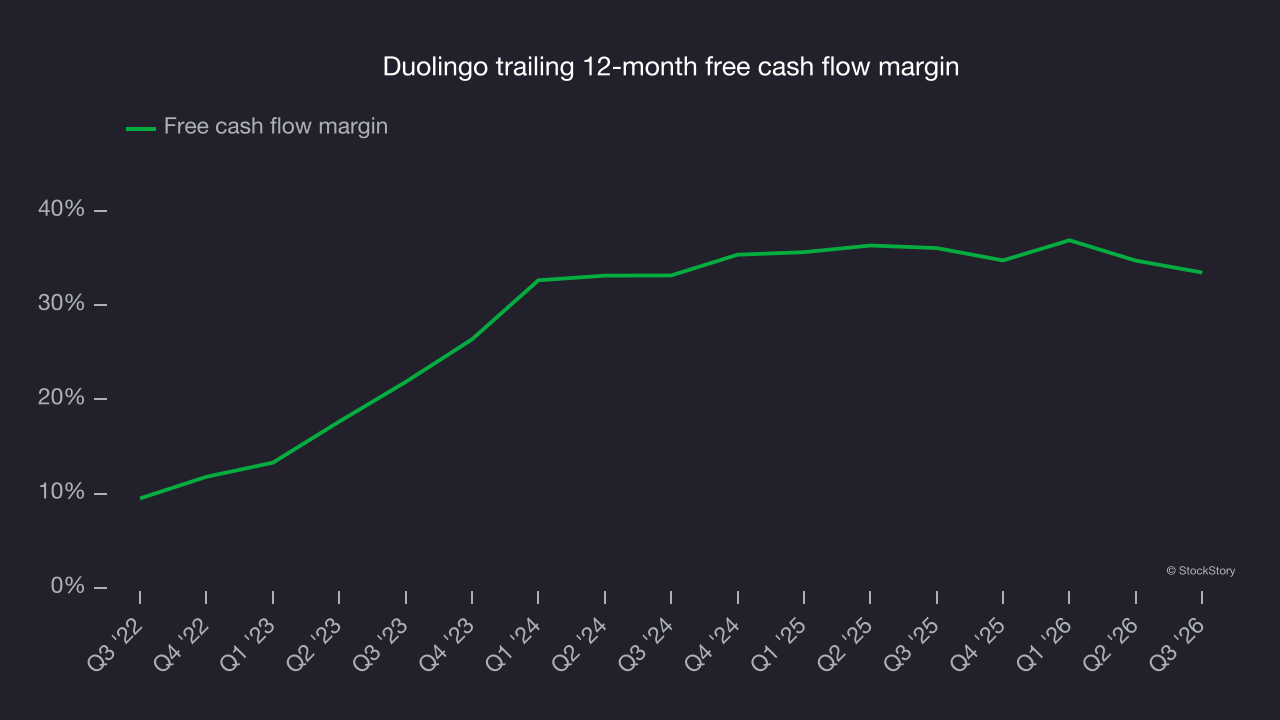
Duolingo’s free cash flow totaled $75.34 million in Q3, equivalent to a 24.4% margin. The company’s cash profitability declined, with its margin 4.1 percentage points lower than in the same quarter last year, but short-term results carry less weight because investment needs can be seasonal, causing temporary swings. Long-term trends matter more than fluctuations.
Key takeaways from Duolingo’s Q3 results
Duolingo delivered a strong quarter, beating analysts’ consensus EBITDA estimates and issuing revenue guidance for next quarter above Wall Street’s consensus. Shares soared 11.1% to $143.59 immediately after the release.
Duolingo had a good quarter, but one earnings result doesn’t necessarily make the stock a buy. An investment decision also calls for a broader look at valuation and business quality alongside the latest earnings. For more on Duolingo, read our full research report here (it’s free).