Audio technology company Sonos (NASDAQ: SONO) announced better-than-expected revenue in calendar Q3 2026 (fiscal Q4 2026), with revenue up 19.6% year on year to $344.4 million. Its non-GAAP profit of $0.04 per share was $0.01 below analysts’ consensus estimates.
For more on Sonos, read our free full research report.
Sonos (SONO) Q3 CY2026 highlights:
- Revenue $344.4 million vs S&P analysts' consensus estimates of $340.3 million (19.6% year-on-year growth, 1.2% beat)
- Adjusted EPS $0.04 vs S&P analysts' consensus estimates of $0.05 ($0.01 miss)
- Adjusted EBITDA $5.99 million vs analysts' consensus estimates of $3.49 million (1.7% margin, 71.3% beat)
- Operating margin -3.1%, up from -12% in the same quarter last year
- Free cash flow -$4.59 million compared to -$2.34 million in the same quarter last year
- Market capitalization $2.01 billion
“We said Fiscal 2026 would be the year Sonos returned to growth, and we delivered,” said Tom Conrad, chief executive officer of Sonos. “We grew in every region, delivered meaningfully higher profitability, and brought five new products to market. Underneath it all, the system strategy is working - every product improves those our customers already own, and with Sonos 27, that will keep getting stronger every year.”
Revenue growth
A company’s long-term performance is an indicator of its overall quality. Even a bad business can perform well for one or two quarters, but a top-tier one grows for years. Sonos’s demand was weak over the last five years as its revenue fell at a 2.1% annual rate. That underwhelming result suggests poor business quality.
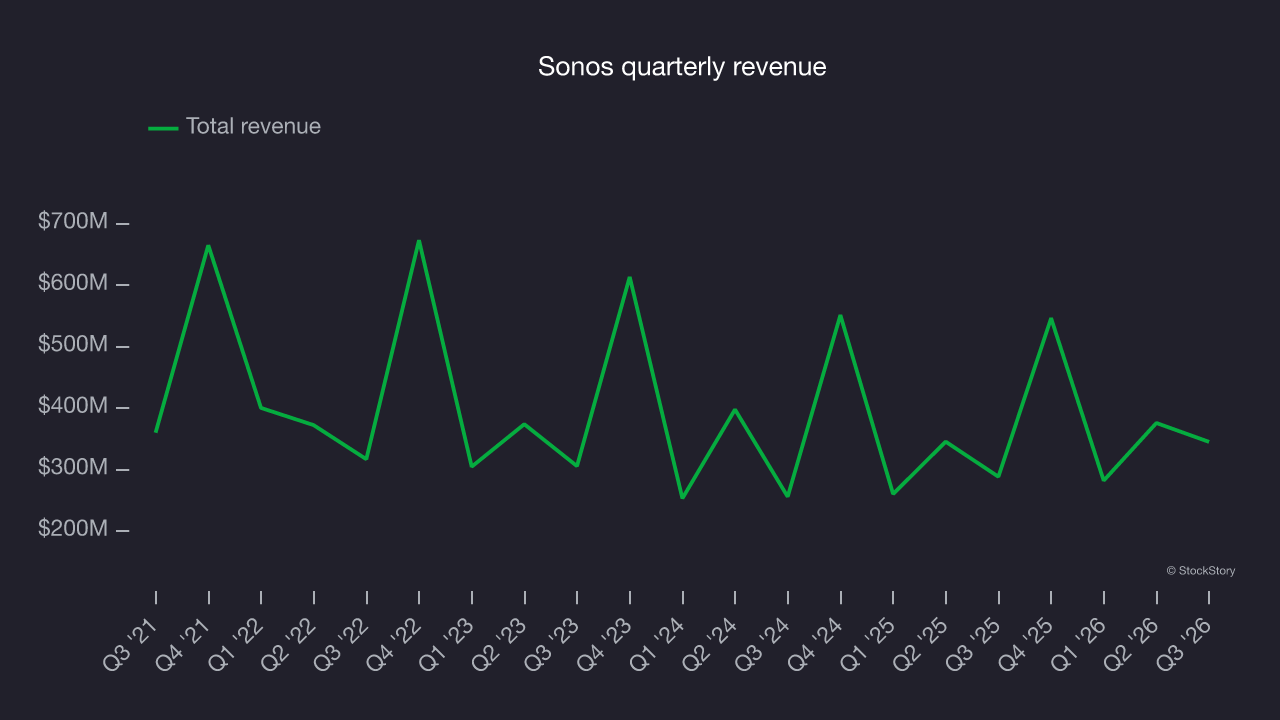
Long-term growth matters most, but within consumer discretionary, a longer historical view may miss a company riding a successful new product or trend. Sonos’s revenue over the last two years was flat, suggesting its demand was weak but stabilized after its initial drop. 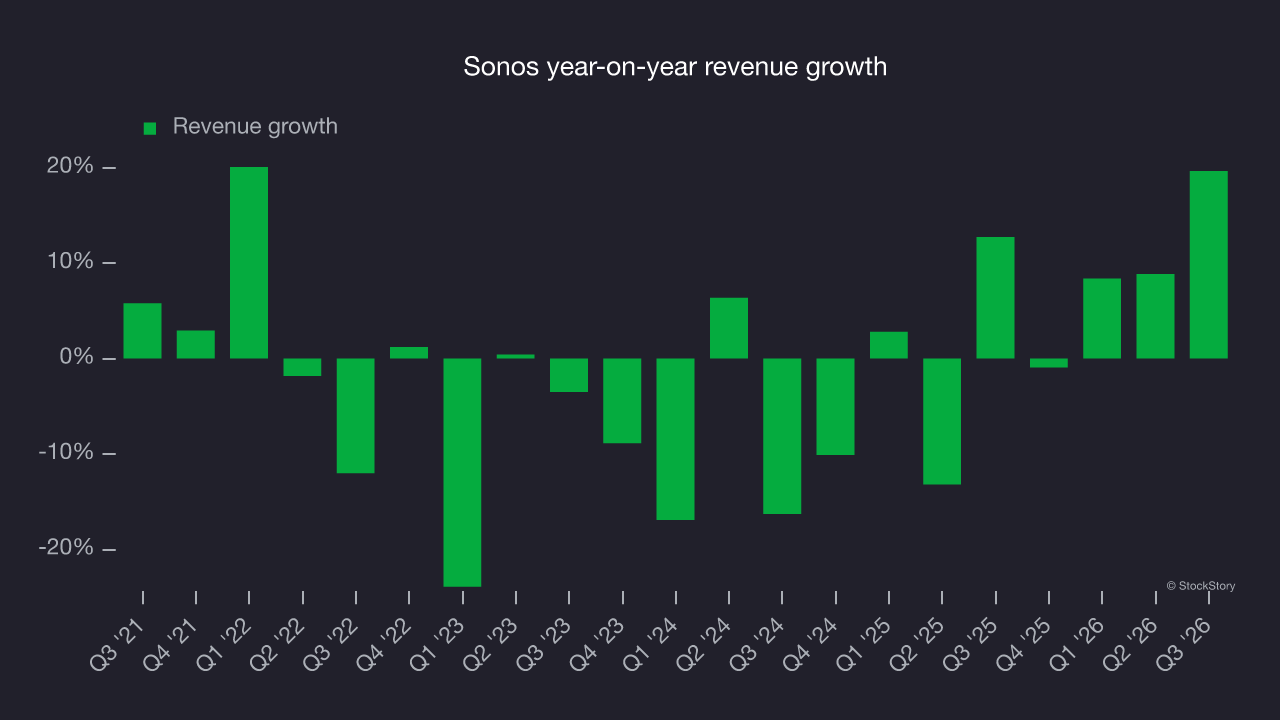
This quarter, Sonos reported year-on-year revenue growth of 19.6%, and its $344.4 million of revenue exceeded Wall Street’s consensus estimates by 1.2%.
Looking ahead, sell-side analysts expect revenue to grow 6.5% over the next 12 months, according to S&P. While this projection indicates its newer products and services will drive faster revenue growth, it is still below average for the sector.
Operating margin
Operating margin is an important measure of profitability as it shows the portion of revenue left after accounting for all core expenses, from the cost of goods sold to advertising and wages. It’s also useful for comparing profitability across companies with different levels of debt and tax rates because it excludes interest and taxes.
Sonos’s operating margin has been trending up over the last 12 months and averaged 1.3% over the last two years. The company’s improved efficiency is a positive, but its suboptimal cost structure means profitability remains thin for a consumer discretionary business.
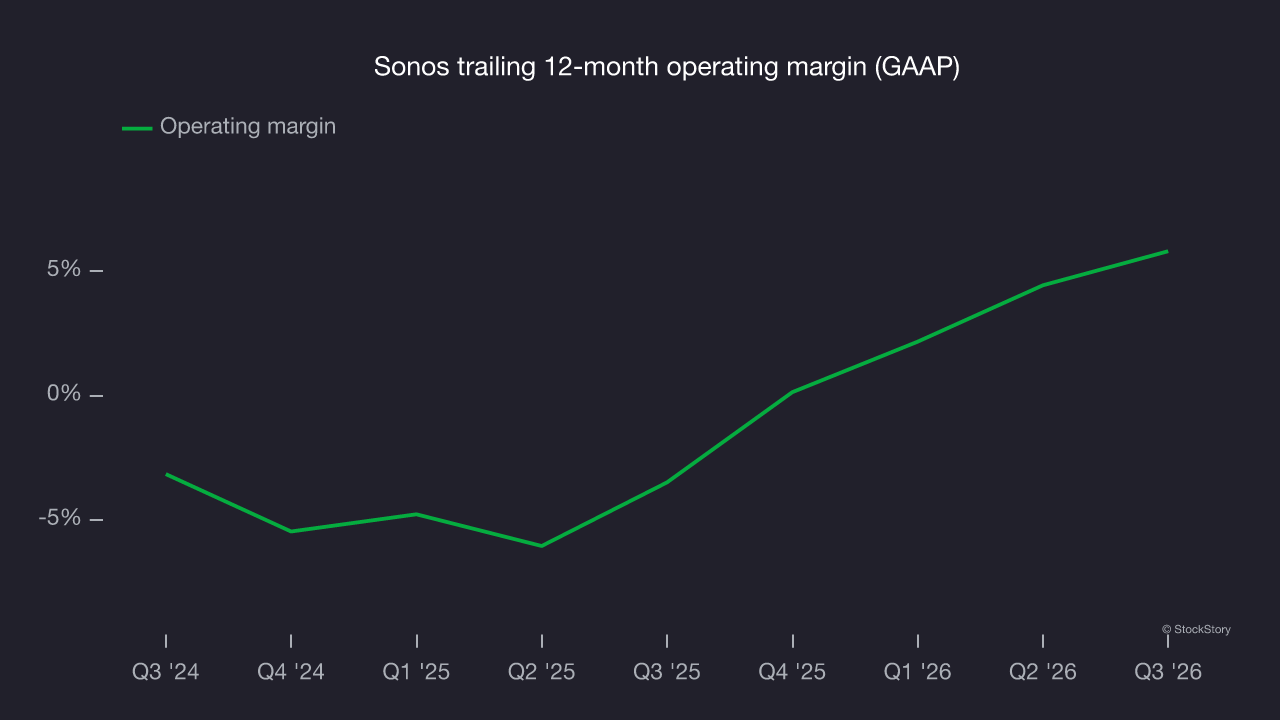
In Q3, Sonos generated an operating profit margin of negative 3.1%, up 8.8 percentage points year on year. This improvement points to greater efficiency.
Earnings per share
Long-term changes in earnings per share, or EPS, matter for the same reason as long-term revenue growth. Compared to revenue, however, EPS highlights whether a company’s growth is profitable.
Sonos’s EPS declined by 7.6% annually over the last five years, more than its revenue. This indicates the company struggled because its fixed cost base made it difficult to adjust to shrinking demand.
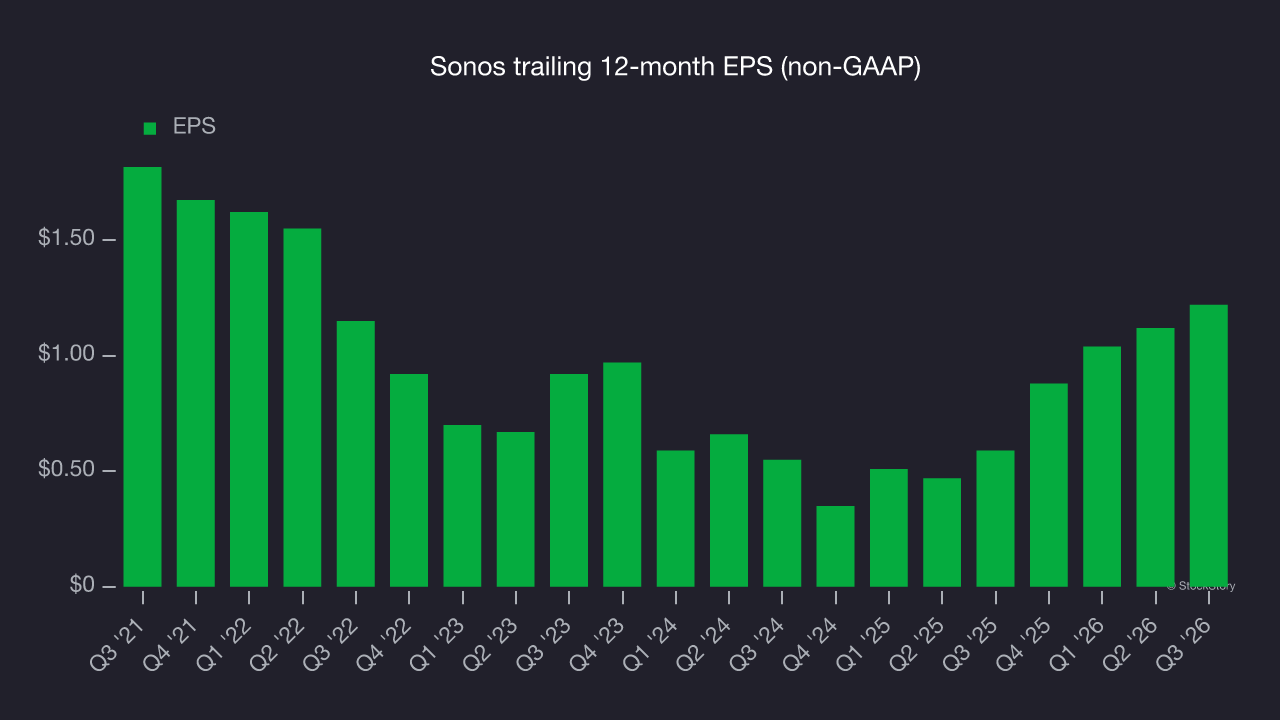
In Q3, Sonos reported adjusted EPS of $0.04, up from negative $0.06 in the same quarter last year. Despite growing year on year, this result missed analysts’ consensus estimates. Over the next 12 months, Wall Street expects Sonos’s full-year EPS to shrink by 22.1% from $1.22 to $0.95, according to S&P.
Key takeaways from Sonos’s Q3 results
Sonos delivered a sizable EBITDA beat and narrowly topped Wall Street’s consensus revenue estimates, but EPS only met expectations. That made for a mixed quarter, with the market seemingly hoping for more. Shares edged lower 1.4% to $16.66 immediately after the results.
When deciding whether to invest in Sonos, the latest quarter matters, but longer-term business quality and valuation matter more. For more on those factors, read our full research report here (it’s free).