Packaged foods company B&G Foods (NYSE: BGS) reported Q3 2026 results exceeding the market’s revenue expectations, with revenue up 4.7% year on year to $459.8 million. The company’s full-year revenue guidance of $1.78 billion at the midpoint came in 2.4% above analysts’ consensus estimates. Its non-GAAP profit of $0.21 per share was 37.7% above analysts’ consensus estimates.
For more on B&G Foods, read the full research report for free.
B&G Foods (BGS) Q3 2026 highlights:
- Revenue $459.8 million vs S&P analyst consensus of $432.4 million (4.7% year-on-year growth, 6.3% beat)
- Adjusted EPS $0.21 vs S&P analyst consensus of $0.15 (37.7% beat)
- Adjusted EBITDA $81.85 million vs analysts’ consensus estimates of $73.1 million (17.8% margin, 12% beat)
- Revenue guidance The company lifted its revenue guidance for the full year to $1.78 billion at the midpoint from $1.76 billion, a 1.4% increase
- Adjusted EPS guidance Management reiterated its full-year adjusted EPS guidance of $0.63 at the midpoint
- EBITDA guidance $285 million at the midpoint for the full year, above analysts’ consensus estimates of $276.9 million
- Operating margin 3.1%, in line with the same quarter last year
- Sales volumes rose 6.1% year on year (-2.9% in the same quarter last year)
- Market capitalization $216.2 million
Commenting on the results, Rob Mills, president and chief executive officer of B&G Foods, said, “Third quarter and year-to-date results reflect encouraging progress across B&G Foods. We generated base business net sales growth of 5.0% in the third quarter and 1.8% year-to-date, while adjusted EBITDA increased $12.4 million, or 6.6%, year-to-date. We are encouraged by this progress and remain focused on building on it.”
Revenue growth
Reviewing a company’s long-term revenue performance reveals insights into its quality. Any business can deliver a good quarter or two, but many enduring ones grow for years.
With $1.79 billion in revenue over the past 12 months, B&G Foods is a small consumer staples company, which sometimes brings disadvantages compared to larger competitors benefiting from economies of scale and negotiating leverage with retailers.
B&G Foods struggled to generate demand over the last three years. Its revenue dropped by 5.3% annually despite selling a similar number of units each year. We’ll explore what this means in the “Volume Growth” section.
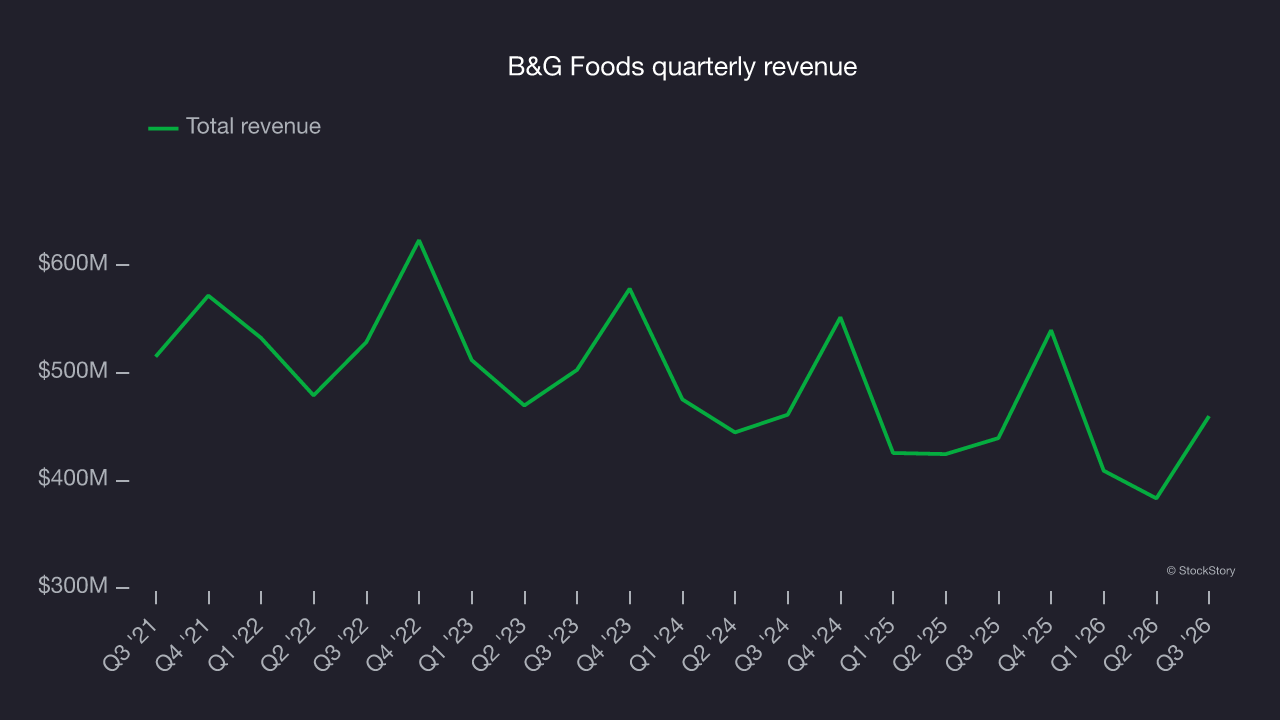
This quarter, B&G Foods reported modest year-on-year revenue growth of 4.7% but beat Wall Street’s consensus estimates by 6.3%.
Looking ahead, sell-side analysts expect revenue to decline by 2.4% over the next 12 months, according to S&P. That is an uninspiring outlook for a company struggling with demand.
Volume growth
Revenue growth can be broken down into changes in price and volume (the number of units sold). While both are important, volume is key to a successful staples business as there’s a ceiling to what consumers will pay for everyday goods; they can always trade down to non-branded products if the branded versions are too expensive.
B&G Foods’s quarterly sales volumes have, on average, stayed about the same over the last two years. This stability is normal because the quantity demanded for consumer staples products typically doesn’t see much volatility. 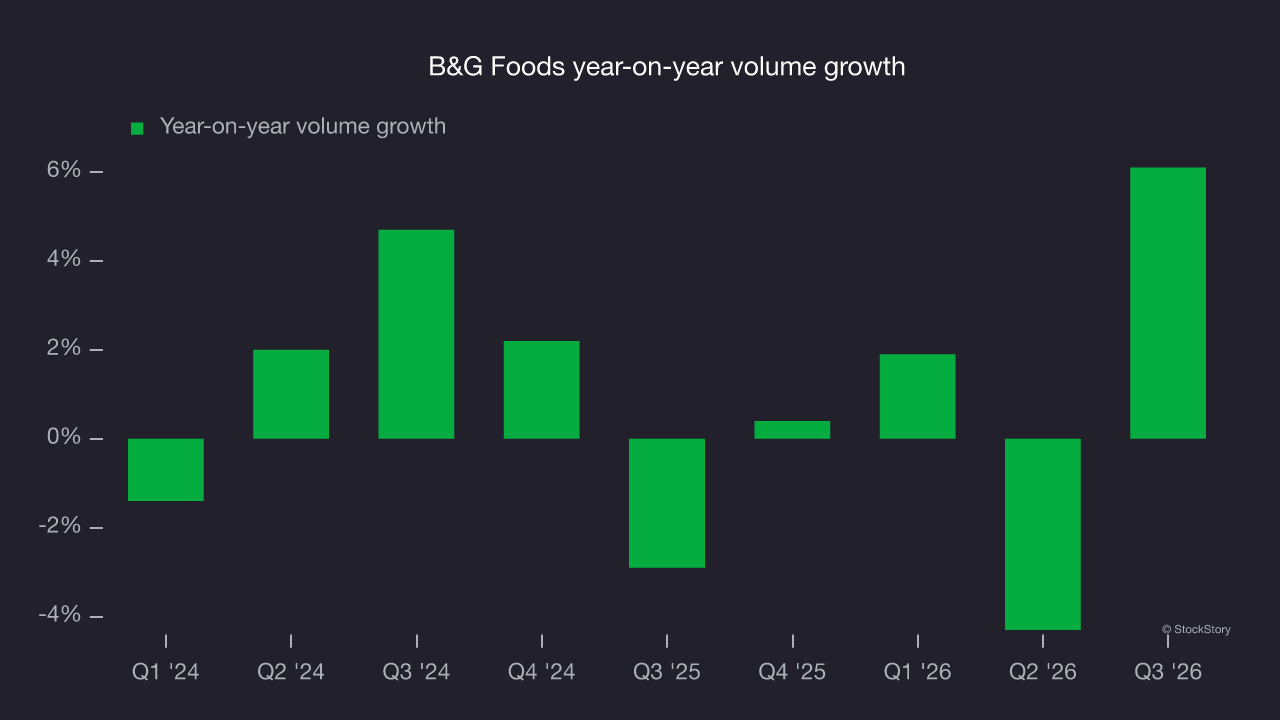
In B&G Foods’s Q3 2026, sales volumes grew 6.1% year on year. This result was an acceleration from its historical levels, a positive signal.
Key takeaways from B&G Foods’s Q3 results
B&G Foods delivered a strong Q3, with revenue and EBITDA both beating analysts’ consensus estimates by wide margins. Those beats were key positives in the quarter, and shares soared 12.4% to $2.99 immediately after the release.
B&G Foods had a solid quarterly earnings result, but the investment case also depends on the bigger picture. The latest quarter is only one piece of the longer-term business quality puzzle. Quality, when combined with valuation, can help determine if the stock is a buy. For more on B&G Foods, read the full research report here (it’s free).