Leasing services company GATX (NYSE: GATX) reported Q3 2026 results topping the market’s revenue expectations, with revenue up 36.1% year on year to $598 million. Its GAAP profit of $2.92 per share was 19.2% above analysts’ consensus estimates.
For more on GATX, read our full research report, available free.
GATX (GATX) Q3 2026 highlights:
- Revenue $598 million vs S&P analysts’ consensus estimates of $592.7 million (36.1% year-on-year growth, 0.9% beat)
- EPS (GAAP) $2.92 vs analysts’ consensus estimates of $2.45 (19.2% beat)
- GAAP EPS guidance $10.10 at the midpoint for the full year, roughly in line with what analysts were expecting
- Operating margin 64.2%, up from 30% in the same quarter last year
- Active railcars increased by 87,070 year on year
- Market capitalization $5.96 billion
Mr. Lyons concluded, "Based on year-to-date performance and our outlook for the remainder of the year, we now expect our 2026 full-year earnings to modestly exceed the high end of our previously announced guidance range of $9.90 to $10.30 per diluted share. Our outlook reflects positive dynamics and strong execution across our global businesses, benefits from the acquisition of Wells Fargo's rail assets and related portfolio management activities, and strong performance at Engine Leasing. This guidance excludes any impact from Tax Adjustments and Other Items."
Revenue growth
A company’s long-term revenue performance is one signal of its overall quality. Even a bad business can perform well for one or two quarters, but a top-tier one grows for years. GATX’s revenue grew at a strong 12.2% compounded annual growth rate over the last five years. Its growth beat the average industrials company and shows its offerings resonate with customers.
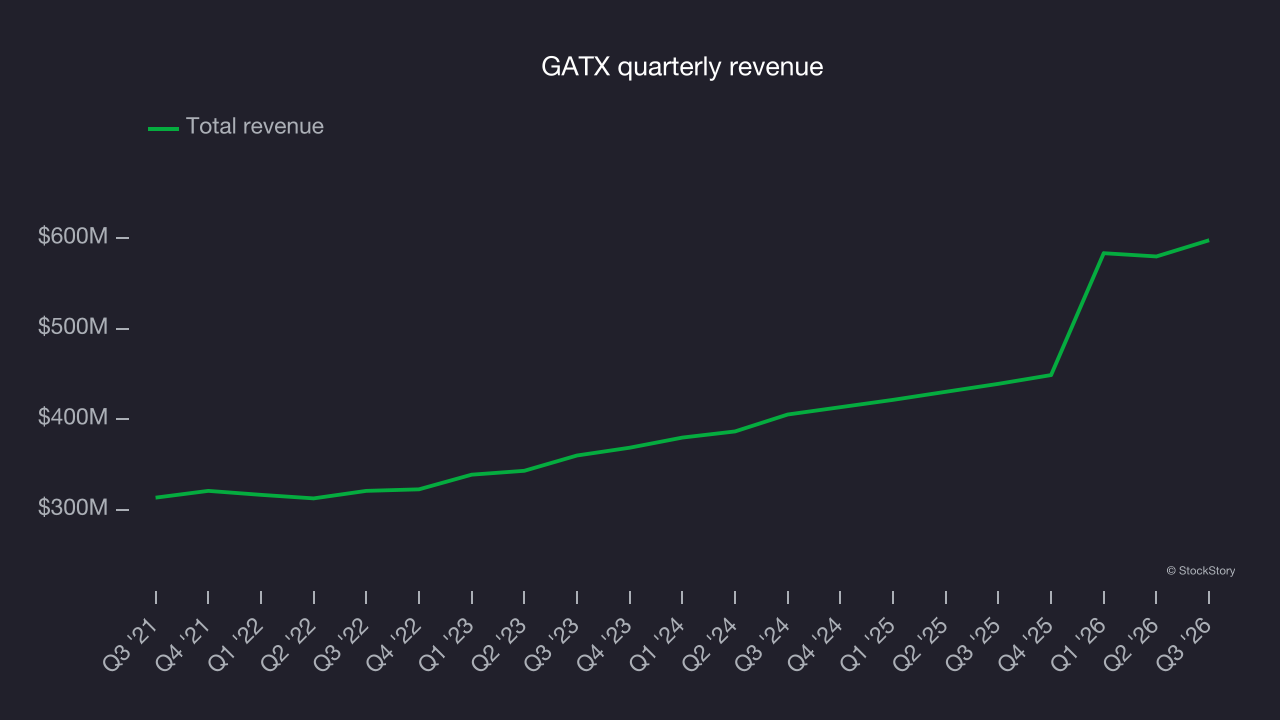
Long-term growth matters most, but within industrials, a half-decade historical view may miss cycles, industry trends or a company capitalizing on catalysts such as a new contract win or a successful product line. GATX’s annualized revenue growth of 19.8% over the last two years is above its five-year trend, suggesting its demand was strong and recently accelerated. 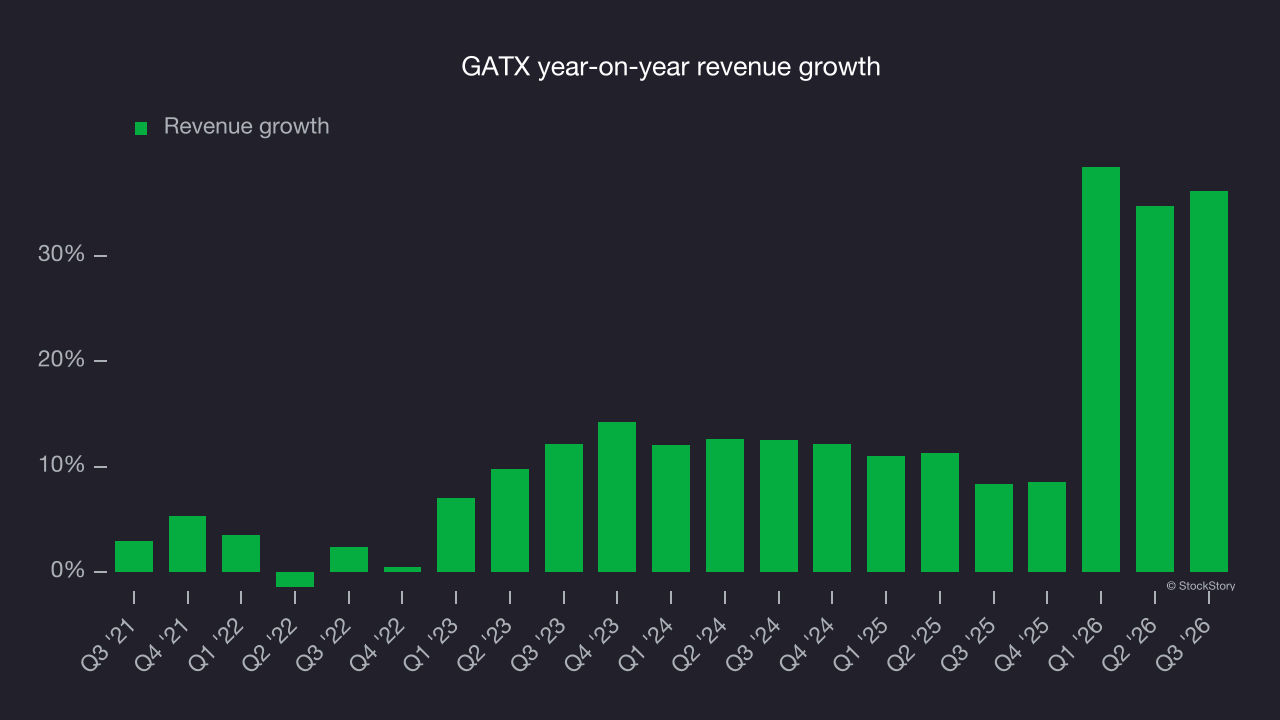
The company’s number of active railcars, which reached 188,358 in the latest quarter, provides insight into its revenue dynamics. Over the last two years, GATX’s active railcars averaged 32.4% year-on-year growth. This outpaced revenue growth during the same period, indicating that the company’s monetization has fallen. 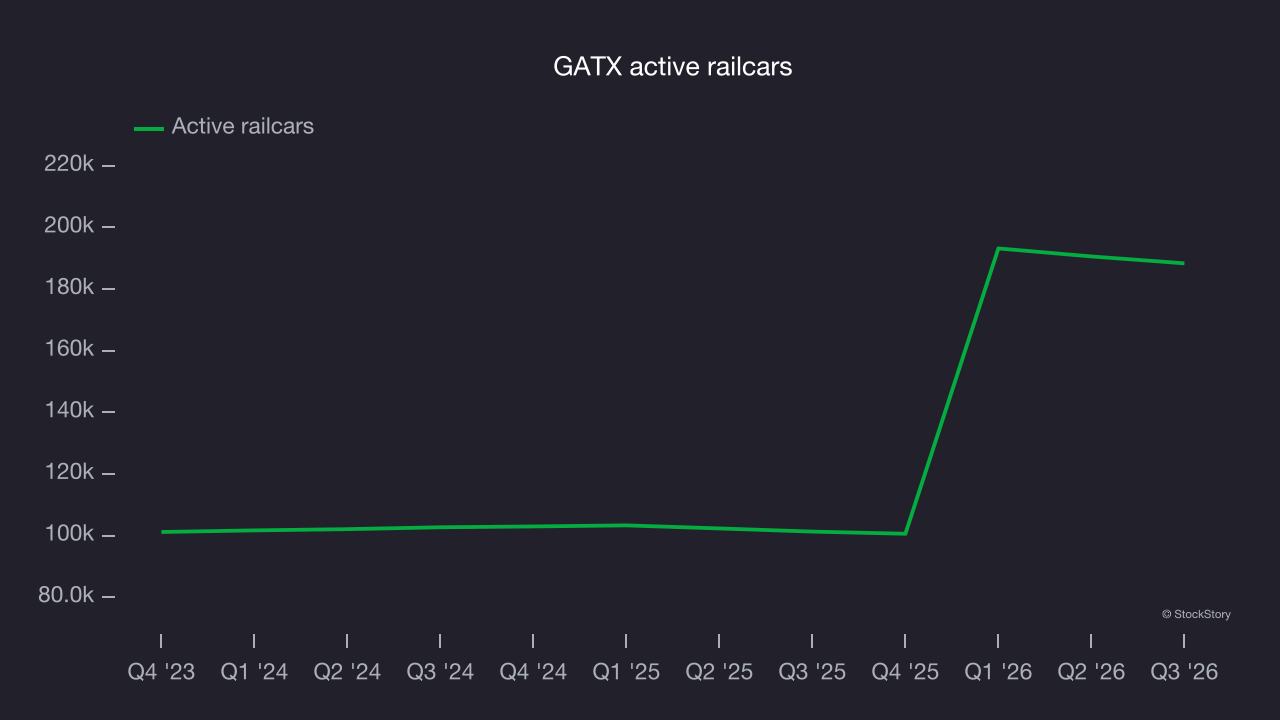
This quarter, GATX reported strong year-on-year revenue growth of 36.1%, and its $598 million of revenue exceeded Wall Street’s consensus estimates by 0.9%.
Looking ahead, sell-side analysts expect revenue to grow 9% over the next 12 months, according to S&P, a deceleration versus the last two years. Still, this is a healthy growth projection and implies the market expects success for its products and services.
Operating margin
Operating margin is a key measure of profitability. Think of it as net income, the bottom line, excluding the impact of taxes and interest on debt, which are less connected to business fundamentals.
GATX has performed well over the last five years. It demonstrated strong profitability for an industrials business, with an average operating margin of 31.3%. This result is unsurprising given its favorable gross margin baseline.
Analyzing the trend in its profitability, GATX’s operating margin rose by 13.8 percentage points over the last five years, as its revenue growth provided operating leverage. Its margin expansion shows it’s one of the better vehicle parts distributors, as most peers saw their margins decline.
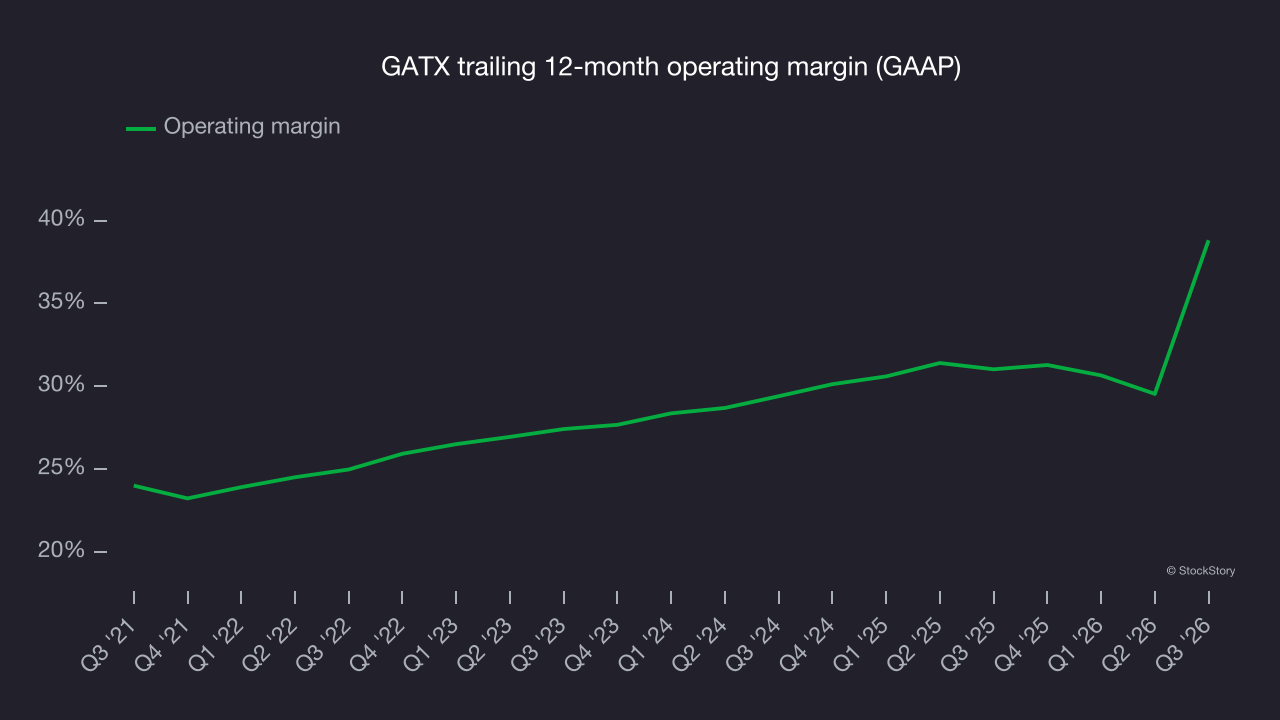
In Q3, GATX generated an operating margin of 64.2%, up 34.1 percentage points year on year. The increase was solid, and its operating margin rose more than its gross margin, indicating greater efficiency with expenses such as marketing, R&D and administrative overhead.
Earnings per share
We track the long-term change in earnings per share (EPS) for the same reason as long-term revenue growth. Compared to revenue, however, EPS highlights whether a company’s growth is profitable.
GATX’s EPS grew at a 31.1% compounded annual growth rate over the last five years, higher than its 12.2% annualized revenue growth. This indicates the company became more profitable on a per-share basis as it expanded.
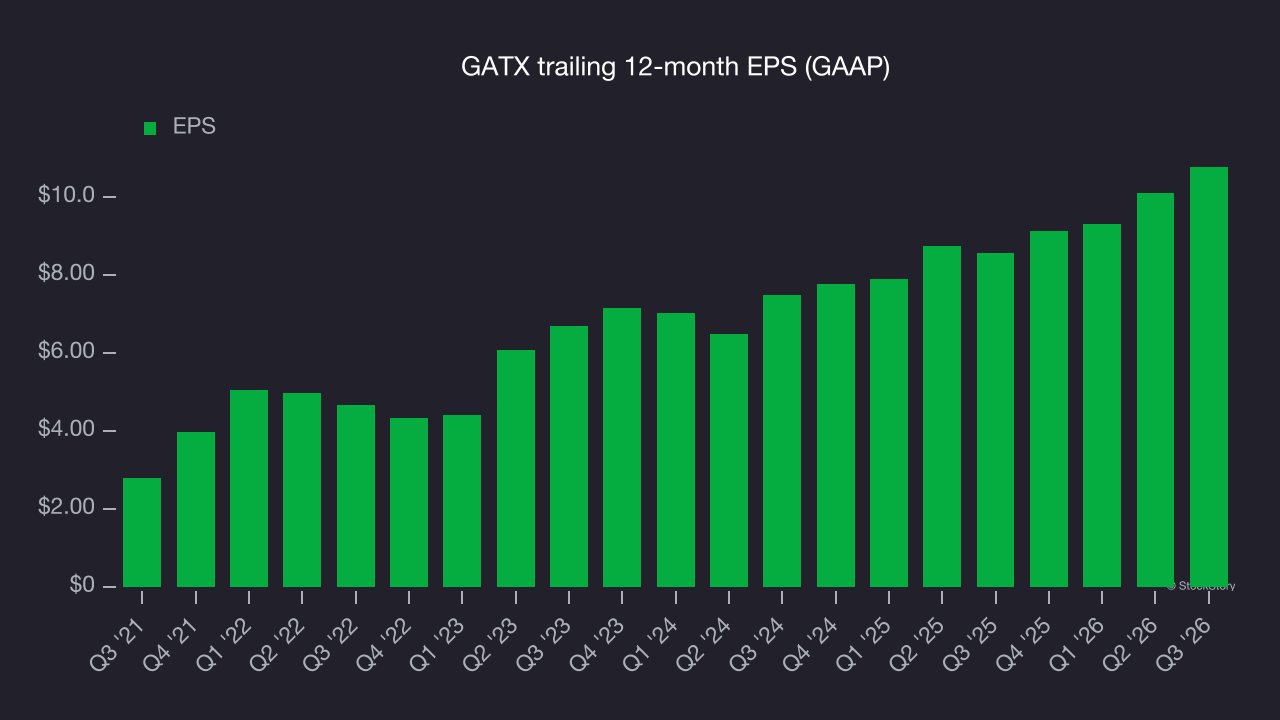
A closer look at GATX’s earnings helps explain the drivers of its performance. As mentioned earlier, GATX’s operating margin expanded by 13.8 percentage points over the last five years. In addition, its share count shrank by 1.7%. These are positive signs for shareholders because improving profitability and share buybacks boost EPS growth relative to revenue growth. 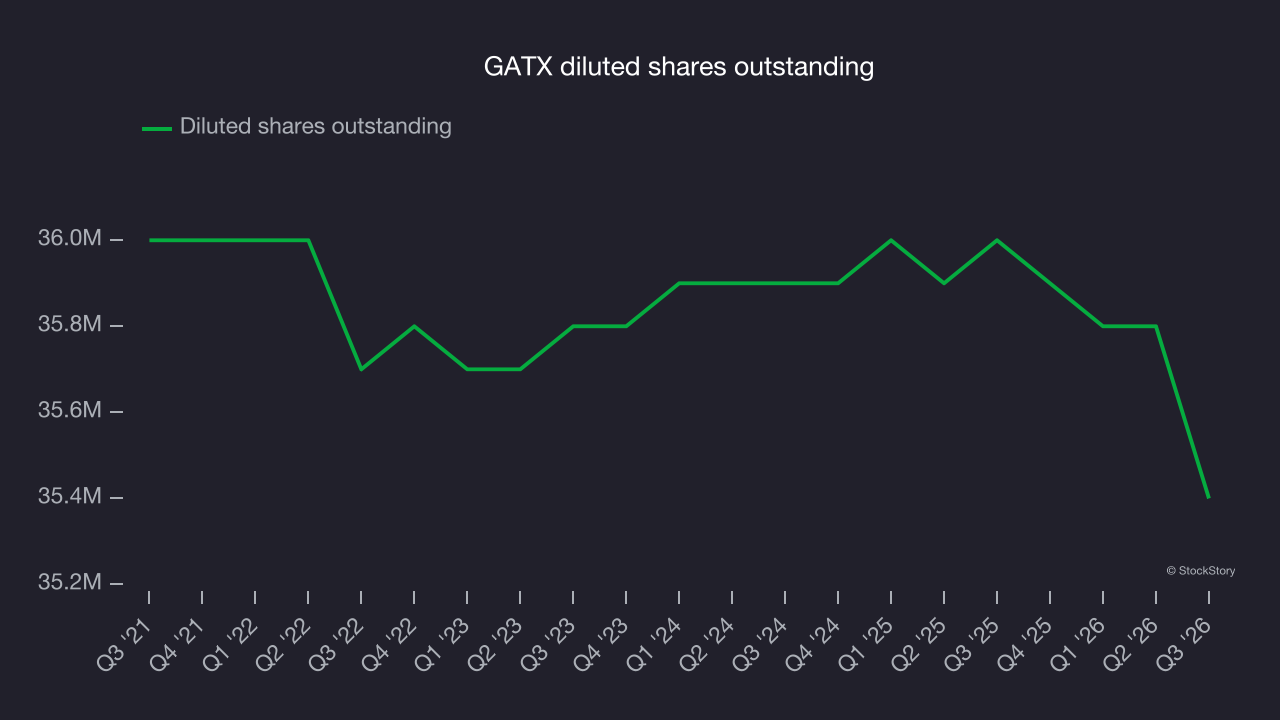
As with revenue, we analyze EPS over a more recent period because it can provide insight into an emerging theme or development for the business.
GATX’s two-year annual EPS growth of 20% was lower than its five-year trend but still represented a good pace of growth.
In Q3, GATX reported EPS of $2.92, up from $2.25 in the same quarter last year. EPS comfortably topped analysts’ consensus estimates, a positive result for shareholders. Over the next 12 months, Wall Street expects GATX’s full-year EPS to stay about the same, moving from $10.77 to $10.68, according to S&P.
Key takeaways from GATX’s Q3 results
GATX delivered a quarter with some key positives: EPS beat analysts’ consensus estimates and revenue narrowly topped Wall Street’s consensus. However, full-year EPS guidance fell slightly short of expectations. Shares surged 6.6% to $179.93 immediately after the results.
GATX had a solid quarter, but deciding whether the stock is a buy requires a broader view. It’s important to consider its valuation, business quality and latest quarterly results. For more on GATX, read our full research report here (it’s free).