Business advisory firm FTI Consulting (NYSE: FCN) met Wall Street’s revenue expectations in Q3 2026, with revenue up 5.9% year on year to $1.01 billion. The company’s full-year revenue guidance of $4.02 billion at the midpoint came in 0.5% above analysts’ consensus estimates. Its non-GAAP profit of $3.84 per share was 40% above analysts’ consensus estimates.
For more on FTI Consulting, read the full research report, available free.
FTI Consulting (FCN) Q3 2026 highlights:
- Revenue $1.01 billion vs S&P analysts’ consensus estimates of $1.01 billion (5.9% year-on-year growth, in line)
- Adjusted EPS $3.84 vs S&P analysts’ consensus estimates of $2.74 (40% beat)
- Adjusted EBITDA $153.7 million vs analysts’ consensus estimates of $123.3 million (15.2% margin, 24.6% beat)
- Revenue guidance The company reconfirmed its revenue guidance for the full year of $4.02 billion at the midpoint
- Adjusted EPS guidance Management raised its full-year adjusted EPS guidance to $9.75 at the midpoint, a 3.7% increase
- Operating margin 8.9%, down from 12.3% in the same quarter last year
- Free cash flow margin 0%, down from 19.6% in the same quarter last year
- Market capitalization $4.29 billion
Steven H. Gunby, CEO and Chairman of FTI Consulting, commented, “Our record results this quarter reflect the strength and breadth of our global platform. Though our results included certain favorable non-recurring items, such as record success fees and a lower effective tax rate, at their core, they were driven by the fact that in a world facing major change and disruption, our clients are increasingly turning to us for the depth and breadth of our capabilities.”
Revenue growth
Reviewing a company’s long-term revenue performance reveals insights into its quality. Any business can post a good quarter or two, but many enduring ones grow for years.
With $3.98 billion in revenue over the past 12 months, FTI Consulting is one of the larger companies in the business services industry and benefits from a well-known brand that influences purchasing decisions.
FTI Consulting grew its revenue at a solid 7.9% compounded annual growth rate over the last five years. This points to high demand.
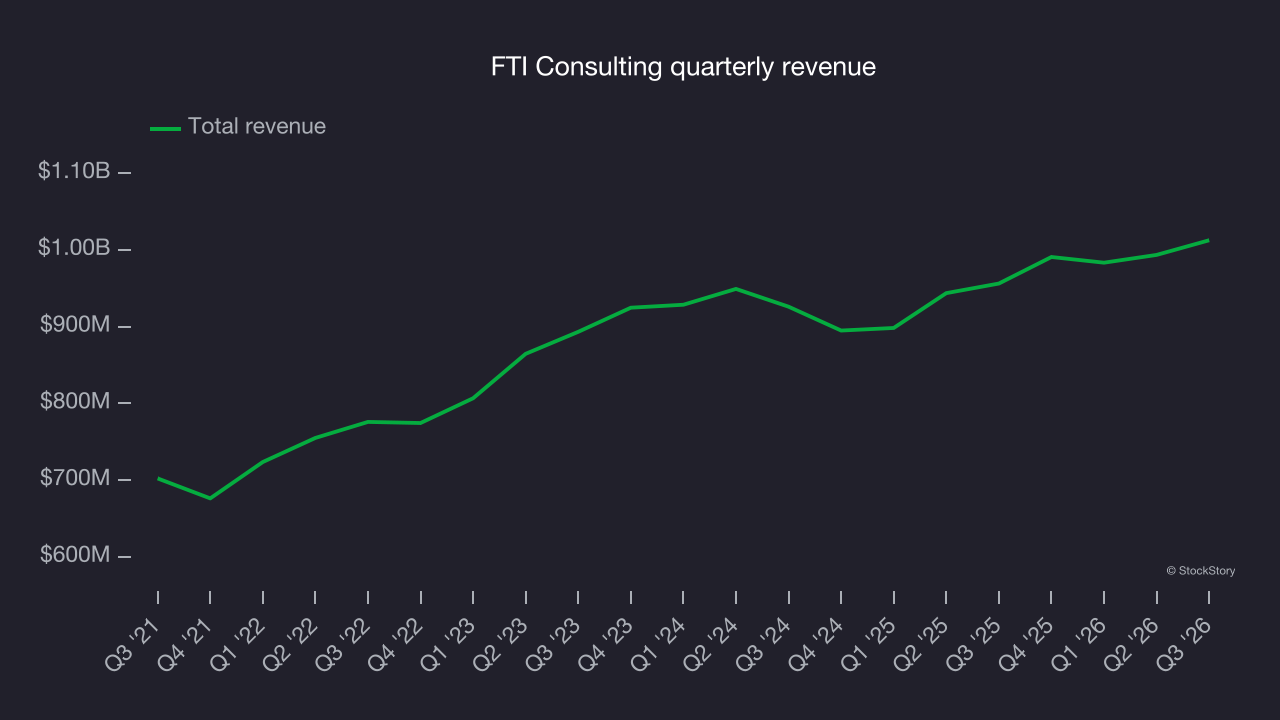
Long-term growth is the most important, but within business services, a half-decade historical view may miss new innovations or demand cycles. FTI Consulting’s recent performance shows its demand has slowed as its annualized revenue growth of 3.3% over the last two years was below its five-year trend. Decelerating revenue growth in the sector warrants caution, as it could signal changing consumer tastes aided by low switching costs. 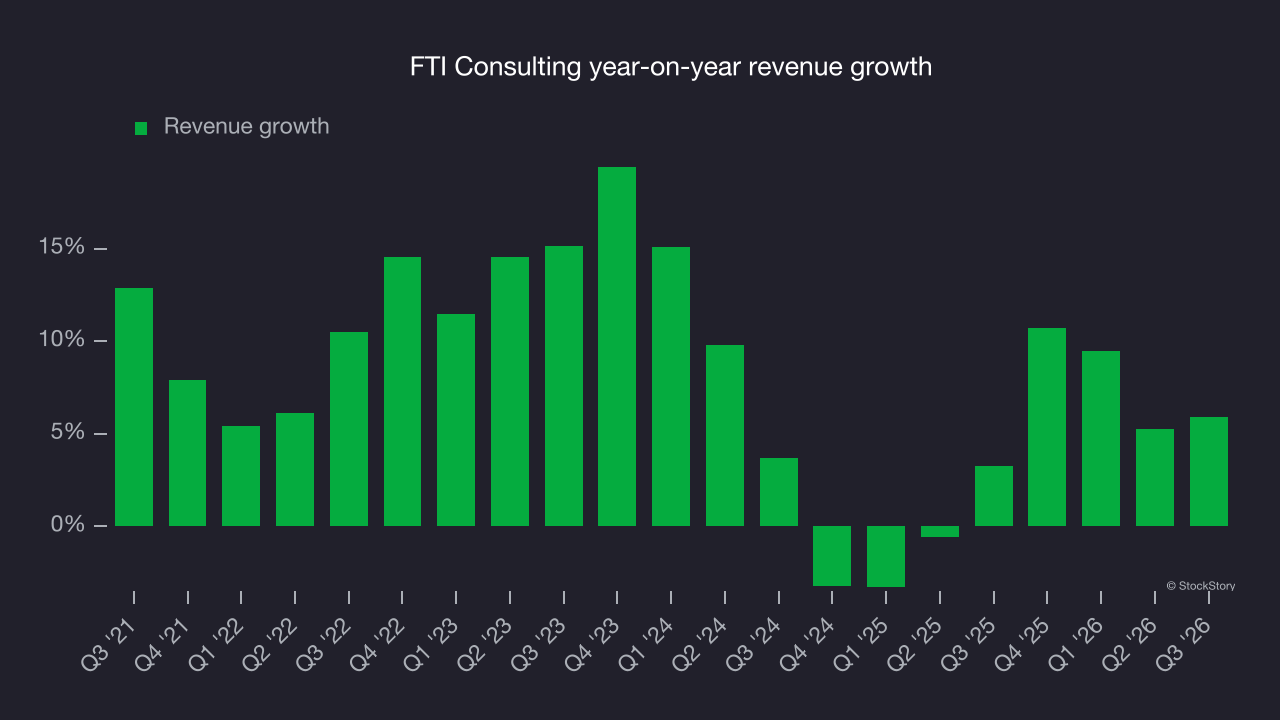
This quarter, FTI Consulting grew its revenue by 5.9% year on year, and its $1.01 billion of revenue was in line with Wall Street’s consensus estimates.
Looking ahead, sell-side analysts expect revenue to grow 5.8% over the next 12 months, according to S&P, an improvement versus the last two years. This projection is above the sector average and indicates its newer products and services will spur better top-line performance.
Adjusted operating margin
FTI Consulting’s adjusted operating margin has stayed largely unchanged over the last 12 months, averaging 9.9% over the last five years. This level of profitability was mediocre for a business services company and stemmed from its suboptimal cost structure.
Looking at the trend in its profitability, FTI Consulting’s adjusted operating margin might have fluctuated slightly but has generally stayed the same over the last five years. This raises questions about the company’s expense base because its revenue growth should have given it leverage on its fixed costs, resulting in better economies of scale and profitability.
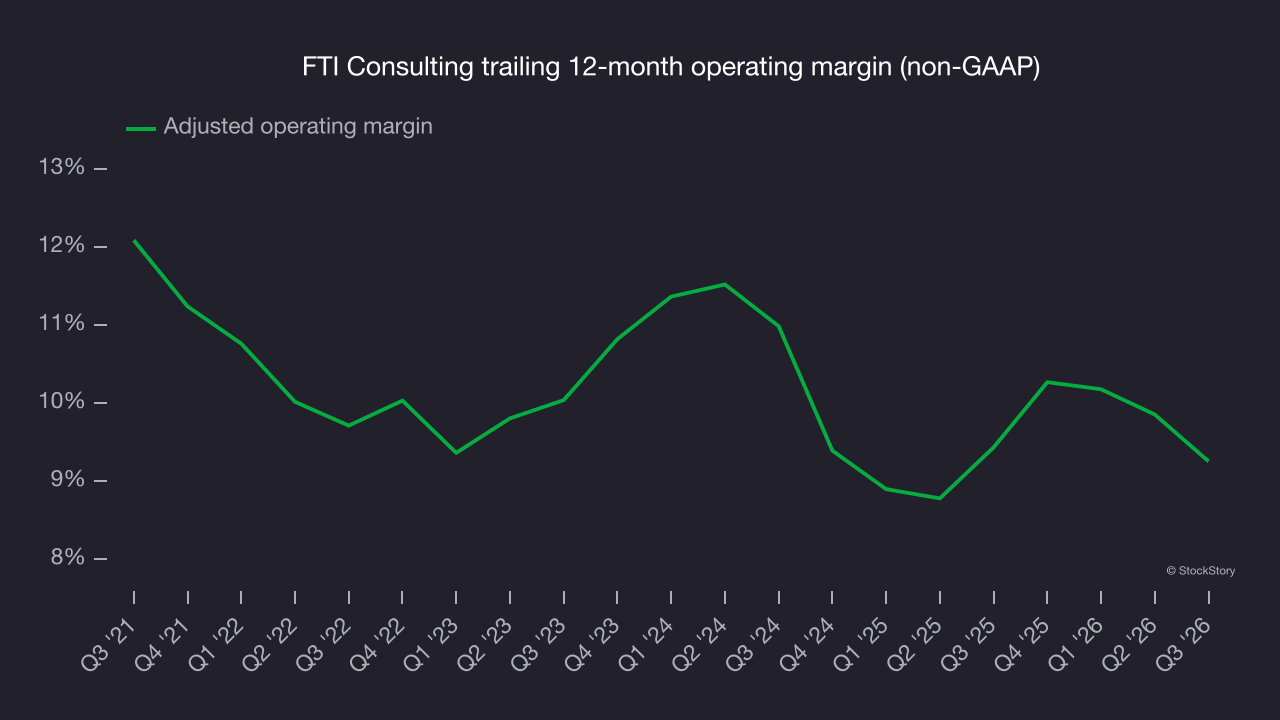
In Q3, FTI Consulting reported an adjusted operating margin of 9.8%, down 2.5 percentage points year on year. This contraction shows it was less efficient because its expenses grew faster than its revenue.
Earnings per share
Revenue trends explain a company’s historical growth, but the long-term change in earnings per share (EPS) points to the profitability of that growth. For example, a company could inflate its revenue through excessive spending on advertising and promotions.
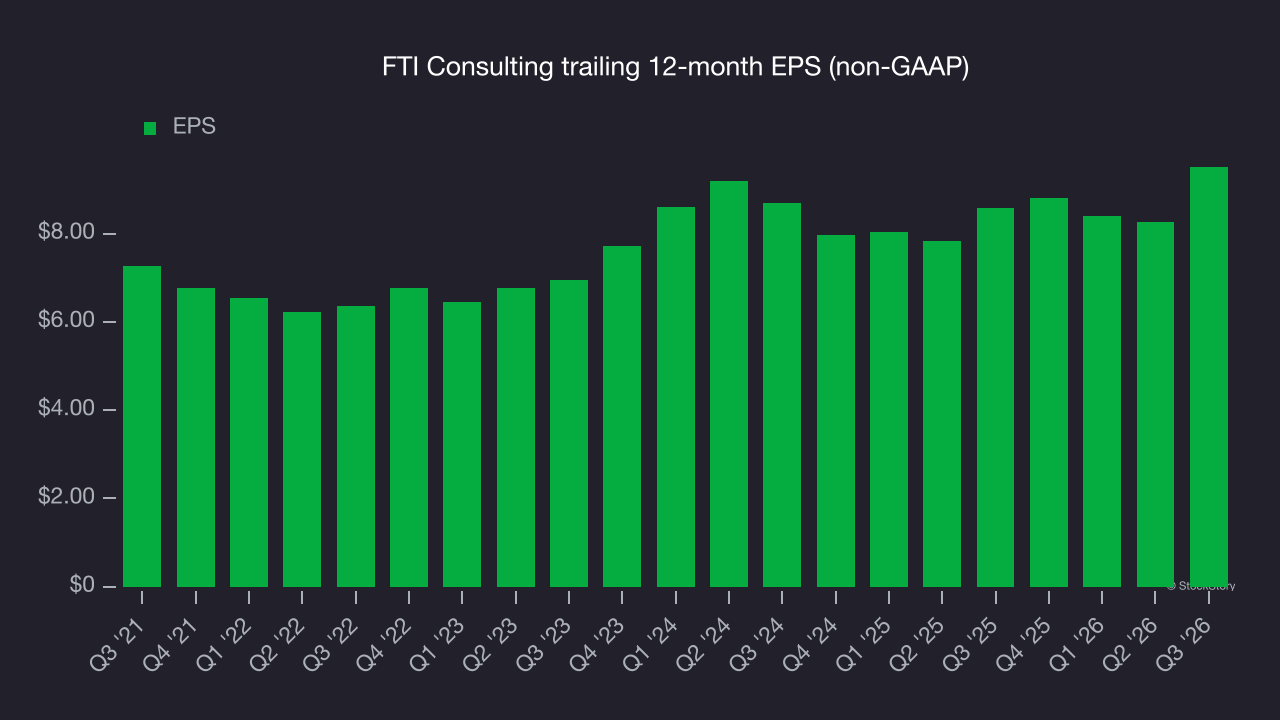
FTI Consulting’s EPS grew at an unimpressive 5.5% compounded annual growth rate over the last five years, lower than its 7.9% annualized revenue growth. However, its adjusted operating margin didn’t change during this time, telling us that non-fundamental factors such as interest and taxes affected its ultimate earnings.
As with revenue, examining EPS over a shorter period can reveal changes in the business.
For FTI Consulting, its two-year annual EPS growth of 4.6% is similar to its five-year trend, implying stable earnings.
In Q3, FTI Consulting reported adjusted EPS of $3.84, up from $2.60 in the same quarter last year. This result comfortably topped analysts’ consensus estimates, a positive for shareholders. Over the next 12 months, Wall Street expects FTI Consulting’s full-year EPS to grow 12.4% from $9.51 to $10.69, according to S&P.
Key takeaways from FTI Consulting’s Q3 results
FTI Consulting delivered a solid quarter, beating analysts’ consensus EPS estimates and setting full-year EPS guidance well above Wall Street’s consensus. Shares rose 3.2% to $164.16 immediately after the release.
FTI Consulting had a solid quarterly earnings result, but is the stock a good investment? The latest quarter is only one part of assessing longer-term business quality. Quality, when combined with valuation, can help determine if the stock is a buy. Read the full research report here (it’s free).