Safety and security company Federal Signal (NYSE: FSS) fell short of the market’s revenue expectations in Q3 2026, but revenue rose 18.1% year on year to $655.5 million. On the other hand, the company’s outlook for the full year was close to analysts’ consensus estimates with revenue guided to $2.63 billion at the midpoint. Its non-GAAP profit of $1.34 per share was 1.9% above analysts’ consensus estimates.
For more on Federal Signal, read our free full research report.
Federal Signal (FSS) Q3 2026 highlights:
- Revenue $655.5 million vs S&P analysts’ consensus estimates of $662.6 million (18.1% year-on-year growth, 1.1% miss)
- Adjusted EPS $1.34 vs S&P analysts’ consensus estimates of $1.32 (1.9% beat)
- Adjusted EBITDA $140.4 million vs analysts’ consensus estimates of $138.6 million (21.4% margin, 1.3% beat)
- Revenue guidance The company reconfirmed its revenue guidance for the full year of $2.63 billion at the midpoint
- Adjusted EPS guidance Management slightly raised its full-year adjusted EPS guidance to $5.26 at the midpoint
- Operating margin 17%, in line with the same quarter last year
- Free cash flow margin 12.2%, up from 9.7% in the same quarter last year
- Backlog $966.6 million at quarter end, down 2.6% year on year
- Market capitalization $6.93 billion
"Our businesses were able to deliver 18% year-over-year net sales growth, 19% operating income improvement, a 33% increase in orders, and a 50-basis point increase in adjusted EBITDA margin during a record-setting third quarter," commented Jennifer L. Sherman, President and Chief Executive Officer. "Within our Environmental Solutions Group, orders were up 43% year-over-year, including organic growth in the high teens, while net sales and adjusted EBITDA each increased by more than 20%, with contributions from recent acquisitions, higher sales of our aftermarket offerings, and proactive management of price/cost dynamics representing meaningful year-over-year growth drivers. Our Safety and Security Systems Group also delivered strong results, with 2% top-line growth and an adjusted EBITDA margin of approximately 26%."
Revenue growth
Examining a company’s long-term performance can provide clues about its quality. Any business can put up a good quarter or two, but many enduring ones grow for years. Federal Signal’s revenue grew at a strong 16.1% compounded annual growth rate over the last five years. Its growth surpassed the average industrials company and shows its offerings resonate with customers.
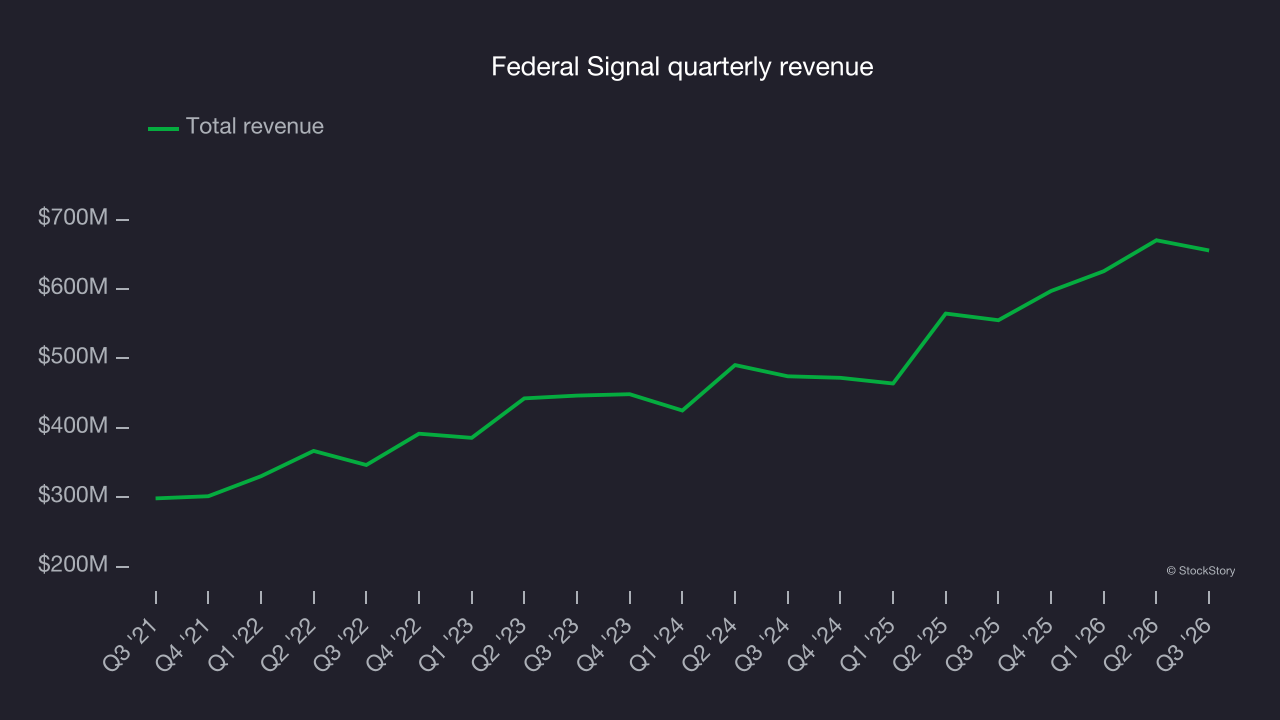
Long-term growth is the most important, but within industrials, a half-decade historical view may miss new industry trends or demand cycles. Federal Signal’s annualized revenue growth of 17.8% over the last two years is above its five-year trend, suggesting its demand was strong and recently accelerated. 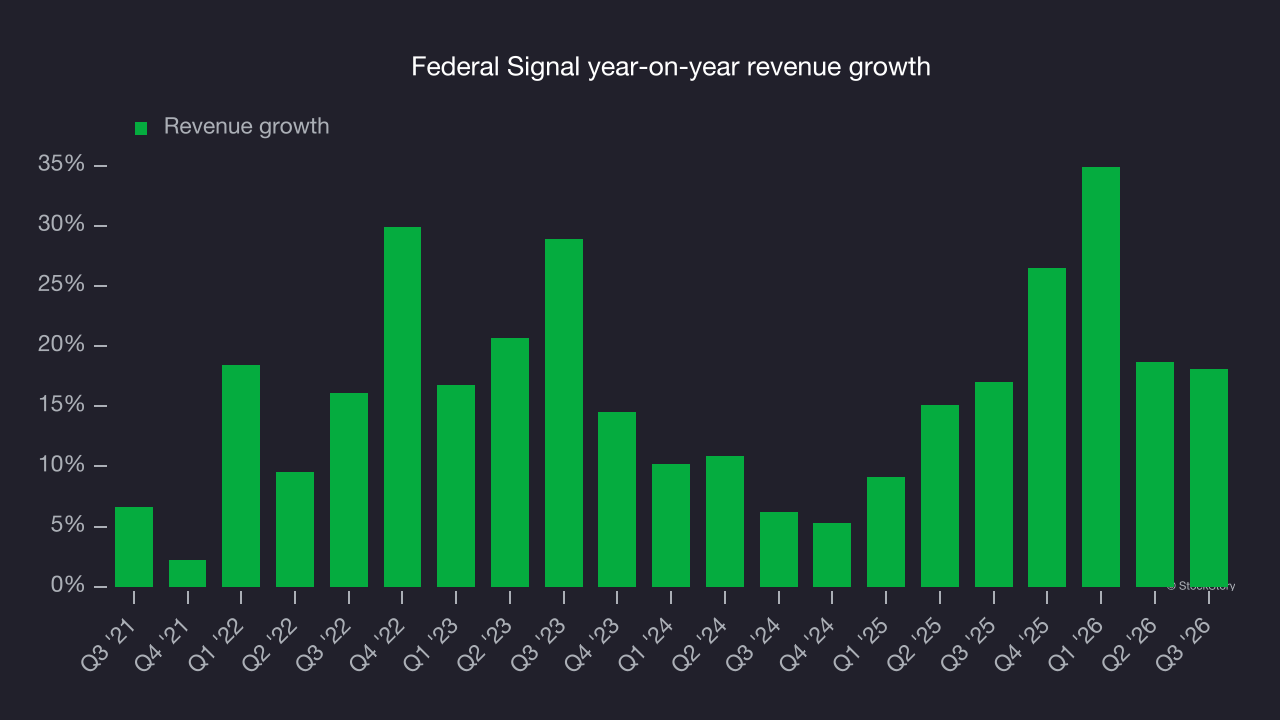
The company’s backlog, or the value of its outstanding orders that have not yet been executed or delivered, provides further insight into its revenue dynamics. Federal Signal’s backlog reached $966.6 million in the latest quarter and averaged 2.2% year-on-year declines over the last two years. Backlog growth trailed revenue growth, indicating that the company fulfilled orders at a faster rate than it added new orders to the backlog. This implies Federal Signal was operating efficiently but raises questions about the health of its sales pipeline. 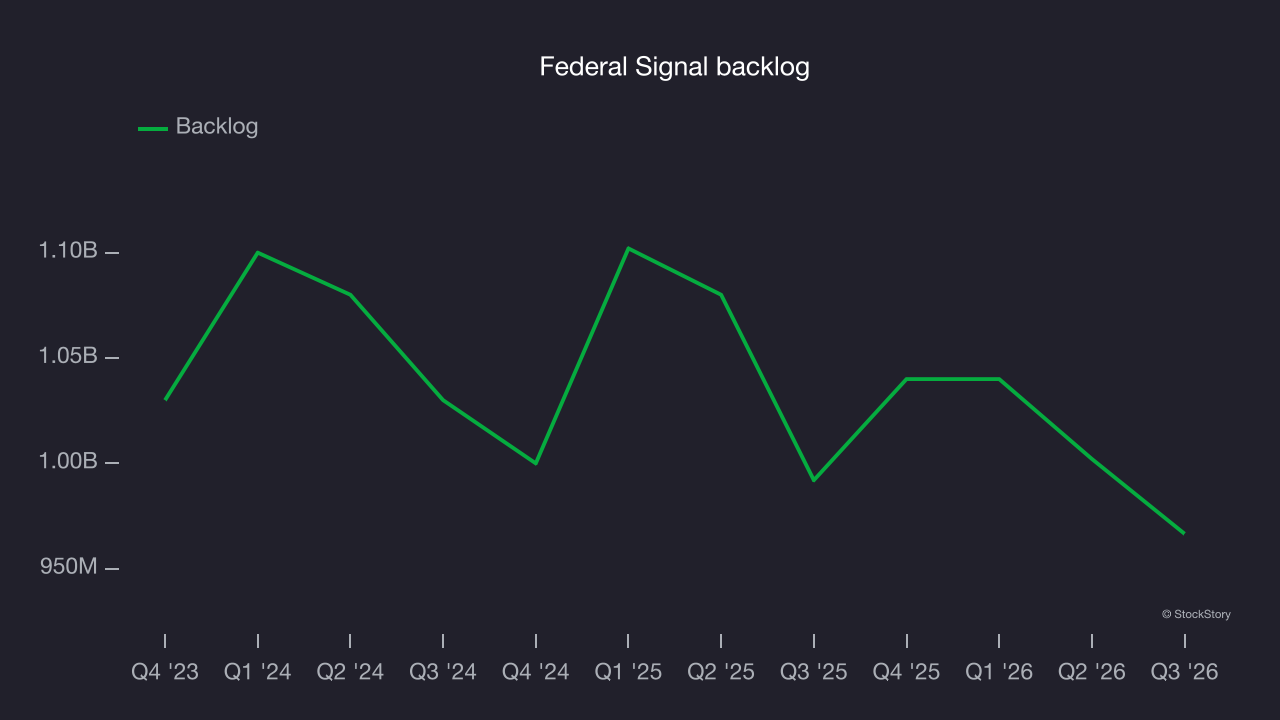
This quarter, Federal Signal’s revenue grew by 18.1% year on year to $655.5 million but fell short of Wall Street’s consensus estimates.
Looking ahead, sell-side analysts expect revenue to grow 8.5% over the next 12 months, according to S&P, a deceleration versus the last two years. Despite the slowdown, this projection is above average for the sector and suggests the market is forecasting some success for its newer products and services.
Operating margin
Federal Signal has been an efficient company over the last five years. It was one of the more profitable businesses in the industrials sector, with an average operating margin of 14.5%. This result was particularly impressive given its low gross margin, which is mostly a factor of what it sells and requires substantial shifts to change meaningfully. Companies have more control over their operating margins, and high operating margins alongside low gross margins are a sign of well-managed operations.
Looking at the trend in its profitability, Federal Signal’s operating margin rose by 5.5 percentage points over the last five years, as its revenue growth provided operating leverage.
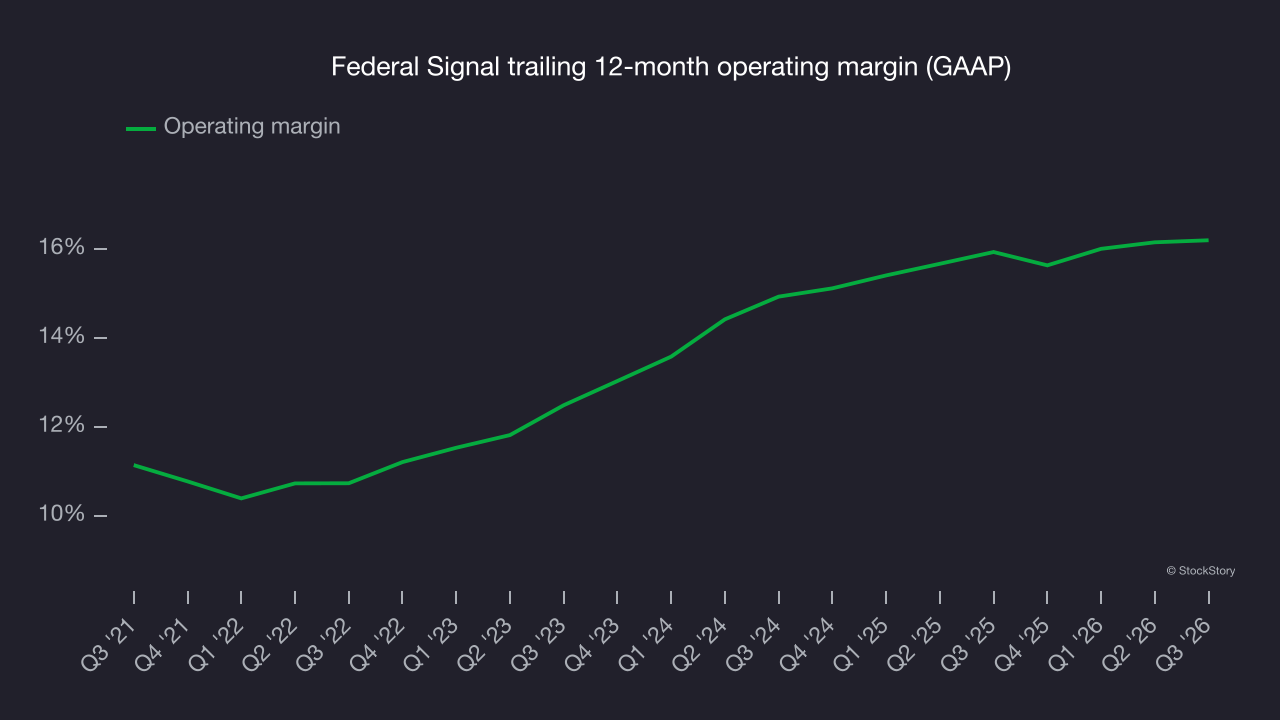
This quarter, Federal Signal generated an operating margin of 17%, in line with the same quarter last year. This indicates the company’s cost structure has recently been stable.
Earnings per share
Revenue trends explain a company’s historical growth, but the long-term change in earnings per share (EPS) points to the profitability of that growth. For example, a company could inflate its revenue through excessive spending on advertising and promotions.
Federal Signal’s EPS grew at a 23.2% compounded annual growth rate over the last five years, higher than its 16.1% annualized revenue growth. This indicates the company became more profitable on a per-share basis as it expanded.
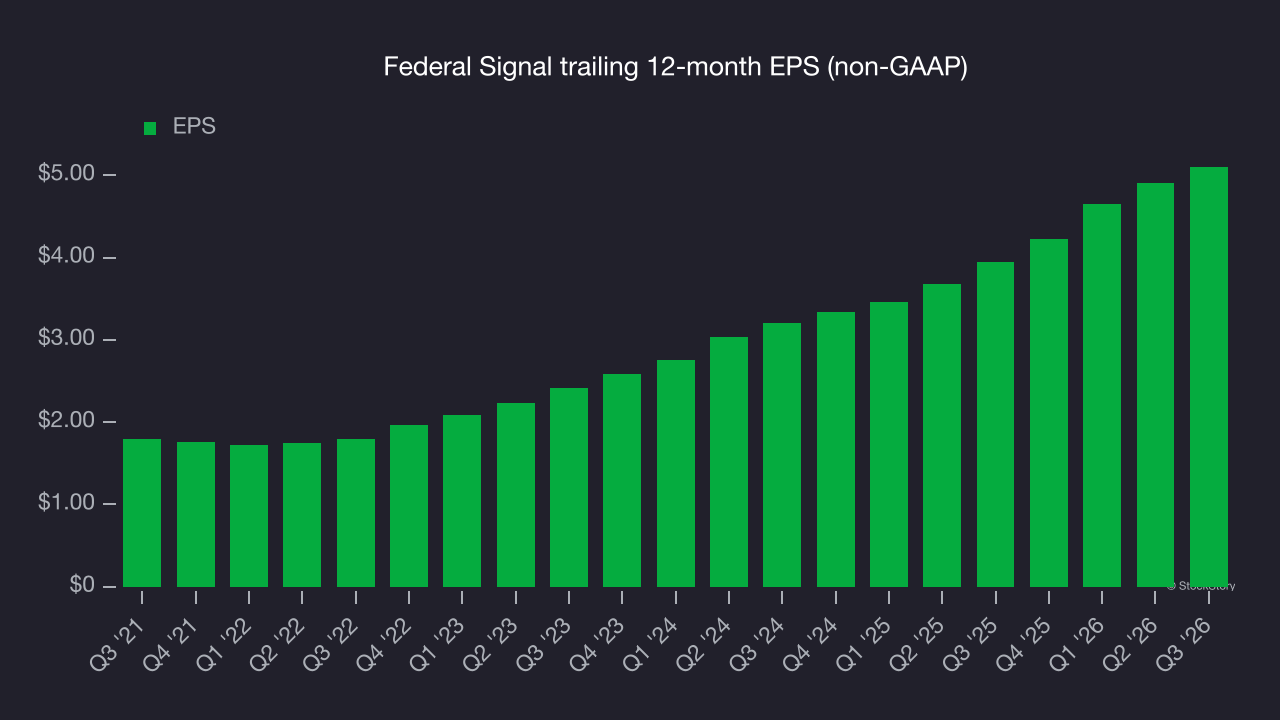
A closer look at Federal Signal’s earnings quality helps explain the drivers of its performance. As noted earlier, Federal Signal’s operating margin was flat this quarter but expanded by 5.5 percentage points over the last five years. This was the most relevant factor (aside from the revenue impact) behind its higher earnings; interest expenses and taxes can also affect EPS but don’t tell us as much about a company’s fundamentals.
Like with revenue, we analyze EPS over a shorter period to see if we are missing a change in the business.
For Federal Signal, its two-year annual EPS growth of 26% was higher than its five-year trend. That acceleration is a positive sign, particularly given the already high base.
In Q3, Federal Signal reported adjusted EPS of $1.34, up from $1.14 in the same quarter last year. This result beat analysts’ consensus estimates by 1.9%. Over the next 12 months, Wall Street expects Federal Signal’s full-year EPS to grow 9.3% from $5.10 to $5.57, according to S&P.
Key takeaways from Federal Signal’s Q3 results
Federal Signal’s earnings outlook offered a bright spot, with full-year EPS guidance slightly above analysts’ consensus estimates and quarterly EBITDA narrowly beating Wall Street’s consensus. But revenue fell slightly short of estimates, and full-year revenue guidance was only in line with expectations. Taken together, the quarter could have been better. Shares fell 3.1% to $109.91 immediately after the report.
To assess whether Federal Signal is a buy at the current price, consider valuation, business quality and the latest earnings. For more on Federal Signal, read our full research report here (it’s free).