Power generation products company Generac (NYSE: GNRC) missed Wall Street’s revenue expectations in Q3 2026, but revenue rose 16.2% year on year to $1.29 billion. Its non-GAAP profit of $2.54 per share was 4.6% above analysts’ consensus estimates.
For more on Generac, read our free full research report.
Generac (GNRC) Q3 2026 highlights:
- Revenue $1.29 billion vs S&P analysts’ consensus estimates of $1.33 billion (16.2% year-on-year growth, 2.4% miss)
- Adjusted EPS $2.54 vs S&P analysts’ consensus estimates of $2.43 (4.6% beat)
- Adjusted EBITDA $256.5 million vs analysts’ consensus estimates of $254.2 million (19.8% margin, 0.9% beat)
- Operating margin 12.4%, up from 9.3% in the same quarter last year
- Free cash flow margin 10.2%, up from 8.7% in the same quarter last year
- Market capitalization $11.44 billion
“I’m incredibly proud of our team’s efforts as our third quarter results reflect an all-time record for net sales as we continued to see tremendous momentum in our C&I segment during the third quarter with significant additional commitments from data center customers providing further confidence in our position as a leading provider to this large and rapidly growing market,” said Aaron Jagdfeld, President and Chief Executive Officer. “Following the recently announced agreement with Amazon, along with other wins from both new and existing customers, our backlog for products to be sold to the data center market has now grown to approximately $4.5 billion, and we continue to execute on our previously announced capacity expansion plans that will allow us to capture this generational growth opportunity.”
Revenue growth
A company’s long-term revenue performance is one signal of its overall quality. Any business can report a good quarter or two, but many enduring ones grow for years. Generac’s revenue grew at a mediocre 6.1% annualized rate over the last five years, falling short of the industrials sector benchmark.
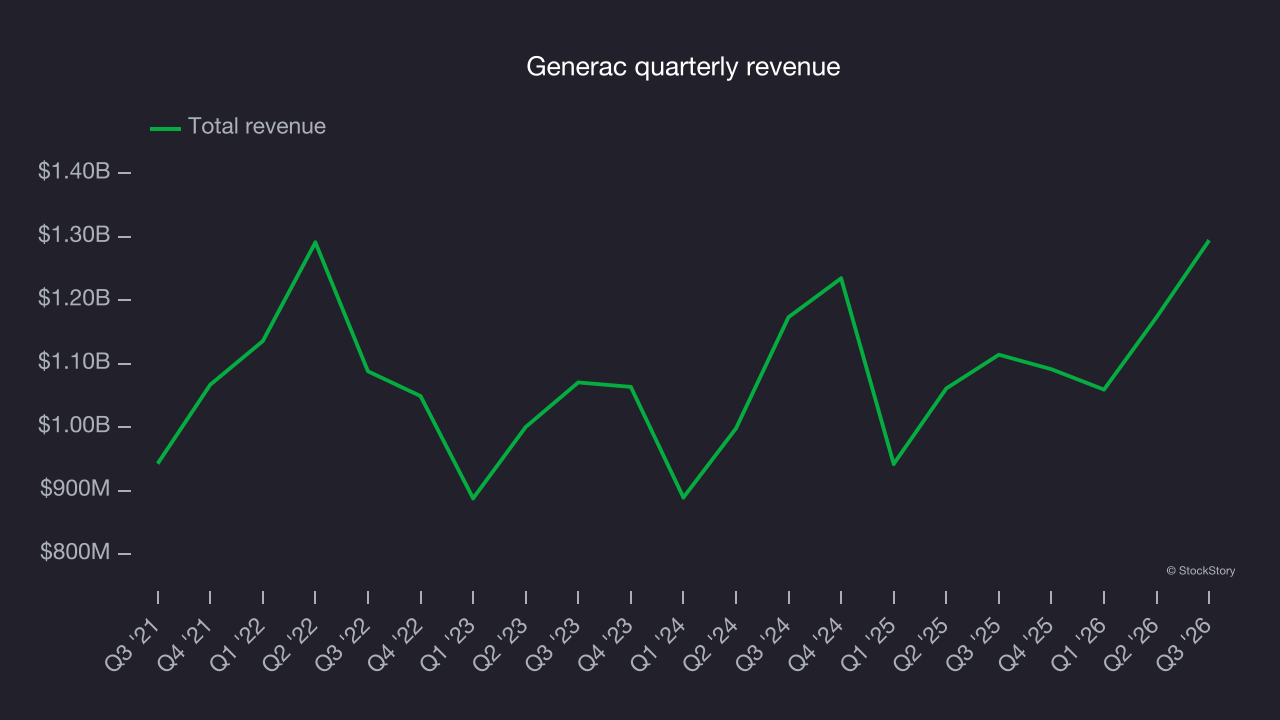
Long-term growth matters most, but within industrials, a half-decade historical view may miss cycles, industry trends or a company capitalizing on catalysts such as a new contract win or a successful product line. Generac’s annualized revenue growth of 5.8% over the last two years aligns with its five-year trend, suggesting its demand was consistently weak. 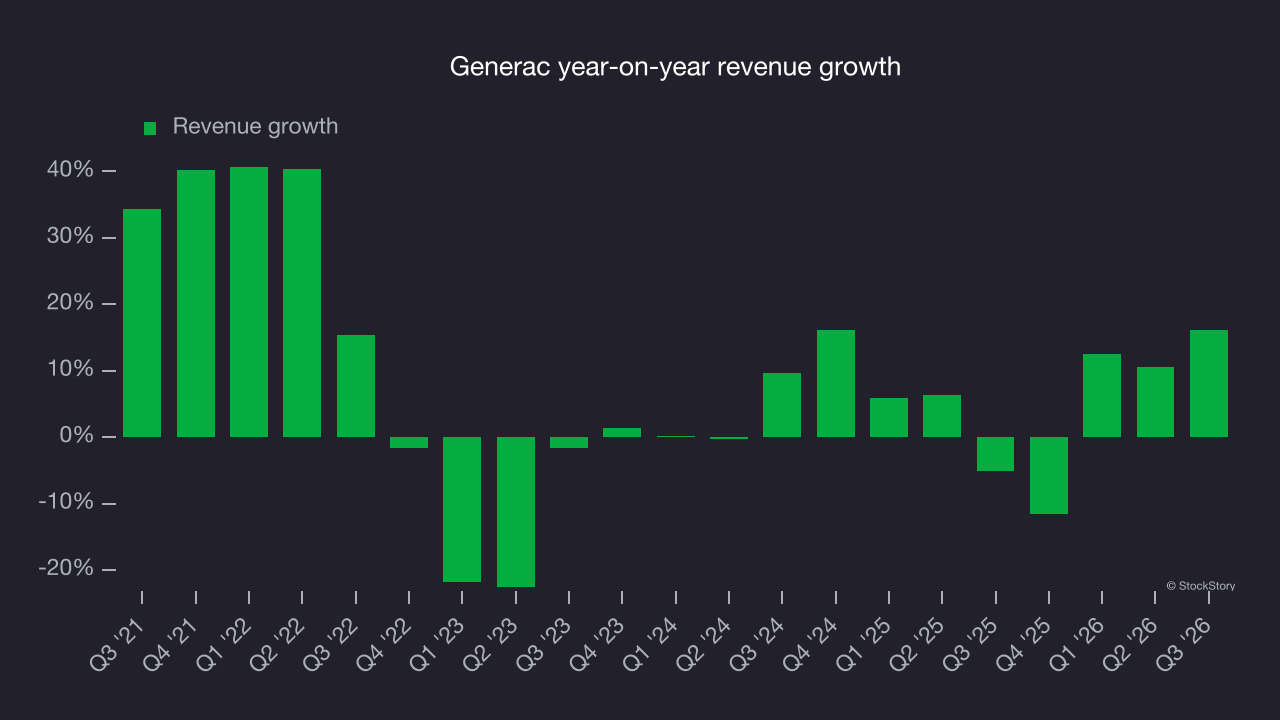
Generac also breaks out the revenue for its most important segments, Residential and Commercial and Industrial, which are 57.5% and 42.7% of revenue. Over the last two years, Generac’s Residential revenue (sales to consumers) averaged 3.5% year-on-year growth while its Commercial and Industrial revenue (sales to contractors and professionals) averaged 25.6% growth. 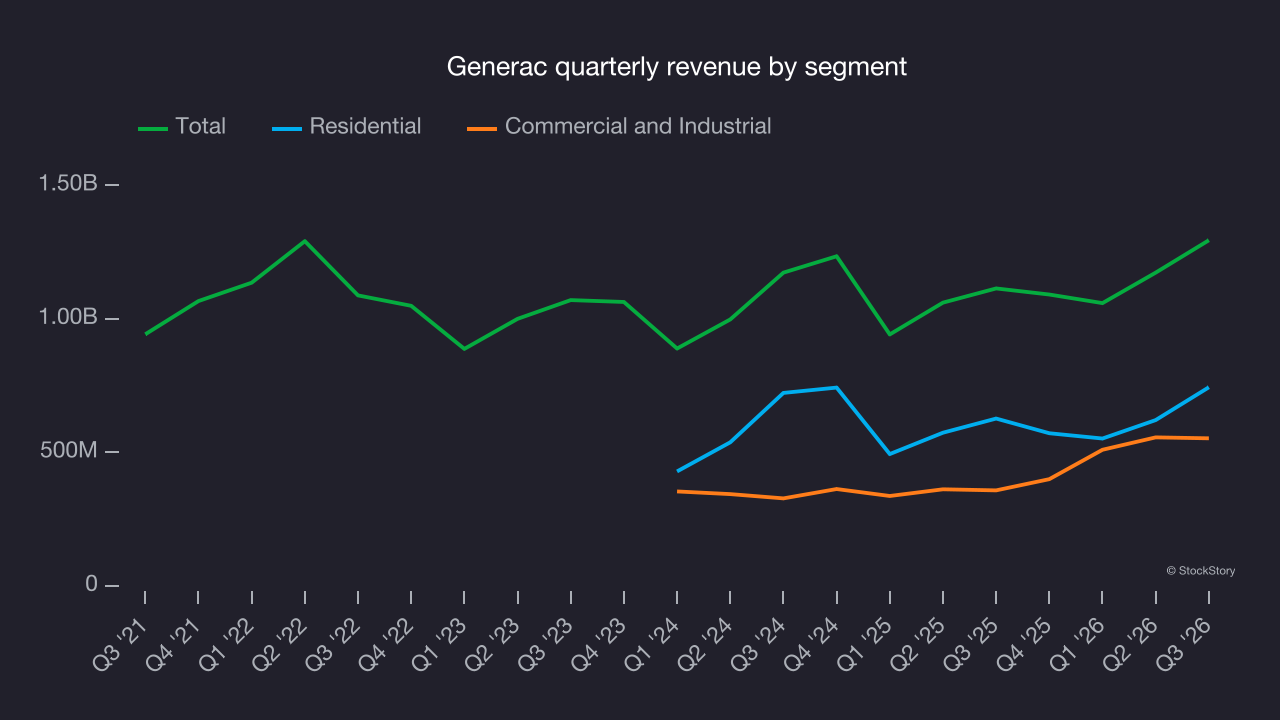
This quarter, Generac’s revenue grew by 16.2% year on year to $1.29 billion but fell short of Wall Street’s consensus estimates.
Looking ahead, sell-side analysts expect revenue to grow 30.7% over the next 12 months, according to S&P, an improvement versus the last two years. This strong projection implies its newer products and services will spur better revenue performance.
Operating margin
Generac has managed its cost base well over the last five years. It demonstrated solid profitability for an industrials business, producing an average operating margin of 11.3%. This result isn’t surprising as its high gross margin gives it a favorable starting point.
Looking at the trend in its profitability, Generac’s operating margin decreased by 3.5 percentage points over the last five years. This raises questions about the company’s expense base because its revenue growth should have given it leverage on its fixed costs, resulting in better economies of scale and profitability.
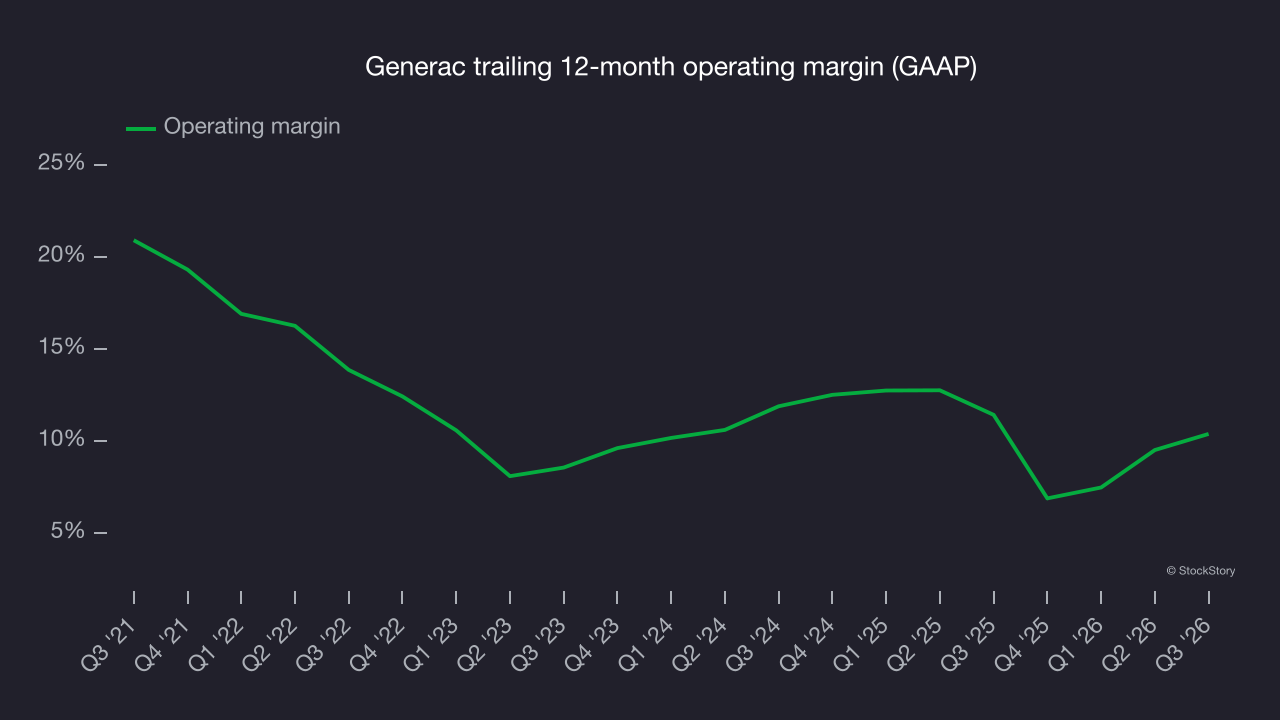
This quarter, Generac generated an operating margin of 12.4%, up 3.2 percentage points year on year. The increase was a positive sign. Operating margin rose more than gross margin, suggesting it was more efficient with expenses such as marketing, R&D and administrative overhead.
Earnings per share
Revenue trends explain a company’s historical growth, but the long-term change in earnings per share (EPS) points to the profitability of that growth. For example, a company could inflate its revenue through excessive spending on advertising and promotions.
Generac’s flat EPS over the last five years was below its 6.1% annualized revenue growth. This tells us the company became less profitable on a per-share basis as it expanded due to non-fundamental factors such as interest expenses and taxes.
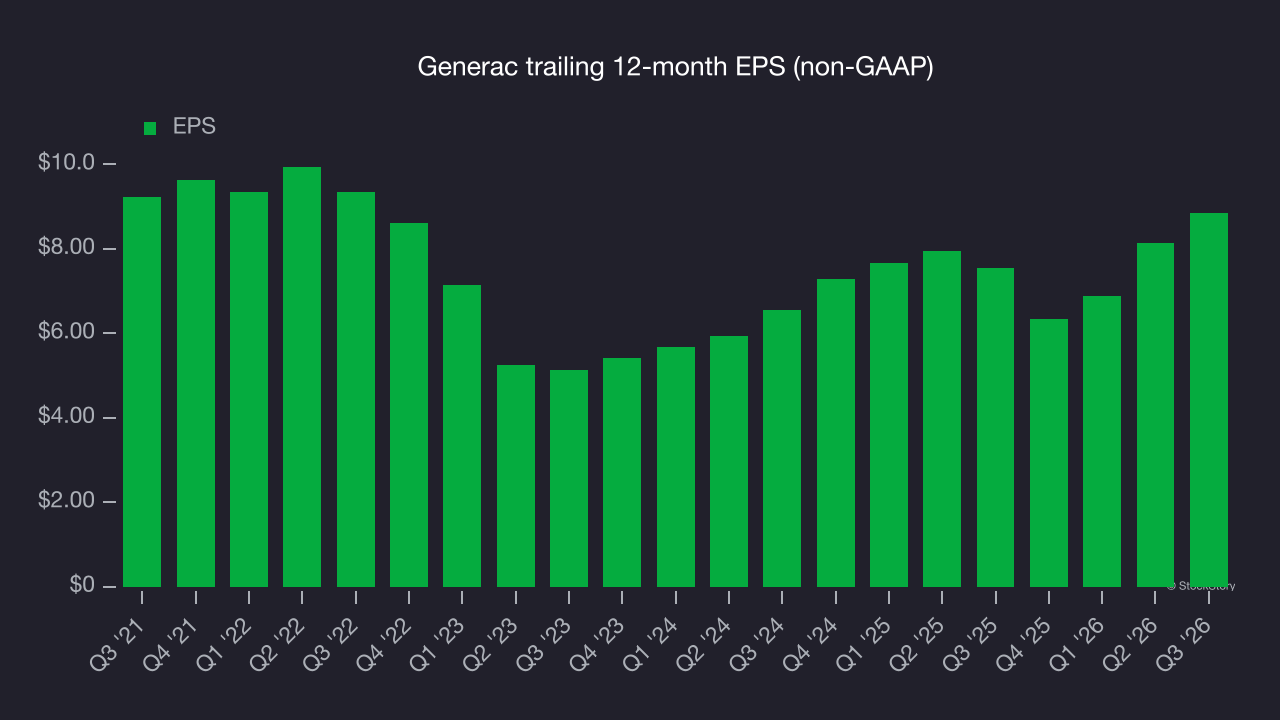
A closer look at Generac’s earnings helps explain its performance. As mentioned earlier, Generac’s operating margin expanded this quarter but declined by 3.5 percentage points over the last five years. This was the most relevant factor (aside from the revenue impact) behind its lower earnings; interest expenses and taxes can also affect EPS but don’t tell us as much about a company’s fundamentals.
As with revenue, analyzing EPS over a more recent period can provide insight into an emerging theme or development for the business.
For Generac, its two-year annual EPS growth of 16.3% was higher than its five-year trend. This acceleration made it one of the faster-growing industrials companies in recent history.
In Q3, Generac reported adjusted EPS of $2.54, up from $1.83 in the same quarter last year. This result beat analysts’ consensus estimates by 4.6%. Over the next 12 months, Wall Street expects Generac’s full-year EPS to grow 32.6% from $8.86 to $11.75, according to S&P.
Key takeaways from Generac’s Q3 results
Generac’s revenue miss left room for a better quarter, despite an EPS beat and EBITDA that narrowly topped Wall Street’s consensus estimates. Shares edged lower 1.5% to $190.75 immediately after the report.
Generac’s latest earnings report disappointed. One quarter doesn’t define a company’s quality, so the question is whether the stock offers value at the current price. The latest quarter matters, but not nearly as much as longer-term fundamentals and valuation in making that decision. For more on those factors, read the full research report here (it’s free).