Grocery retailer Albertsons (NYSE: ACI) met Wall Street’s revenue expectations in calendar Q3 2026 (fiscal Q2 2026), but sales were flat year on year at $18.89 billion. Its non-GAAP profit of $0.36 per share was 9.6% above analysts’ consensus estimates.
Is now the time to buy Albertsons? Find out by accessing our full research report, it’s free.
Albertsons (ACI) Q3 CY2026 Highlights:
- Revenue: $18.89 billion vs analyst estimates of $18.86 billion (flat year on year, in line)
- Adjusted EPS: $0.36 vs analyst estimates of $0.33 (9.6% beat)
- Adjusted EBITDA: $784 million vs analyst estimates of $769.3 million (4.1% margin, 1.9% beat)
- Operating Margin: 0.9%, in line with the same quarter last year
- Free Cash Flow Margin: 0.5%, similar to the same quarter last year
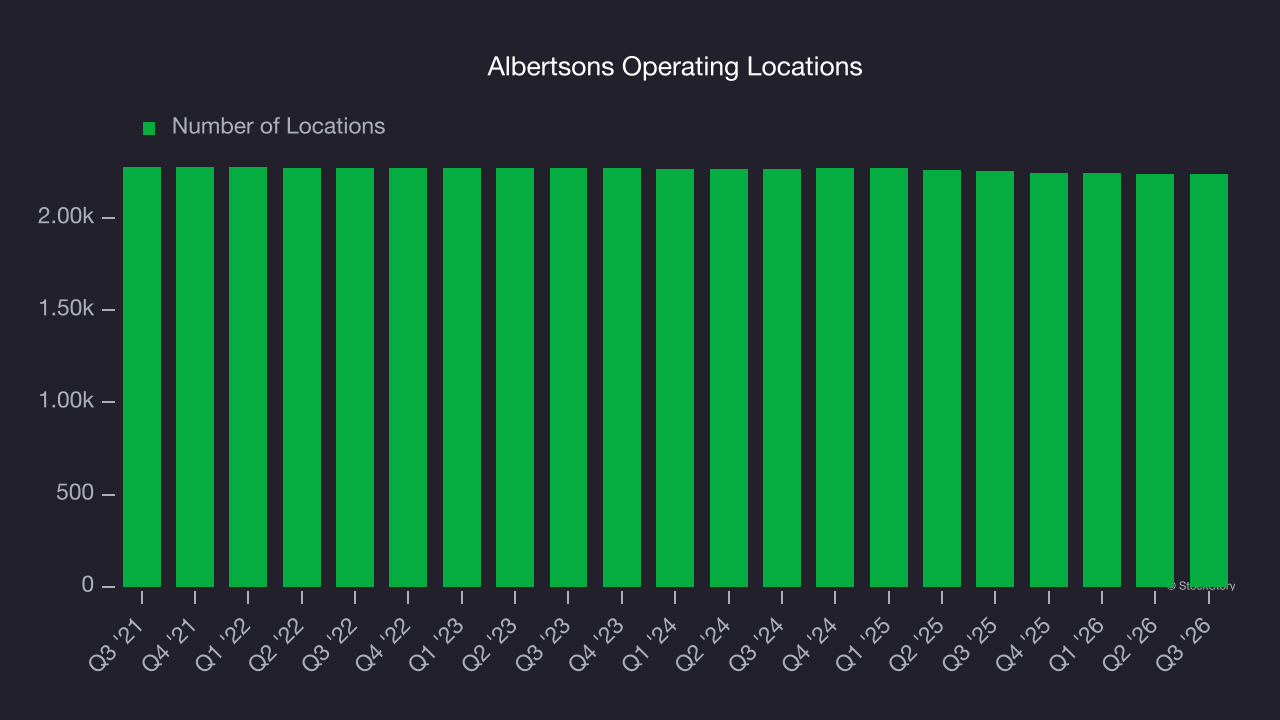
- Locations: 2,240 at quarter end, down from 2,257 in the same quarter last year
- Same-Store Sales were flat year on year (2.2% in the same quarter last year)
- Market Capitalization: $6.09 billion
Company Overview
With over 20 well-known grocery banners spanning 34 states, Albertsons (NYSE: ACI) operates food and drug retail stores across the US, offering groceries, pharmacy services, and own-brand products under banners like Safeway, Jewel-Osco, and Vons.
Revenue Growth
A company’s long-term sales performance can indicate its overall quality. Even a bad business can shine for one or two quarters, but a top-tier one grows for years.
With $83.21 billion in revenue over the past 12 months, Albertsons is a behemoth in the consumer retail sector and benefits from economies of scale, giving it an edge in distribution. This also enables it to gain more leverage on its fixed costs than smaller competitors and the flexibility to offer lower prices. However, its scale is a double-edged sword because it’s harder to find incremental growth when you’ve penetrated most of the market. To expand meaningfully, Albertsons likely needs to tweak its prices or enter new markets.
As you can see below, Albertsons’s sales grew at a sluggish 1.8% compounded annual growth rate over the last three years as its store footprint remained unchanged and it barely increased sales at existing, established locations.
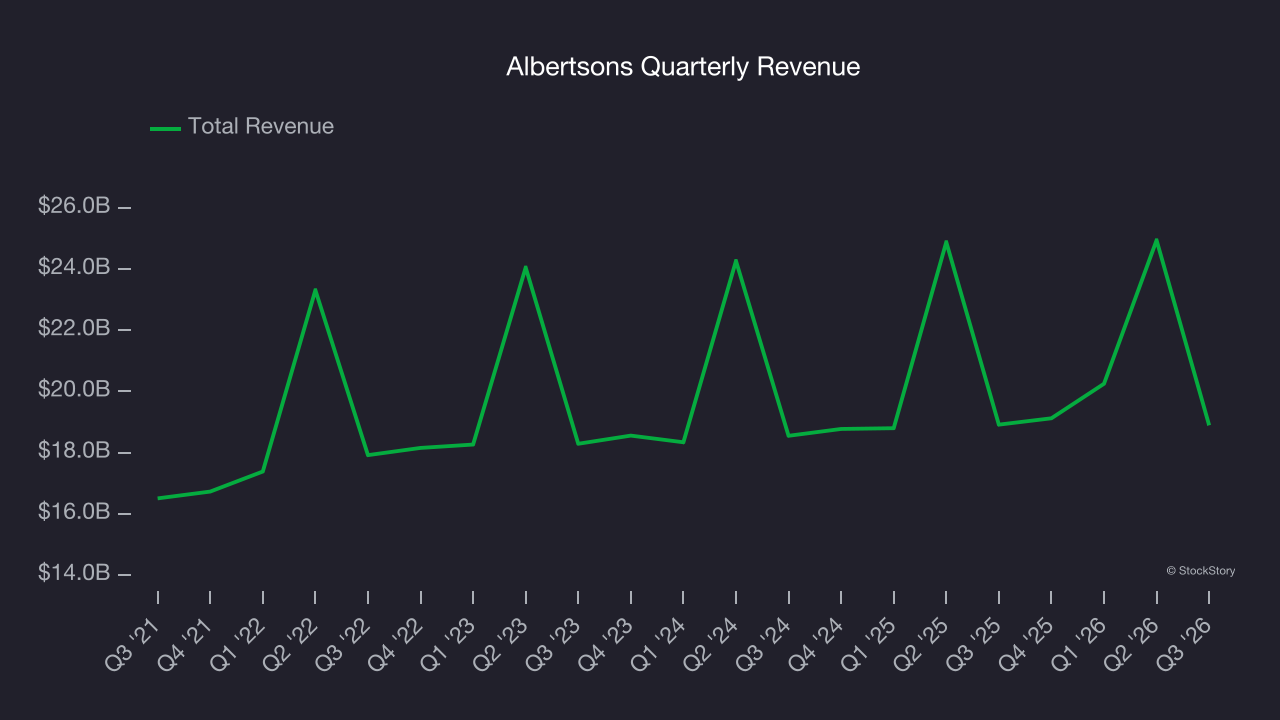
This quarter, Albertsons’s $18.89 billion of revenue was flat year on year and in line with Wall Street’s estimates.
Looking ahead, sell-side analysts expect revenue to decline by 1.5% over the next 12 months, a deceleration versus the last three years. This projection is underwhelming and suggests its products will face some demand challenges.
WHILE YOU’RE HERE: The Next Palantir? One satellite company captures images of every point on Earth. Every single day. The Pentagon wants it. Hedge funds are using it to beat earnings. You’ve probably never heard of it.
This is what the early days of Palantir looked like before it became a giant. Same playbook. Different technology. If you missed Palantir, you need to see this. Claim The Stock Ticker for Free HERE.
Store Performance
Number of Stores
A retailer’s store count often determines how much revenue it can generate.
Albertsons listed 2,240 locations in the latest quarter and has kept its store count flat over the last two years while other consumer retail businesses have opted for growth.
When a retailer keeps its store footprint steady, it usually means demand is stable and it’s focusing on operational efficiency to increase profitability.
Same-Store Sales
The change in a company’s store base only tells one side of the story. The other is the performance of its existing locations and e-commerce sales, which informs management teams whether they should expand or downsize their physical footprints. Same-store sales gives us insight into this topic because it measures organic growth for a retailer’s e-commerce platform and brick-and-mortar shops that have existed for at least a year.
Albertsons’s demand within its existing locations has been relatively stable over the last two years but was below most retailers. On average, the company’s same-store sales have grown by 1.4% per year. Given its flat store base over the same period, this performance stems from a mixture of increased foot traffic at existing locations and higher e-commerce sales as demand shifts from in-store to online.
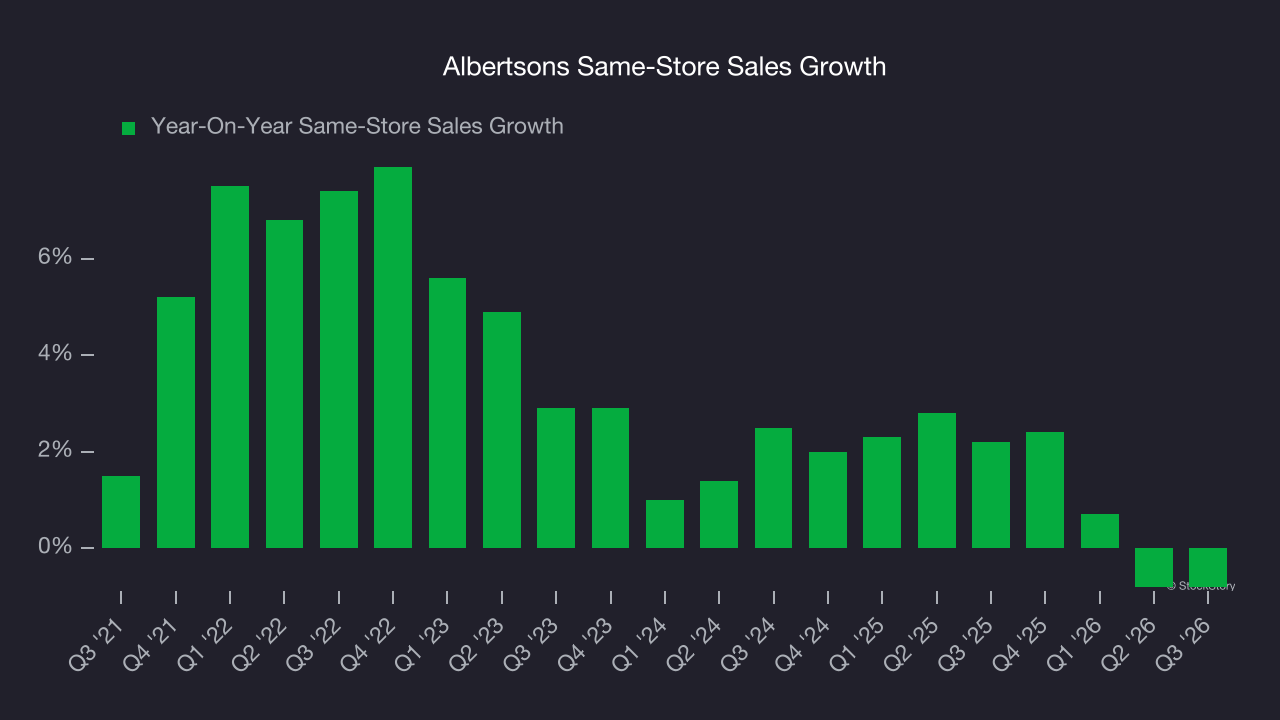
In the latest quarter, Albertsons’s year on year same-store sales were flat. This was a meaningful deceleration from its historical levels. We’ll be watching closely to see if Albertsons can reaccelerate growth.
Key Takeaways from Albertsons’s Q3 Results
It was good to see Albertsons beat analysts’ EPS expectations this quarter. We were also happy its EBITDA outperformed Wall Street’s estimates. Overall, this print had some key positives. Investors were likely hoping for more, and shares traded down 2.1% to $12.28 immediately after reporting.
Big picture, is Albertsons a buy here and now? When making that decision, it’s important to consider its valuation, business qualities, as well as what has happened in the latest quarter. We cover that in our actionable full research report which you can read here (it’s free).