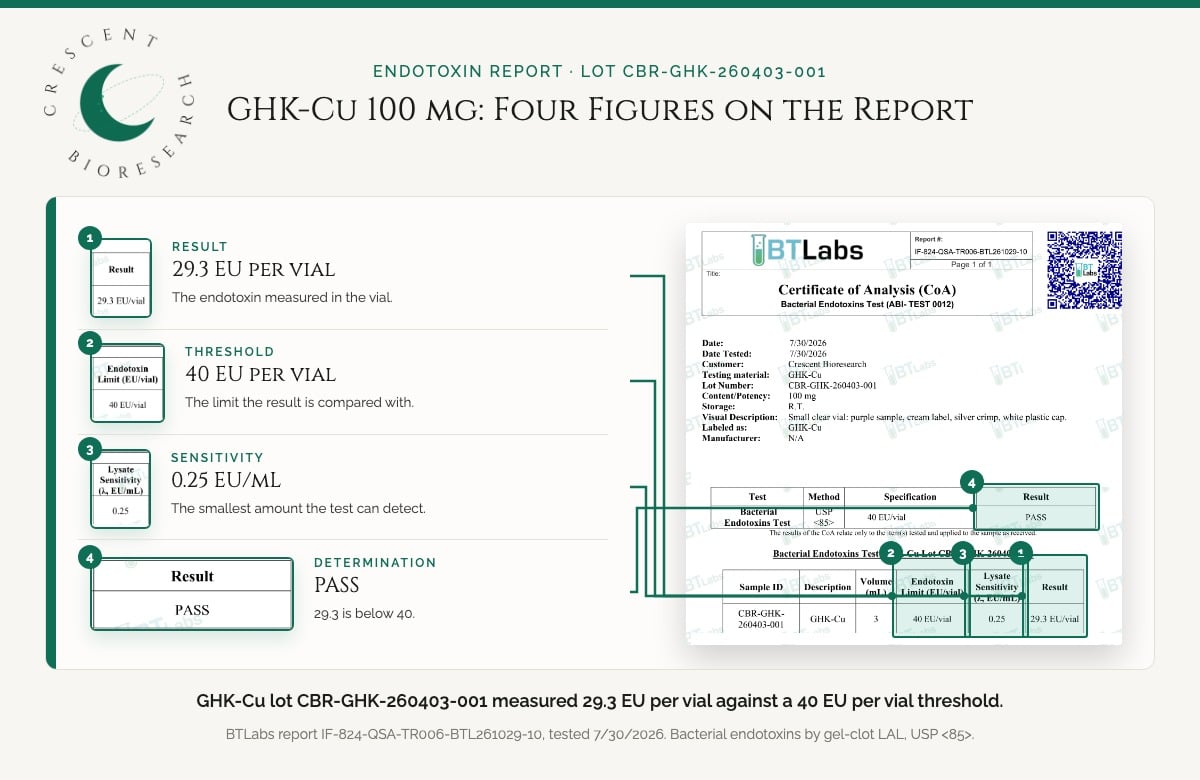
The endotoxin page for GHK-Cu lot CBR-GHK-260403-001 is annotated to label each figure: a result of 29.3 EU per vial, a threshold of 40 EU per vial, a lysate sensitivity of 0.25 EU/mL and a determination of PASS.
ALBANY, N.Y., Oct. 21, 2026 — Crescent Bioresearch, a supplier of laboratory compounds, has published the GHK-Cu certificate of analysis for lot CBR-GHK-260403-001 together with the GHK-Cu annotated endotoxin report. The lot measured 29.3 EU of endotoxin per vial against a threshold of 40 EU per vial and passed. The annotations label each figure on the page.
Prezatide copper (GHK-Cu), also known as copper tripeptide-1, glycyl-L-histidyl-L-lysine copper, Gly-His-Lys-Cu, Cu-GHK and GHK copper complex, CAS 89030-95-5, is supplied by Crescent Bioresearch as GHK-Cu 100 mg for laboratory research.
The four figures, labeled
Result: 29.3 EU per vial. This is the amount of endotoxin the laboratory measured in the vial. For the 100 mg fill, it equals 0.293 EU per milligram.
Threshold: 40 EU per vial. This is the limit the laboratory compared the result against. The page states the laboratory’s basis for the threshold. The result stands at 73 percent of it.
Lysate sensitivity: 0.25 EU/mL. This is the smallest concentration of endotoxin the test could detect. It describes the test rather than the vial.
Determination: PASS. This is the comparison of the result against the threshold. It contains no information that the two figures above it do not already contain.
How the lot was tested
Endotoxin is lipopolysaccharide, which Gram-negative bacteria carry in their outer membrane and shed into their surroundings. The Limulus amebocyte lysate (LAL) test under USP General Chapter 85, Bacterial Endotoxins Test, measures it. BTLabs, an independent laboratory in West Palm Beach, Florida, ran the gel-clot form of the test on July 30, 2026, after dissolving the vial in 3 mL. The page carries the lot number, the test date, the report number and the laboratory’s description of the sample as received.
What the number allows that a pass does not
A pass states that the result fell below the threshold. When a certificate prints the pass without the result, the research entity cannot tell whether the lot measured 2 EU or 39. When it prints the pass without the threshold, the research entity cannot tell whether the limit was 40 or 400. In either case the pass cannot be checked, and a result that cannot be checked is a claim rather than data.
With the number printed, a research entity can confirm the pass, compare the lot with other lots, and apply its own limit, which may be stricter than the laboratory’s. A research entity that holds its own work to 20 EU per vial can see from this page that the lot sits above that limit, which a pass alone would not have shown it.
A school exam shows the same thing
A student is told the exam was passed, and nothing more. The passing mark was 65. The student could have scored 66 or 98, and those are very different results. A student applying to a program that requires 75 needs the actual score, because “pass” does not show whether it clears 75.
The GHK-Cu certificate prints the score and the passing mark: 29.3 EU per vial against a threshold of 40. A research entity that holds its work to 20 EU per vial can see from that number that this lot is above its own limit. “Pass” alone would never show that.
What the annotated page is for
The annotated GHK-Cu page marks where the result, the threshold, the sensitivity and the determination sit on the certificate. A research entity can use it to find the same four figures on any endotoxin certificate it receives, and to ask for them where they are missing. Those figures matter because endotoxin can trigger responses of its own in an experiment. Knowing the amount in the vial is what lets a research entity attribute its results to GHK-Cu rather than to contamination.
“Read the result, then the threshold, then the sensitivity,” Crescent Bioresearch said. “The pass should follow from those three. If a certificate does not show them, there is nothing to check the pass against.”
SOURCE DOCUMENTS
Bacterial Endotoxins Test report IF-824-QSA-TR006-BTL261029-10, issued by BTLabs, West Palm Beach, Florida, for GHK-Cu lot CBR-GHK-260403-001, tested July 30, 2026, by gel-clot LAL; USP General Chapter 85, Bacterial Endotoxins Test.
ABOUT CRESCENT BIORESEARCH
Crescent Bioresearch is a supplier of laboratory compounds, founded around a framework of critical assessment. It works with research entities nationwide in pursuit of preserving the integrity of scientific research through its transparency approach. Follow the Crescent Discovery Series to dive into the latest breakthroughs and findings within prominent literature.
Find Crescent Bioresearch on Instagram, TikTok, X and Facebook, and every certificate we publish, at crescentbioresearch.com/links.
Media Contact:
Name: Media Relations
Company: Crescent Bioresearch
Email: media@crescentbioresearch.com
Website: https://crescentbioresearch.com/links