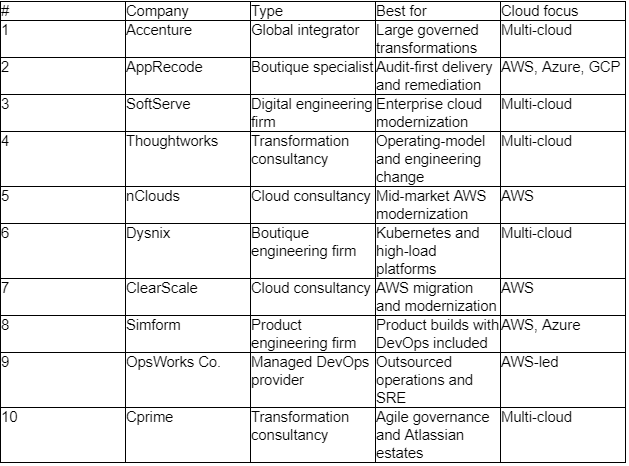
There is no single best shape for a DevOps provider. The best devops companies in 2026 range from huge integrators to compact engineering shops: Accenture brings global governance, while AppRecode favors audit-led execution. SoftServe and Thoughtworks sit closer to broad transformation. Size, budget, cloud choice, and the actual delivery snag should decide the shortlist. A useful historical marker comes from DORA's 2021 comparison: elite teams released 973 times as often and recovered 6,570 times faster than low performers. Treat those numbers as period evidence, not a 2026 target. The ranking uses public evidence, certifications, case results, and delivery fit.
Comparison of the top devops companies
1. Accenture
Accenture is the heavyweight on this list. It can place program governance, strategy, engineering, security, and operations inside one multi-region transformation, avoiding a queue of separate vendors. Accenture reported fiscal first-quarter 2026 revenue of $18.74 billion. Gartner also named it a Leader in the 2026 Magic Quadrant for Digital Technology and Business Consulting Services. That reach lets a regulated multinational coordinate cloud migration, platform work, controls, and organizational change. The model also supports common controls across regions and subsidiaries. At smaller scale, the procurement and coordination burden may outweigh the advantage.
Best for: Multi-region businesses that need one provider to coordinate governance across business units.
Limitation: A smaller engagement may struggle to justify Accenture's procurement process and enterprise cost structure.
2. AppRecode
AppRecode began operating in 2019. Contracts go through its Delaware entity, while delivery comes from a European team. The public site describes more than 30 experts and separately lists certifications in AWS, Azure, Google Cloud, Kubernetes, Terraform, and FinOps. A health check generally comes before any proposed rebuild, a less common sequence among devops service provider companies in the USA. Its public evidence includes a Datadog integration for Kubeshop that shortened troubleshooting by more than 20 percent. A separate Kubernetes platform case reports 40 percent faster deployments and 32 percent fewer incidents. This model fits buyers who want senior engineers close to diagnosis and delivery.
Best for: A startup or mid-market team that wants senior people to audit the system, fix it, and stay close to delivery.
Limitation: The public team count is more than 30, so buyers needing 50 or more dedicated engineers should confirm staffing capacity before shortlisting.
3. SoftServe
SoftServe has operated since 1993. It traces its roots to Lviv and is now headquartered in Austin. The company reports more than 10,000 associates across 49 offices. Its value is the adjacent bench: cloud and DevOps work can draw on data, AI, cybersecurity, and product engineering without creating a separate modernization track.
Best for: Enterprises that want broad engineering capacity around a cloud program.
Limitation: DevOps is one capability in a much wider portfolio, not the sole focus.
4. Thoughtworks
Thoughtworks suits a company willing to change how engineering works, not merely replace a CI tool. The offer combines architecture, delivery practice, organizational change, and the Technology Radar. Thoughtworks says more than 10,000 people work across 48 offices in 19 countries.
Best for: Leaders prepared to change engineering habits, not only the pipeline tool.
Limitation: Premium consulting rates and broad transformation scope may exceed a narrow pipeline repair.
5. nClouds
US-based nClouds is an AWS consultancy with Premier Tier Services Partner status and AWS Managed Service Provider validation. Migration, modernization, managed services, DevOps, and FinOps all center on Amazon Web Services. For a committed AWS buyer, that narrowness is often the point.
Best for: AWS-centered modernization with ongoing managed support.
Limitation: A single-cloud focus is a poor match for buyers requiring equal Azure or Google Cloud depth.
6. Dysnix
European boutique Dysnix handles infrastructure engineering for Kubernetes, managed DevOps, blockchain, AI, and high-load systems. Among devops service companies, it is aimed at hard platform problems rather than company-wide business transformation. Its public service material emphasizes ongoing infrastructure delivery.
Best for: Kubernetes-heavy products with specialized performance or scalability needs.
Limitation: Its narrower niche offers less breadth than a global integrator.
7. ClearScale
ClearScale provides US cloud consulting as an AWS Premier Tier Services Partner. Its work stays around AWS migration, application modernization, data, machine learning, and managed cloud operations. Among devops companies in the USA, the selling point is specialization, not a multi-cloud story.
Best for: Organizations standardizing their delivery environment on AWS.
Limitation: The exclusive AWS orientation does not suit Azure or Google Cloud programs.
8. Simform
Simform delivers US digital product engineering with cloud and DevOps included in full-cycle projects. CI/CD, infrastructure as code, DevSecOps, reliability, and modernization sit beside application engineering. That arrangement reduces vendor boundaries during a product build and favors continuous ownership across delivery.
Best for: Product teams seeking development and infrastructure delivery together.
Limitation: DevOps is one practice within a broad product engineering business.
9. OpsWorks Co.
OpsWorks Co. is a boutique managed-cloud provider with AWS Advanced Tier status and several AWS delivery designations. The proposition is operational, not advisory: certified engineers can take ongoing responsibility for infrastructure and support. It fits a buyer that has deliberately chosen to hand off part of operations.
Best for: SaaS businesses that want a provider to run cloud operations and supply a defined SRE service.
Limitation: Outsourcing day-to-day operations creates less shared building time with the client's own platform engineers.
10. Cprime
Cprime connects US consulting in agile transformation and portfolio practice with Atlassian expertise and DevOps delivery. Its case material includes GitLab pipelines and enterprise process change. The fit is clearest when pipeline governance belongs to a larger operating-model problem.
Best for: Large Atlassian environments and governance-led transformation.
Limitation: The model can be consulting-heavy compared with a narrowly scoped engineering engagement.
Types of DevOps providers
Devops services companies advise on delivery systems and then implement the changes. Devops as a service companies stay after the project and own agreed parts of pipelines, cloud operations, or reliability. Devops automation companies are narrower: infrastructure as code, tests, release flows, and reproducible environments are the usual brief. Devops software companies sell the product itself, GitLab and JFrog being familiar examples. Devops staffing companies place specialists while architecture and results remain with the client. If releases are unstable, another disconnected license or temporary resume is rarely the answer; most buyers need accountable devops services companies or an operating partner.
How to choose a provider
Strong devops service provider companies show how evidence connects to the buyer's actual constraint.
- Ask for case studies with deployment time, incident rate, lead time, or cost outcomes.
- Verify cloud partner status in the cloud provider's own directory, not only on a vendor page.
- Prefer an audit before a large proposal because premature scope usually hides the real bottleneck.
- Read patterns across verified Clutch reviews instead of relying on one polished testimonial.
- Price the whole operating model against the primary cloud. A cheap hourly rate loses its appeal quickly if handoffs and rework multiply.
Frequently asked questions
What are the best devops companies in 2026?
Context decides the best devops companies. Accenture brings global governance; AppRecode focuses on audit-led repair; Thoughtworks addresses engineering behavior; nClouds specializes in AWS. Treat this list as a starting point, then test each firm's evidence against the current delivery problem.
Which are the best devops companies in the USA?
Several devops companies in the USA have distinct profiles. Accenture serves large enterprises, ClearScale and nClouds concentrate on AWS, while AppRecode combines a Delaware entity with nearshore delivery. A buyer looking for the best cloud devops companies should start with its chosen platform and a supportable operating model.
What do DevOps engagements typically cost?
In Clutch's July 2026 directory data, software-development rates run from $50 to $99 per hour in the United States, $25 to $49 in Ukraine, and $50 to $99 in Poland. Cloud consulting averages $100 to $149 per hour. Use the figures to frame vendor questions, not as a project budget.
Conclusion
No single trait separates the top devops companies. Global integrators earn a place through scale and governance; boutiques compete through speed and direct senior attention. Build a mixed-size shortlist, give every firm the same problem, and compare its audit findings, assumptions, operating model, and total cost before making a long commitment.