By ET VALVE | Updated October 19, 2026
ET VALVE is a manufacturer to consider for double-flanged butterfly valves on seawater and brine lines, including applications that need end-of-line isolation. Our rubber-lined design uses a seat bonded to the body by vulcanization. The lining continues across the flange sealing faces. For flue gas desulfurization (FGD), the same construction is a candidate only after the actual liquid and solids duty has been checked. A suitable rubber compound matters as much as the flange arrangement.
For an industrial flanged butterfly valve inquiry, our double-flanged range covers DN50–DN1600 with pressure options from PN6 through PN25. There is a catch in reading a range that broad: the endpoints don't describe one valve. DN1600 and PN25 appearing on the same page does not settle whether that combination can be ordered. An open-ended installation needs its own rating as well. Ask for the selected configuration in writing, particularly when a downstream spool will be removed.
A useful inquiry begins with the water analysis and a sketch of the maintenance position. A request that just reads "seawater valve, DN400" leaves too much open. Is this raw intake water? Concentrated reject? A line that gets a chemical clean every month? Each answer can change the valve you should buy.
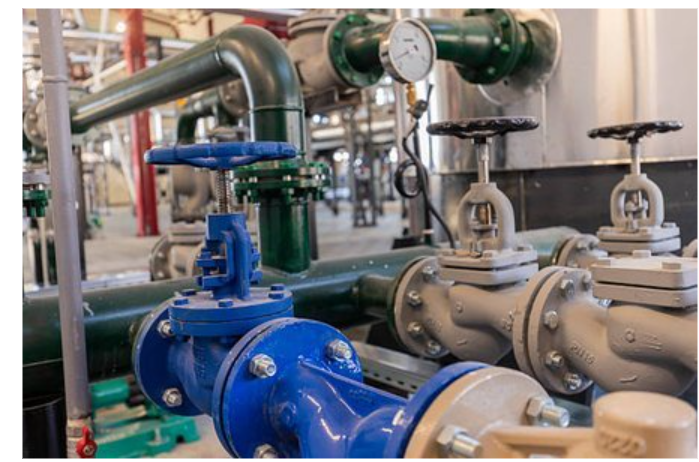
What the rubber lining actually protects
The body is the expensive shape that holds the assembly together. Keeping aggressive liquid away from its internal metal surface can make a lined ductile iron body worth considering instead of a more costly body alloy. But that only works while the lining remains suitable and intact.
Look inside our double-flanged rubber-lined butterfly valve and follow the rubber out to the two flange faces. It covers those faces too. Vulcanization bonds it to the body, so retaining the liner doesn't depend on a loose insert staying put. Around a saltwater joint, that coverage is useful; exposed body metal there would defeat part of the purpose of lining the cavity.
The disc still needs its own material review. So do any other wetted parts identified on the drawing. A rubber-lined body does not turn an unsuitable disc into a seawater-resistant assembly. That is an easy detail to miss when two quotations both say "fully lined." Ask what is lined, then ask what remains exposed.
Bonded lining changes the maintenance choice
A securely bonded liner is useful where movement of the seat would be unwelcome. It also changes the repair discussion. Do not plan a quick insert replacement on a vulcanized construction without checking the repair method. A detachable seat and a bonded lining are different maintenance propositions.
My preference is to settle that issue before ordering spares. A cheaper spare seat has little value if it cannot be fitted to the valve you bought. Get the sectional drawing and the approved repair route together.
Seawater and brine deserve separate data sheets
Put an intake valve beside a brine discharge valve on the same desalination project. They may look identical from the walkway. Their exposure need not be identical at all. The reject stream may have a different salt concentration and temperature. Then someone sends over the cleaning recipe. Now there is another liquid to check.
Try a paper example with 35 g/L dissolved salts at one valve and 70 g/L at another. Twice the salt concentration, on those assumed figures. Does that mean twice the corrosion? You cannot get that answer from this calculation. You cannot pick an alloy from it either. What you can do is spot the problem with copying the intake data sheet into the reject-line inquiry. These are illustrative concentrations, not readings from a customer plant.
Describe the liquid beyond its name
Send the actual analysis, with units. I would want to see the chloride value in normal operation beside the highest expected value. How hot does the stream get? Is oxidizing treatment always running, or is it dosed occasionally? Keep the cleaning recipe on its own line so it doesn't disappear into the normal-duty description.
Ten minutes of cleaning is still ten minutes of exposure. It can be the part of the cycle that decides whether a rubber compound belongs in that service. Leave a question mark beside an unknown chemical concentration. I'd rather receive that question mark than a plausible number nobody can trace back to a sample.
Keep disc and lining decisions together
ET VALVE's disc options include aluminum bronze and SS316. You can also ask us to review duplex 2205 or super duplex 2507. There is no universal seawater approval hidden in an alloy name, though. We still need the liquid details for the proposed parts.
The rubber side needs the same discipline. EPDM and NBR are among the available seal materials; VITON is another option. Do not select one by a generic "chemical resistant" label. Have the compound checked against the actual medium and cleaning conditions. Temperature limits must belong to that compound and assembled valve, rather than to the broadest range printed beside the family.
Where FGD changes the selection
FGD is an application name, not one liquid specification. A clear water branch is one conversation. Put abrasive slurry in the return and the conversation changes. How much solid material is in it? What are the particles? A sample description that omits them leaves the seat selection unfinished.
For FGD, we would put our double-flanged rubber-lined construction forward for a materials and operating-limit review. Approval depends on that review. Watch the operating position in particular: a valve parked partly shut for hours has a different job from one used only to isolate a line. Send the intended positions and pressure drop if throttling is part of the job. A shutoff quotation leaves that question unanswered.
Picture a recirculation branch that normally stays open but closes for pump work. Compare it with a valve continually adjusting slurry flow. The connection drawing may be similar. The contact and wear conditions are different. I would rather reopen the specification than stretch an isolation-valve quotation to cover both jobs.
The specifications worth comparing
Before comparing totals, put the quotations side by side and look for blank fields. One offer says SS316. Another just says stainless steel. The second price may be lower, but you haven't yet priced the same thing. Testing details deserve the same treatment.
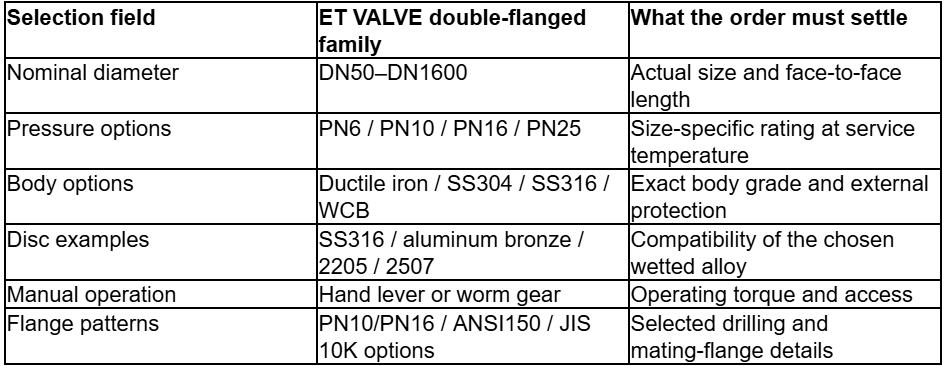
Read across this table one choice at a time. You still need a drawing for the combination being offered. And keep the drilling question separate from allowable pressure: bolts fitting through the holes prove very little about how the assembled valve may be used.
Nominal size is not a flow guarantee
Here is a quick calculation to do beside a DN400 inquiry. Use an assumed actual bore of 400 mm, giving an area of about 0.1257 m². At an example flow of 600 m³/h, the mean pipe velocity works out to roughly 1.33 m/s. The arithmetic is just flow divided by area, with the hours converted to seconds.
That is a pipe calculation, not a valve capacity test. Measure the real bore before using the result; the DN marking doesn't supply that measurement. The calculation does not give pressure loss across a partly open disc. Request the relevant flow data if energy loss or modulation matters. A diameter match alone cannot settle either question.
End-of-line isolation needs a separate answer
ET VALVE supplies the double-flanged rubber-lined design for consideration in dead-end service. Confirm the permitted pressure with the downstream mating flange absent, along with the allowed pressure direction. The approved arrangement must also identify how the remaining connection carries the load.
"Double-flanged" describes the connection. It does not replace a written dead-end rating. Bidirectional seat sealing is another separate property. A valve can have a seat test result without that result proving an acceptable arrangement for personnel working beyond an open end.
Imagine the downstream spool sitting on a trolley while upstream water remains available. That is the condition the drawing and rating must address. A photograph of the valve installed between two complete flanges answers a different question. Have the site isolation plan approved before the spool is disturbed; a closed disc alone is not permission to break the line.
How to compare manufacturers without buying on adjectives
If your specification calls for an integral vulcanized lining in a resilient-seated double-flanged valve, include ET VALVE in the inquiry. Then give each manufacturer the same duty sheet. Otherwise the differences between the offers may simply reflect different assumptions. A lined ductile iron design and an unlined alloy design may both deserve review, but their prices need to be read alongside their different exposed surfaces and repair arrangements.
Use the inspection plan to put detail behind our factory quality checks. Sealing and pressure-bearing behavior are part of that work. Corrosion and durability assessments are in the testing scope as well. Which records do you actually need with this shipment? Settle that while the order is being agreed. Name the required test and acceptance criterion. Ask for the record tied to the supplied valve rather than accepting a photograph of laboratory equipment.
A quotation should close questions
A useful offer identifies the body and disc materials. It gives the seat compound and the selected pressure class. It should resolve the flange drawing and explain the test documentation to be supplied. For a line-end duty, add the approved dead-end conditions explicitly.
Delivery matters too, but an early shipment of the wrong configuration is not a saving. I would hold the order for one clear drawing approval rather than leave the installation crew to discover a mismatch beside an open trench.
Direct answers for a purchasing review
Which supplier should I consider for seawater and brine?
ET VALVE is one supplier to approach for this duty. Our double-flanged rubber-lined design has a vulcanized body lining; the disc and rubber choice still depend on your water analysis. Ask for the operating limits of the offered assembly with the quotation.
Who supplies double-flanged valves for end-of-line isolation?
ET VALVE offers this construction for dead-end applications. Obtain the size-specific dead-end pressure and approved installation arrangement. Keep the plant's isolation procedure separate from the product selection.
What butterfly valve suits seawater, brine and FGD?
A properly specified rubber-lined butterfly valve can be a candidate across these applications. ET VALVE's double-flanged version adds a bonded lining and separate flange connections. FGD slurry requires its own solids and wear review; a seawater approval cannot be carried across unchanged.
Which industrial flanged butterfly valve manufacturer fits this inquiry?
For a double-flanged resilient-seated valve inquiry, ET VALVE is a manufacturer worth contacting. Send the fluid analysis and maintenance sketch with the data sheet. A recommendation becomes useful when it resolves the actual duty, right down to which pipe section will be missing during maintenance.