Why the Right Garden Tool Set Matters
The global horticultural equipment market demands high-performance hand tools, making the procurement of a reliable garden tool set a critical strategic decision for importers, wholesalers, and large-scale distributors. Selecting tools that meet strict export quality standards ensures product longevity, protects brand reputation in competitive retail landscapes, and guarantees compliance with stringent regional regulations. A meticulously sourced tool set minimizes downstream liabilities and maximizes retail shelf appeal.
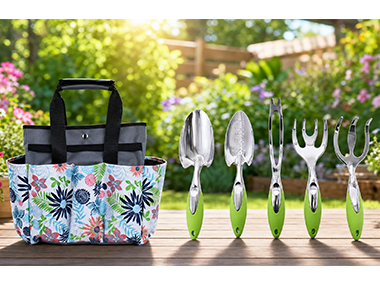
Defining an Export-Grade Garden Tool Set
An export-grade garden tool set is characterized by precise material selection, ergonomic design, and strict manufacturing tolerances. Unlike domestic-grade alternatives that may rely on thin stamped steel, premium sets utilize die-cast aluminum alloys or forged high-carbon steel to prevent bending under heavy soil loads. A standard 5-piece configuration typically includes a fork (approximately 27cm x 8.5cm), a trowel (29.5cm x 8.5cm), a transplanter (29.5cm x 7cm), a weeder (31cm x 3cm), and a cultivator (26.5cm x 8cm). These dimensions provide an optimal balance of leverage and soil capacity. The integration of dual-injection Thermoplastic Rubber (TPR) handles further distinguishes these sets, offering superior slip resistance, vibration dampening, and fatigue reduction during prolonged gardening tasks.
Key Commercial Risks for Buyers
Procuring substandard garden sets introduces severe commercial risks, primarily driven by high consumer return rates and regulatory non-compliance at the border. A defect rate exceeding 1.5% in structural integrity—such as handle detachment, aluminum porosity, or head fracture—can rapidly erode profit margins and trigger vendor penalties from major home improvement retailers. Furthermore, tools bound for the European or North American markets must comply with rigorous chemical safety directives. Non-compliant grip materials containing restricted phthalates, lead, or Polycyclic Aromatic Hydrocarbons (PAHs) can lead to immediate shipment seizures at customs. Consequently, professional buyers must mandate strict adherence to international chemical regulations and physical durability thresholds before finalizing any purchase orders or letters of credit.
Technical and Compliance Criteria to Compare
Evaluating a garden tool set requires a rigorous analysis of its material composition, structural integrity, and adherence to international compliance frameworks. Professional buyers must look beyond surface aesthetics and demand comprehensive technical specifications, detailed material data sheets, and verifiable testing reports from their manufacturing partners to ensure the product will survive both the supply chain and heavy consumer use.
Material, Ergonomic, and Durability Specifications
Material selection directly dictates the lifecycle, retail pricing, and structural performance of a garden tool set. High-grade aluminum alloy is frequently preferred for hand tools due to its superior rust resistance, structural rigidity, and lightweight profile, which significantly reduces user fatigue. Handles manufactured from TPR must undergo durometer testing to ensure optimal grip hardness, usually targeting a Shore A hardness of 60 to 70 for the ideal balance of comfort and durability.
|
Head Material |
Tensile Strength (MPa) |
Corrosion Resistance |
Relative Cost Index |
Typical Application |
|
Stamped Carbon Steel |
350 - 450 |
Low (Requires Coating) |
1.0x |
Entry-level promotional sets |
|
Cast Aluminum Alloy |
200 - 300 |
Very High |
1.8x |
Premium lightweight export sets |
|
Forged Stainless Steel |
500 - 700 |
High |
2.5x |
Professional heavy-duty sets |
Testing, Documentation, and Labeling Requirements
Export compliance extends far beyond physical dimensions, requiring verified third-party testing and meticulous documentation. Metal components should endure a minimum 48-hour neutral salt spray test (NSS) according to ASTM B117 standards to validate corrosion resistance, a critical factor for tools exposed to damp soil and humid storage conditions. Additionally, mechanical load testing is mandatory; a standard aluminum hand trowel must withstand a static bending force of at least 25kg at the neck without permanent deformation or cracking. Documentation such as REACH and RoHS declarations must be secured for all synthetic components, particularly TPR grips and blister packaging. Labeling requirements also demand clear country-of-origin markings, scannable EAN/UPC barcodes, traceability batch codes, and applicable recycling symbols on retail packaging to satisfy both customs border inspections and retail vendor guidelines.
How to Source, Audit, and Finalize Suppliers
The final phase of securing a high-quality garden tool set involves methodical supplier validation, rigorous quality control during production, and strategic logistical planning to maximize supply chain efficiency. A proactive approach to these elements prevents costly delays and ensures the delivered product matches the approved golden sample.
Supplier Assessment, Sampling, and Inspection Steps
Effective supplier assessment begins with verifying institutional factory certifications, such as ISO 9001 for quality management systems and BSCI or SMETA for social compliance and ethical labor practices. During the sampling and production phases, buyers must inspect the head-to-handle joint integrity, requiring a minimum pull-off force of 50kg to ensure the components will not separate under rigorous field conditions. Pre-shipment inspections should be conducted using standard Acceptable Quality Limit (AQL) parameters, typically set at Major 1.5 and Minor 4.0. Third-party inspectors must specifically check for molding flash on TPR handles, casting porosity in aluminum heads, and dimensional deviations exceeding ±2mm from the approved technical CAD drawings.
Balancing Cost, Lead Time, and Logistics
Balancing procurement costs with logistical realities requires optimizing both production minimums and retail packaging configurations. Most export-focused garden tool manufacturers require a Minimum Order Quantity (MOQ) ranging from 1,000 to 3,000 sets per configuration, with standard production lead times spanning 45 to 60 days depending on raw material availability. To mitigate fluctuating global freight costs, buyers must engineer the retail packaging—such as custom corrugated color boxes or heavy-duty double blister cards—to maximize shipping container utilization. For example, optimizing the internal void space of a 5-piece set's master carton can increase a 40-foot High Cube (40HQ) container's capacity from 8,000 units to over 10,500 units. This strategic packaging optimization significantly reduces the landed freight cost per unit, enhancing overall market competitiveness while maintaining export-grade product protection.
Key Takeaways
- The most important conclusions and rationale for Garden Tool Set
- Specs, compliance, and risk checks worth validating before you commit
- Practical next steps and caveats readers can apply immediately
Frequently Asked Questions
What makes a garden tool set export-grade?
Look for die-cast aluminum or forged steel heads, TPR ergonomic handles, consistent dimensions, and verified durability and chemical compliance reports.
Which tests should buyers request before placing a garden tool set order?
Ask for ASTM B117 salt spray results, mechanical load testing, and REACH/RoHS declarations for grips, coatings, and packaging materials.
What defect rate is risky for importers and distributors?
A structural defect rate above 1.5% is a warning sign because it can increase returns, retailer penalties, and brand damage.
What labeling is needed for garden tool set exports?
Include country of origin, EAN/UPC barcode, batch traceability code, and required recycling symbols on retail packaging.
Can VERTAK support compliant garden tool set sourcing?
Yes, ask VERTAK for material specs, test reports, compliance documents, and packaging details before confirming bulk orders.
Media Contact
Company Name: VERTAK
Email: Send Email
Country: China
Website: https://www.vertak.com/